India and Chile Strengthen Critical Minerals and Economic Partnerships
Source:Indian Express ↗
Why It Matters
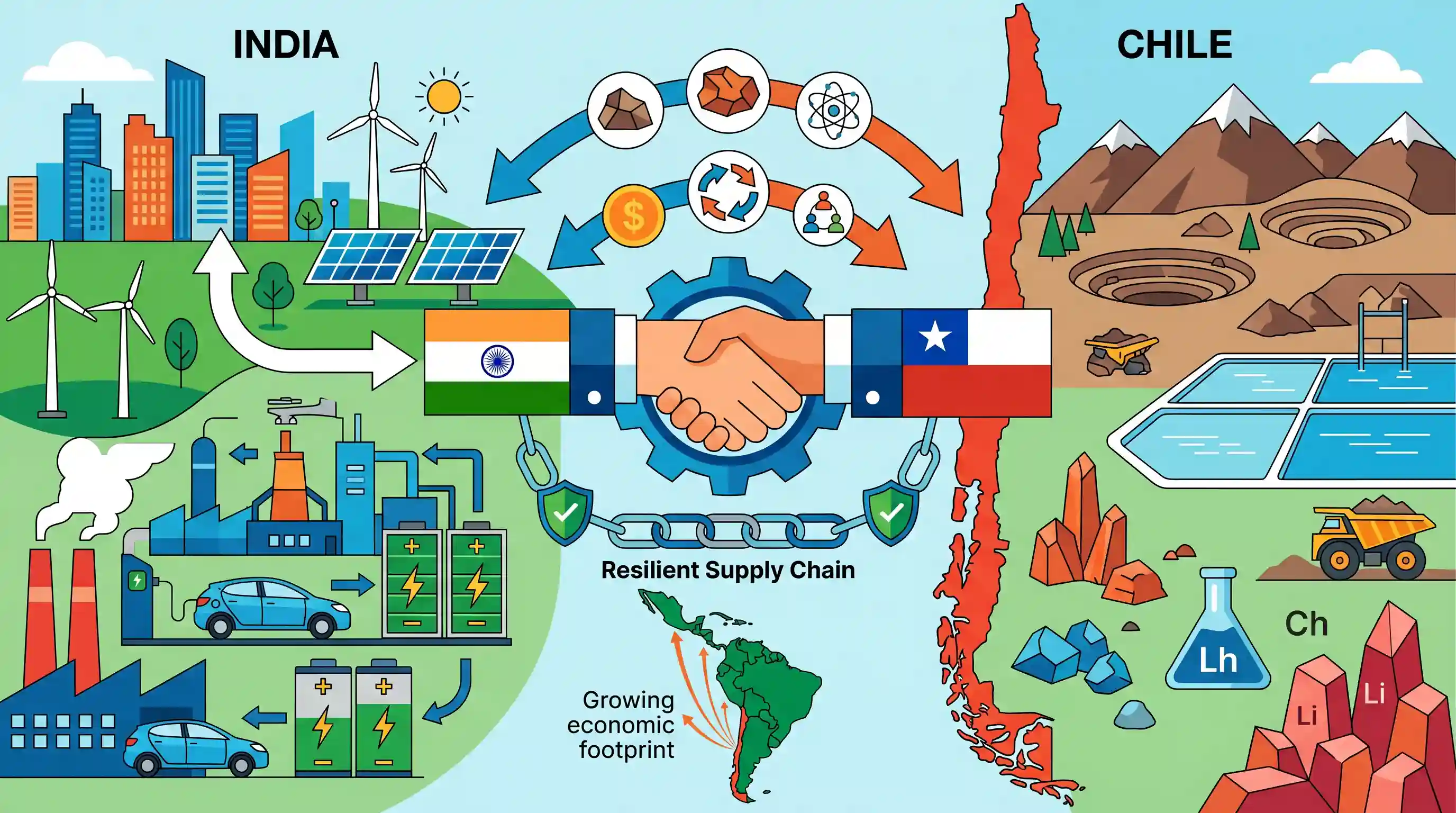
Securing access to critical minerals like lithium and copper is fundamental to India's energy transition, EV targets, and climate commitments. Deepening bilateral ties with resource-rich nations like Chile highlights the growing intersection of India's foreign policy and its long-term economic and environmental security.
Summary
India and Chile are working towards deepening their bilateral economic ties, with a specific focus on trade in critical minerals such as lithium and copper. As India aggressively pursues a transition to clean energy and aims to boost domestic electric vehicle (EV) manufacturing, securing a stable and diversified supply of these essential minerals has become a strategic priority. Engaging with Chile, a leading global producer of these resources, represents a key element in India's broader diplomatic strategy to build resilient supply chains and increase its economic footprint in Latin America.
Key Points
- India is looking to deepen its economic relationship with Chile, primarily focusing on securing supply chains for critical minerals like lithium and copper.
- Chile is a global powerhouse in copper production and a central part of South America's 'Lithium Triangle', making it a strategic partner for India's clean energy goals.
- Securing these minerals is essential for India to build its domestic electric vehicle (EV) manufacturing ecosystem and to achieve its renewable energy and net-zero emissions targets.
- The partnership exemplifies India's expanding economic diplomacy in Latin America as it seeks to diversify imports away from traditional dominant suppliers and build resilient global supply chains.
Important Terms
Critical Minerals

Minerals essential for economic development and national security but vulnerable to supply disruptions (e.g., lithium, cobalt). India has identified 30 such minerals.
UPSC context
GS Paper 3 (Energy/Economy); tests understanding of strategic resource management and clean energy transition.
Lithium Triangle
A lithium-rich region in the Andean highlands encompassing parts of Chile, Argentina, and Bolivia, holding over 50% of global lithium reserves.
UPSC context
GS Paper 2 (International Relations) and GS Paper 1 (Geography); vital for India’s "Act Latin America" strategy.
KABIL (Khanij Bidesh India Limited)
A joint venture of three Indian CPSEs (NALCO, HCL, MECL) tasked with identifying and acquiring strategic mineral assets like lithium and cobalt abroad.
UPSC context
GS Paper 3 (Economic Development); relates to state-led efforts for resource security and self-reliance.
Preferential Trade Agreement (PTA)
A trade pact where member countries give preferential access to certain products by lowering tariffs, as seen in the 2006 India-Chile agreement.
UPSC context
GS Paper 2 (Bilateral Relations); tests knowledge of trade diplomacy and economic integration stages.
Supply Chain Resilience
The capacity of a global supply system to withstand, adapt to, or recover from shocks and disruptions, ensuring stable flow of goods.
UPSC context
GS Paper 2 (International Relations); key concept in post-pandemic diplomacy and reducing over-dependence on single sources.
Energy Security
The uninterrupted availability of energy sources at an affordable price, currently focused on diversifying away from fossil fuels toward battery-based storage.
UPSC context
GS Paper 3 (Infrastructure); tests understanding of the link between mineral imports and national power needs.
Prelims Trap
"The 'Lithium Triangle' consists of Chile, Argentina, and Peru."
Aspirants frequently confuse the third member of the triangle. The triangle consists of Argentina, Bolivia, and Chile, not Peru.
Static Concepts Connected
What is the geographical significance of the Lithium Triangle?
- Member Countries: Comprises the borders of Argentina, Bolivia, and Chile in South America.
- Reserve Concentration: Holds over 50% of the world's identified lithium reserves, concentrated in high-altitude salt flats (salars) along the Andes.
- Extraction Method: Lithium here is primarily extracted from brine pools, a highly water-intensive process in ecologically fragile, arid regions like the Atacama.
What is Khanij Bidesh India Limited (KABIL)?
- Structure: A joint venture of three CPSEs under the Ministry of Mines: NALCO, Hindustan Copper Ltd (HCL), and MECL.
- Strategic Mandate: Mandated to identify, explore, and acquire critical and strategic minerals overseas to ensure India's supply chain security.
- Target Minerals: Currently prioritizing the acquisition of lithium and cobalt assets in resource-rich nations like Australia, Argentina, and Chile.
Cross-Topic Patterns
EV Subsidies + Upstream Resource Security
Domestic EV manufacturing schemes (like PM E-DRIVE) are deeply tied to upstream overseas resource acquisitions (KABIL) to bypass Chinese dominance in battery mineral processing.
Upgrading India-LAC Trade Architectures
India is actively upgrading limited Preferential Trade Agreements (PTAs) in Latin America (like Chile and MERCOSUR) to comprehensive CEPAs, signaling a shift toward deeper investment and strategic ties.

Geography mapping of South American salt flats/deserts linked to critical mineral reserves (Li, Cu) is highly probable in 2026.
Linked PYQs · 3
Linked PYQs · 3
- 2025PrelimsGS1
In the context of electric vehicle batteries, consider the following elements : I. Cobalt II. Graphite III. Lithium IV. Nickel How many of the above usually make up battery cathodes?
- 2023MainsGS3
The adoption of electric vehicles is rapidly growing worldwide. How do electric vehicles contribute to reducing carbon emissions and what are the key benefits they offer compared to traditional combustion engine vehicles?
- 2021MainsGS1
Discuss the multi-dimensional implications of uneven distribution of mineral oil in the world.
