Sovereign Artificial Intelligence Models and Multilingual Ecosystems
Source:The Hindu ↗
Why It Matters
Highly relevant for GS3 Science & Technology. It touches upon India's strategic positioning in emerging technologies, the importance of sovereign AI for data security and cultural context (multilingual models), and the realistic assessment of India's capabilities in foundational AI versus AI adoption.
Summary
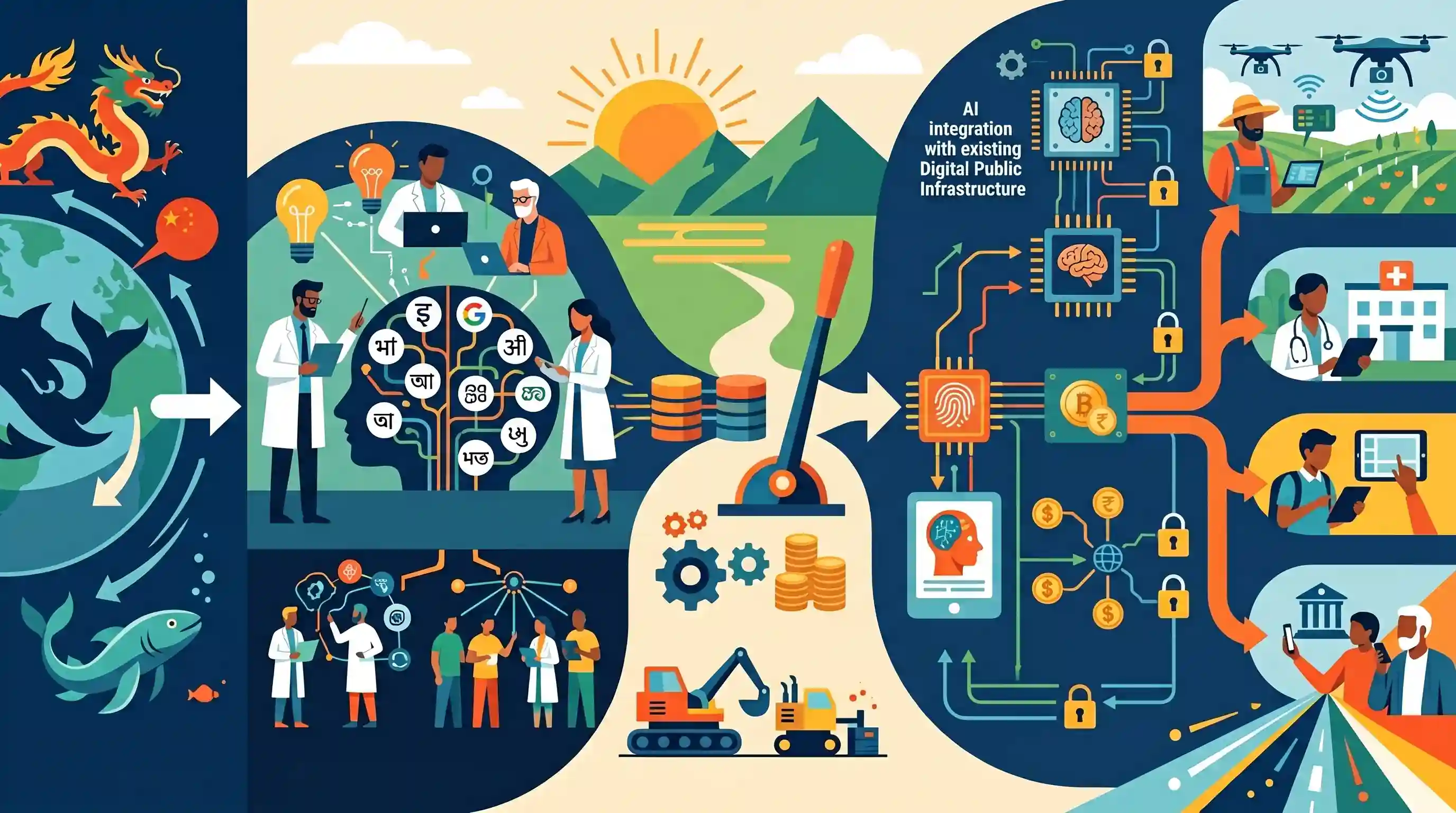
As global attention shifts toward sovereign AI capabilities following breakthroughs like China's DeepSeek, India is encouraging its own ecosystem of homegrown large language models (LLMs). Discussions at the recent AI Impact Summit highlighted efforts by startups like Sarvam AI and initiatives like BharatGen to build multilingual models optimized for Indian languages, aiming to bypass the biases of Western platforms. While the goal is to achieve a 'DeepSeek moment' in foundational AI, industry experts suggest that due to compute and capital constraints, India's immediate trajectory points toward becoming a dominant force in AI adoption and application by integrating it with its existing Digital Public Infrastructure (DPI).
Key Points
- India is fostering a nascent ecosystem of homegrown AI models to counter US dominance, spurred by the success of China's DeepSeek.
- Startups like Sarvam AI and government-backed initiatives like BharatGen are focusing on sovereign, multilingual large language models (LLMs) tailored for India's linguistic diversity.
- Developing indigenous models is viewed as critical to avoiding the inherent biases of Western AI platforms and securing digital sovereignty.
- Despite ambitions for a 'DeepSeek moment', experts believe India is currently better positioned as a massive market for AI adoption and application, leveraging its Digital Public Infrastructure (DPI), rather than a primary hub for foundational AI innovation.
Important Terms
BharatGen

A Department of Science and Technology (DST) initiative to develop India’s first government-backed multimodal sovereign AI models, specifically tailored for 22+ Indian languages and cultural contexts to ensure digital inclusivity.
UPSC context
GS-III: Indigenization of technology. Relevant for questions on Digital India, linguistic inclusivity, and public-sector-led technological self-reliance.
Sarvam AI
A Bengaluru-based startup selected under the IndiaAI Mission to build India’s first indigenous sovereign Large Language Model (LLM), focusing on cost-effective, multilingual AI solutions for population-scale applications.
UPSC context
GS-III: Science and Technology. Demonstrates private sector contribution to 'Atmanirbhar Bharat' in frontier technologies like generative artificial intelligence.
DeepSeek
A Chinese AI startup whose release of cost-effective, open-source reasoning models (DeepSeek-R1) triggered a global 'DeepSeek moment,' challenging Western dominance and emphasizing algorithmic efficiency over massive compute power.
UPSC context
GS-II/III: Geopolitics of technology. Tests understanding of the US-China AI race and the shift toward sovereign AI capabilities worldwide.
Gnani.ai
A homegrown deep-tech firm specializing in voice-first AI and foundational voice models. It developed India’s first indigenous voice-to-voice AI model to support multilingual communication across diverse sectors.
UPSC context
GS-III: Digital Public Infrastructure (DPI). Important for its role in creating voice-based interfaces for inclusive governance and banking.
Prelims Trap
"BharatGen is a private-sector initiative driven by Indian AI startups."
BharatGen is actually India's first government-funded Multimodal LLM initiative, spearheaded by IIT Bombay under the National Mission on Interdisciplinary Cyber-Physical Systems (NM-ICPS).
Static Concepts Connected
What constitutes India's Digital Public Infrastructure (India Stack)?
- Identity layer: Aadhaar provides a foundational biometric and demographic-based digital identity for residents.
- Payments layer: The Unified Payments Interface (UPI) ensures instant, interoperable fiat money transfers across bank accounts.
- Data empowerment layer: DigiLocker and Account Aggregator frameworks enable secure, consent-based data and document sharing.
What are Cyber-Physical Systems (CPS) and the NM-ICPS?
- Definition: CPS integrates sensing, computation, control, and networking into physical objects and infrastructure (e.g., smart grids, autonomous vehicles).
- Nodal Agency: Implemented by the Department of Science and Technology (DST) through a network of specialized Technology Innovation Hubs (TIHs).
- Objective: Aims to catalyze translational research, commercialization, and deep-tech startup ecosystems in AI, robotics, and IoT.
Cross-Topic Patterns
Sovereign AI & Data Localization
Developing homegrown LLMs relies heavily on the National Data Governance Framework and 'AI Kosh', linking AI innovation directly to data localization and non-personal data sharing policies.
AI for e-Governance (Project Bhashini)
Foundational AI models are critical for Project Bhashini, merging native language translation with DPIs like UPI and e-NAM to drive financial and agricultural inclusion for non-English speakers.
Supercomputing & IndiaAI Mission
The IndiaAI Mission's push to subsidize 38,000 GPUs aligns with the National Supercomputing Mission, shifting India's strategic focus from traditional supercomputers to AI-specific high-performance computing (HPC) ecosystems.

Expect a multi-statement GS3 question on 'Sovereign AI' linking BharatGen, GPU subsidies under IndiaAI Mission, and Project Bhashini.
Linked PYQs · 2
Linked PYQs · 2
- 2023MainsGS3
Introduce the concept of Artificial Intelligence (AI). How does Al help clinical diagnosis? Do you perceive any threat to privacy of the individual in the use of Al in healthcare?
- 2020PrelimsGS1
With the present state of development, Artificial Intelligence can effectively do which of the following? 1. Bring down electricity consumption in industrial units 2. Create meaningful short stories and songs 3. Disease diagnosis 4. Text-to-Speech Conversion 5. Wireless transmission of electrical energy Select the correct answer using the code given below:
