BNP Electoral Victory Poses Strategic Challenges for India
Source:Indian Express ↗
Why It Matters
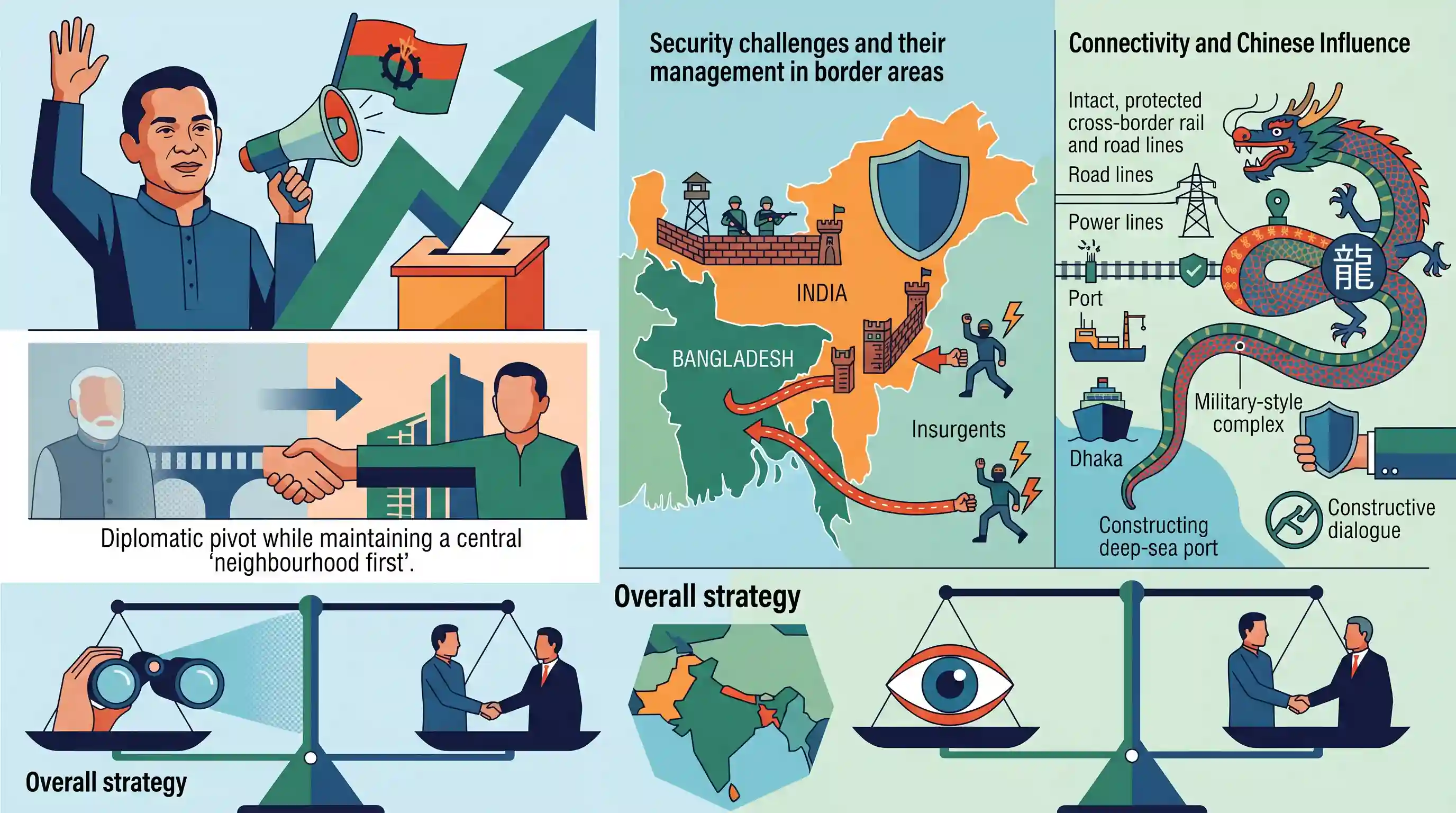
A political regime change in Bangladesh directly impacts India's border security, particularly for the vulnerable North-East region. It also challenges India's strategic 'Neighbourhood First' policy and alters the geopolitical balance in South Asia regarding Chinese influence.
Summary
The landslide electoral victory of the Bangladesh Nationalist Party (BNP), led by Tarique Rahman, presents significant diplomatic and security challenges for India. Historically aligned with Sheikh Hasina's Awami League, New Delhi must now pivot to establish pragmatic working relations with the BNP to sustain its 'Neighbourhood First' policy. Critical priorities include preventing a resurgence of anti-India insurgent activities in the North-East by tightening border security, safeguarding cross-border connectivity projects, and checking the likely expansion of China's strategic influence in Dhaka. India's foreign policy apparatus will need to balance vigilance with constructive diplomatic engagement to maintain regional stability.
Key Points
- The BNP's landslide victory under Tarique Rahman alters the diplomatic status quo, requiring India to recalibrate its relations with a party historically perceived as less aligned with New Delhi's interests.
- A major internal security concern is the potential resurgence of cross-border terrorism and safe havens for North-East Indian insurgents, necessitating robust border management.
- India must pragmatically engage the new administration to protect ongoing bilateral trade, connectivity, and infrastructure initiatives.
- The political shift in Dhaka risks increasing China's strategic and economic footprint in South Asia, posing a challenge to India's regional influence.
Important Terms
Neighbourhood First Policy

India's core diplomatic strategy prioritizing immediate neighbors (SAARC nations minus Pakistan, plus others) for regional stability and connectivity. It emphasizes non-reciprocity, outcome-oriented projects, and collective growth to maintain regional leadership.
UPSC context
GS Paper 2 (International Relations); essential for questions on regional diplomacy, SAARC/BIMSTEC, and managing China's influence in South Asia.
Act East Policy
A proactive diplomatic initiative launched in 2014 to strengthen economic, strategic, and cultural ties with Southeast Asia and the Indo-Pacific. It focuses on connectivity, particularly using Northeast India as a gateway to ASEAN.
UPSC context
GS Paper 2 (IR) and GS Paper 3 (Internal Security); tests integration of foreign policy with domestic development of the Northeast.
Bangladesh Nationalist Party (BNP)
A major center-right political party in Bangladesh founded by Ziaur Rahman. Historically skeptical of India, it emphasizes "Bangladesh First" sovereignty and has previously been associated with Islamist groups like Jamaat-e-Islami.
UPSC context
GS Paper 2 (India-Neighbourhood); relevant for analyzing political shifts in Dhaka and their impact on India’s security and connectivity.
Awami League
A secular, center-left party led by Sheikh Hasina, instrumental in Bangladesh’s liberation. It maintained a "golden chapter" of ties with India (2009–2024), focusing on counter-terrorism, border management, and high-speed connectivity.
UPSC context
GS Paper 2 (IR); vital for understanding the historical "pro-India" anchor in Dhaka and the evolution of bilateral security cooperation.
Cross-Border Connectivity
Bilateral infrastructure initiatives like the Agartala-Akhaura Rail Link and Maitri Setu designed to bypass the Siliguri Corridor ("Chicken's Neck") and integrate Northeast India with Bangladeshi ports and Southeast Asian markets.
UPSC context
GS Paper 3 (Infrastructure/Security); tests knowledge of regional economic integration and the strategic necessity of transit through Bangladesh.
Internal Security (Northeast)
A major concern for India involving separatist movements in the North-East. New Delhi relies on Dhaka's cooperation to deny safe havens to groups like ULFA and NSCN within Bangladeshi territory.
UPSC context
GS Paper 3 (Security); tests the link between neighborhood political stability and India's management of border-area insurgencies.
Prelims Trap
"Bangladesh shares a land border with all North-Eastern states of India."
Bangladesh borders only five Indian states: West Bengal, Assam, Meghalaya, Tripura, and Mizoram. It does not border Manipur, Nagaland, or Arunachal Pradesh.
Static Concepts Connected
What makes the Siliguri Corridor vulnerable and Bangladesh transit crucial?
- Geographic Chokepoint: A narrow 22-km 'Chicken's Neck' connecting North-East India to the mainland, highly vulnerable to geopolitical blockades.
- Strategic Redundancy: Cross-border road, rail, and waterway transit through Bangladesh provides an essential, faster alternate logistical route.
- Economic Integration: Access to Bangladesh's Chittagong and Mongla ports is critical for unlocking the landlocked North-East's economic potential.
What are the core pillars of India's 'Neighbourhood First' policy?
- Asymmetric Engagement: Rooted in the Gujral Doctrine, India provides non-reciprocal economic and developmental assistance to build trust.
- Security Cooperation: Ensuring that neighboring territories are not utilized as launchpads or safe havens for anti-India insurgencies.
- Regional Connectivity: Prioritizing seamless cross-border transit, power grids, and digital infrastructure to foster mutual economic dependence.
Cross-Topic Patterns
NE Insurgency + External State Actors
Historical use of Bangladeshi territory by groups like ULFA directly links internal border management (GS3) with shifting geopolitical regimes and India's foreign policy challenges (GS2).
China's Naval Footprint + Regional Security
A pro-Beijing shift in Dhaka accelerates the 'String of Pearls' strategy, complicating India's maritime security in the Bay of Bengal alongside existing pressures from Myanmar and Sri Lanka.

Expect a multi-statement question interlinking Bangladesh regime changes, North-East border security, and Siliguri corridor vulnerabilities.
Linked PYQs · 2
Linked PYQs · 2
- 2020MainsGS3
Analyze internal security threats and transborder crimes along Myanmar, Bangladesh and Pakistan borders including Line of Control (LoC). Also discuss the role played by various security forces in this regard.
- 2022MainsGS2
Do you think that BIMSTEC is a parallel organisation like the SAARC ? What are the similarities and dissimilarities between the two ? How are Indian foreign policy objectives realized by forming this new organisation?
