Renewable energy targets and persistent coal dependence in India
Source:The Hindu ↗
Why It Matters
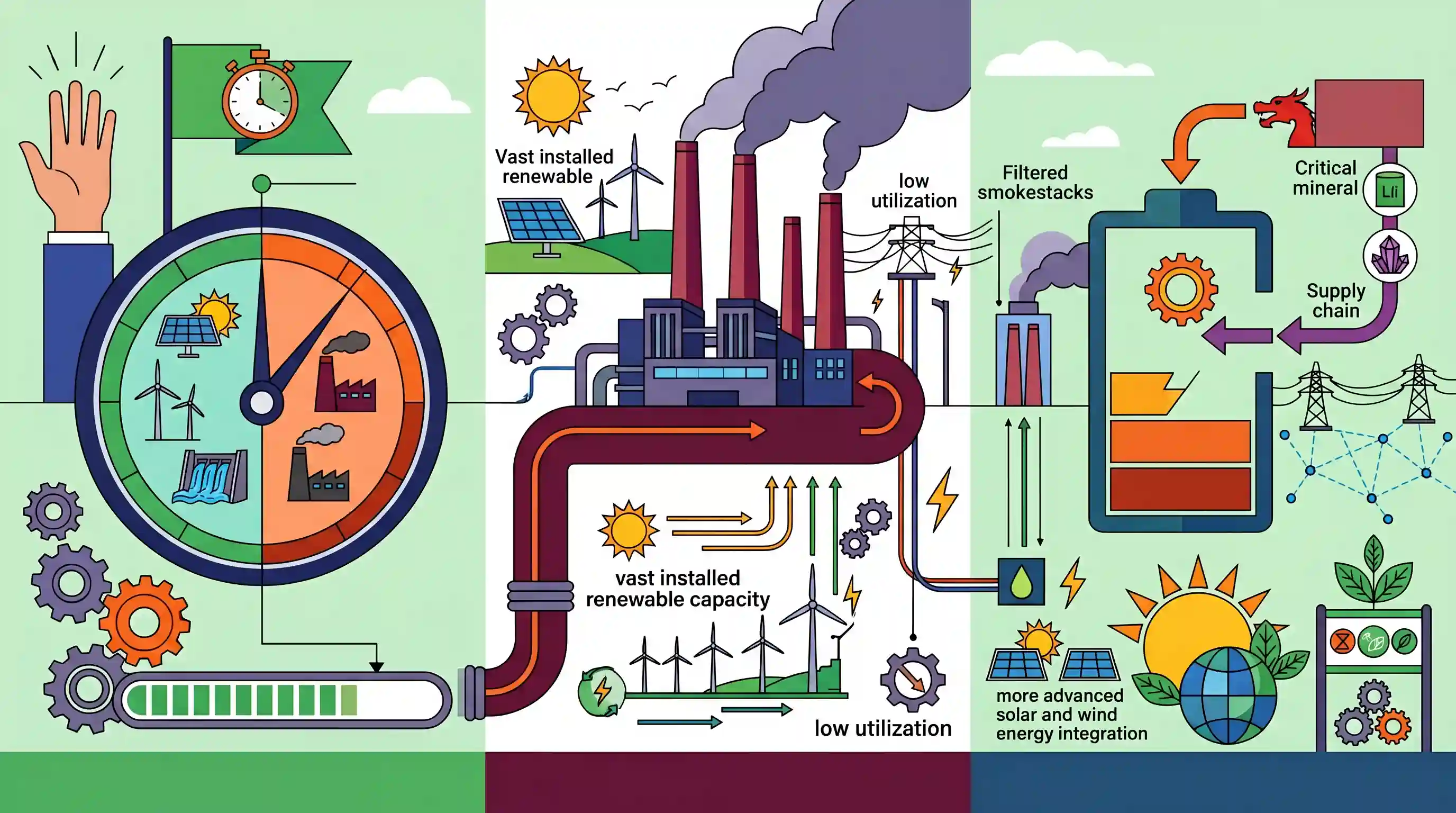
Highlights the paradox of India's energy transition: impressive gains in installed renewable capacity versus the persisting reality of coal dominance in actual generation. It illustrates critical bottlenecks in energy storage and supply chain vulnerabilities, crucial for analyzing India's progress toward its 2070 net-zero targets and NDCs in GS3.
Summary
India recently achieved a major milestone by meeting its Paris Agreement target five years early, with non-fossil fuels now accounting for half of the country's total installed power generation capacity. However, coal remains deeply entrenched in India's energy mix, contributing over 74% of actual electricity generation last year. Despite vast installed renewable capacity, low capacity utilization and a severe lack of energy storage solutions restrict actual renewable power generation. Addressing the storage bottleneck—which is partly hindered by import dependence on China for critical minerals—and finding ways to reduce the emission intensity of existing thermal plants remain vital for India to achieve its 2070 net-zero emissions target.
Key Points
- India reached 50% of its total installed capacity from non-fossil fuel sources, fulfilling a key commitment under the 2030 Paris Agreement five years early.
- Despite renewable capacity milestones, coal generated over 74% of India's electricity in the past year, with domestic coal production growing by 5% to hit a record 1 billion tonnes.
- Renewable sources like solar and wind have lower capacity utilization factors compared to thermal plants, resulting in a significant gap between installed capacity and actual power generation.
- The severe lack of energy storage solutions (current battery storage is just 505 MWh) means excess renewable power is often wasted, forcing reliance on coal for nighttime and baseload power demand.
- Building sufficient battery storage requires rare earth metals and critical minerals, 70% of which are controlled by China, posing a strategic vulnerability for India's energy transition.
- Alternative storage solutions like pumped-hydro energy storage are being explored, along with continued efforts to reduce the emission intensity of existing thermal power plants.
Important Terms
Paris Agreement

A legally binding international treaty on climate change, adopted in 2015, aiming to limit global warming to well below 2°C, preferably 1.5°C, compared to pre-industrial levels.
UPSC context
GS Paper III: Environmental conservation and international climate negotiations. Tests understanding of global frameworks and India's obligations.
Nationally Determined Contributions (NDCs)
Self-defined climate action plans submitted by countries under the Paris Agreement, detailing targets for reducing greenhouse gas emissions and adapting to climate impacts.
UPSC context
GS Paper III: Environment and Disaster Management. Essential for questions on India's specific 2030 and 2035 climate targets.
Net-Zero Emissions
The state where the amount of greenhouse gases produced by a country is balanced by the amount removed from the atmosphere, achieving a neutral carbon footprint.
UPSC context
GS Paper III: Government policies for achieving carbon neutrality by 2070 and the associated socio-economic challenges.
Critical Minerals
Strategic minerals (e.g., lithium, cobalt, graphite) essential for high-tech industries and clean energy technologies that face significant supply chain risks and import dependencies.
UPSC context
GS Paper II & III: National Security, International Relations (resource diplomacy), and Energy Security. Tests knowledge of India's 30-mineral list.
Capacity Utilization Factor (CUF)
The ratio of actual energy generated by a power plant to its maximum possible output over a specific period, reflecting the operational efficiency and intermittency of sources.
UPSC context
GS Paper III: Infrastructure and Energy. Crucial for analyzing why renewable capacity does not immediately translate to 1:1 power generation.
Panchamrit
Five major climate commitments announced by India at COP26, including a 500 GW non-fossil capacity target and a 2070 net-zero goal.
UPSC context
GS Paper III: India's leadership in global climate action. A fundamental keyword for writing effective answers on environment policy.
Prelims Trap
"India currently generates 50% of its electricity from non-fossil fuel sources."
UPSC deliberately confuses 'installed capacity' with 'actual generation'. India achieved 50% non-fossil installed capacity, but coal still handles over 74% of actual power generation.
Static Concepts Connected
What is Capacity Utilization Factor (CUF)?
- Definition: The ratio of actual electrical energy generated by a power plant to the maximum possible energy output over a specific period.
- Renewables vs Coal: Solar and wind have low CUFs due to weather intermittency, explaining why 50% installed capacity doesn't equal 50% actual generation.
What are India's updated NDC targets under the Paris Agreement?
- Emissions Intensity: Reduce the emissions intensity of its GDP by 45% by 2030, from 2005 levels.
- Non-Fossil Capacity: Achieve about 50% cumulative electric power installed capacity from non-fossil fuel-based energy resources by 2030.
- Carbon Sink: Create an additional carbon sink of 2.5 to 3 billion tonnes of CO2 equivalent by 2030.
Cross-Topic Patterns
Energy Storage + Critical Minerals Diplomacy
The push for Battery Energy Storage Systems (BESS) directly links to India’s role in the Minerals Security Partnership (MSP) to bypass China's supply chain monopoly.
Pumped Hydro + Grid Stability
Renewable intermittency revives focus on pumped-storage hydroelectricity, bridging Geography (terrain suitability) and Economy (peak-load management).

Expect a 2026 Prelims statement trapping you on India's 'installed capacity' vs 'actual generation' share for non-fossil fuels.
Linked PYQs · 5
Linked PYQs · 5
- 2025MainsGS3
Write a review on India's climate commitments under the Paris Agreement (2015) and mention how these have been further strengthened in COP26 (2021). In this direction, how has the first Nationally Determined Contribution intended by India been updated in 2022?
- 2022MainsGS3
Do you think India will meet 50 percent of its energy needs from renewable energy by 2030 ? Justify your answer. How will the shift of subsidies from fossil fuels to renewables help achieve the above objective ? Explain.
- 2025MainsGS3
How can India achieve energy independence through clean technology by 2047? How can biotechnology can play a crucial role in this endeavour?
- 2018MainsGS3
“Access to affordable, reliable, sustainable and modern energy is the sine qua non to achieve Sustainable Development Goals (SDGs).” Comment on the progress made in India in this regard.
- 2024PrelimsGS1
Consider the following: 1. Battery storage 2. Biomass generators 3. Fuel cells 4. Rooftop solar photovoltaic units How many of the above are considered "Distributed Energy Resources"?
