SCO Trade Ministers Meet Export Restrictions and Supply Chains
Source:The Hindu ↗
Why It Matters
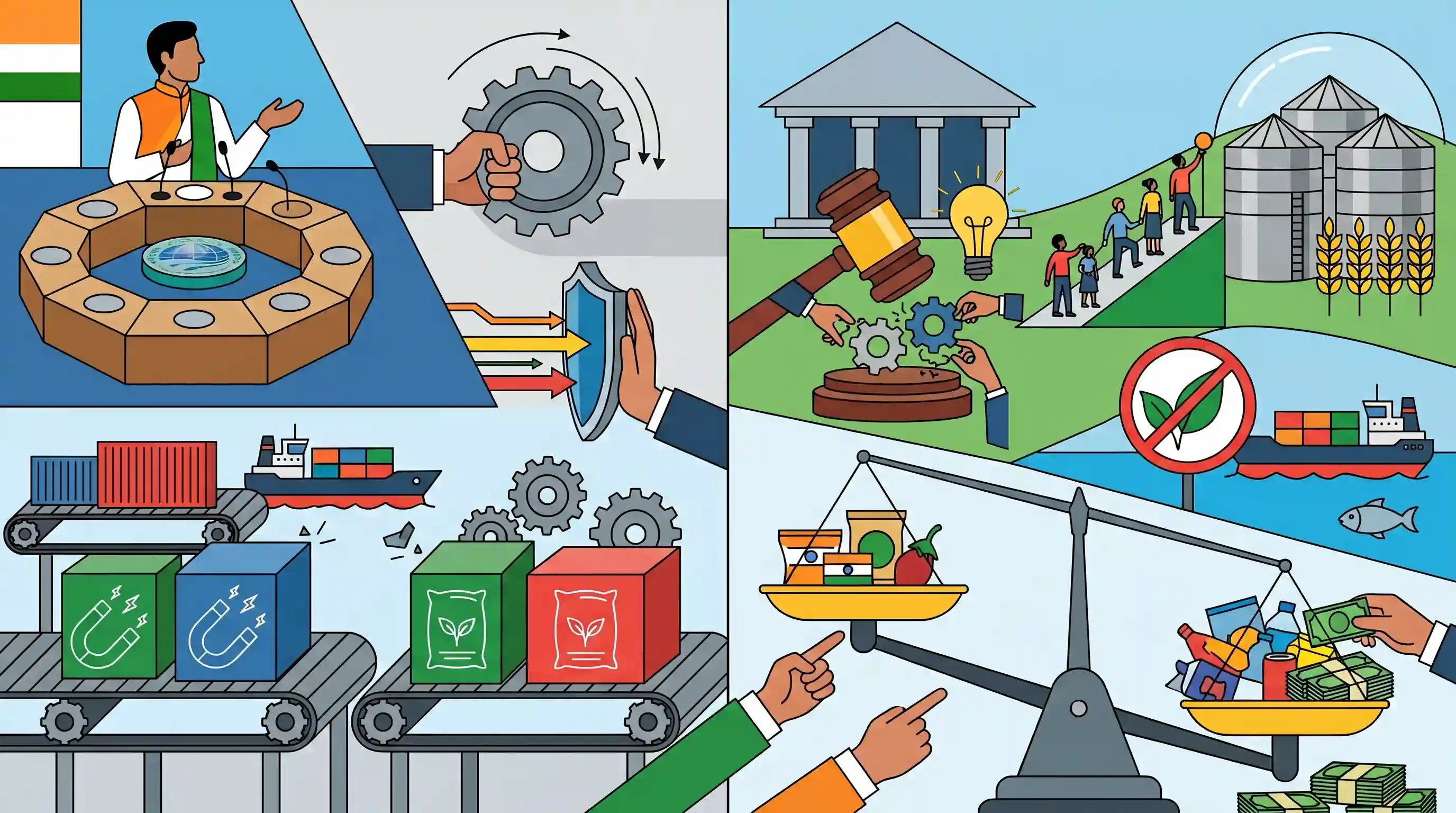
The article encapsulates India's dual strategy of pushing back against the weaponization of critical supply chains by regional adversaries while simultaneously advocating for a reformed, development-friendly global trading order at multilateral institutions like the WTO. This is essential for GS2 IR and GS3 Economy questions on global trade regimes, supply chain vulnerabilities, and regional group dynamics.
Summary
At the SCO Trade Ministers’ meeting in Vladivostok, Russia, India strongly cautioned against the misuse and weaponization of export-related measures that distort markets and disrupt global supply chains. Obliquely targeting China’s export curbs on critical inputs like rare earth magnets and fertilizers, India highlighted the need to address persistent trade imbalances (with its own deficit with China nearing $100 billion). Additionally, India championed a development-centric agenda at the WTO, advocating for a permanent solution to Public Stockholding (PSH) for food security, Special and Differential Treatment (S&DT) for developing nations, and the restoration of a fully functional dispute settlement mechanism, while warning against discriminatory trade-linked climate measures.
Key Points
- India cautioned against the 'weaponization' of export measures, warning that creating artificial scarcity distorts markets and disrupts global supply chains.
- The remarks were obliquely directed at China, which has imposed export restrictions on critical inputs like rare earth magnets and fertilizers, affecting India's auto and electronics sectors.
- India called for addressing persistent structural trade deficits through better market access; India's trade deficit with China reached approximately $100 billion in 2024-25.
- India advocated for an open multilateral trading system with the WTO at its core, pressing for a permanent solution on Public Stockholding for food security and the restoration of a two-tier dispute settlement mechanism.
- India warned that trade-linked climate measures should not result in arbitrary discrimination, and championed Special and Differential Treatment (S&DT) for developing nations.
Important Terms
Public Stockholding (PSH)

Policy tool allowing governments to procure, stockpile, and distribute food grains (e.g., MSP) to ensure food security. It is a major negotiating point in the WTO Agreement on Agriculture.
UPSC context
GS3 Economy: Food security; GS2 IR: WTO negotiations. Focuses on 'Amber Box' subsidies and the 'Peace Clause'.
Special and Differential Treatment (S&DT)
WTO provisions granting developing and least-developed countries (LDCs) special rights, such as longer transition periods for commitments and softer trade obligations to support economic growth.
UPSC context
GS2 IR: Global institutions. Tests understanding of 'Self-Selection' status and trade equity for emerging economies.
Shanghai Cooperation Organisation (SCO)
Eurasian political, economic, and security alliance founded in 2001. Current members include India, China, Russia, Pakistan, Iran, and several Central Asian states.
UPSC context
GS2 IR: Regional groupings. Crucial for India's 'Connect Central Asia' policy and managing relations with China/Russia.
Dispute Settlement Mechanism (DSM)
A structured system under the WTO to resolve trade conflicts. Currently in crisis due to the paralysis of its Appellate Body, which lacks a quorum for judges.
UPSC context
GS2 IR: Institutional reforms. Tests knowledge of the 'Appellate Body' crisis and its impact on rules-based trade.
Supply Chain Resilience
Strategic diversification of supply sources to reduce over-reliance on a single nation (e.g., China), ensuring trade continues despite geopolitical or environmental disruptions.
UPSC context
GS3 Economy: Industrial growth; GS2 IR: Geopolitics. Relates to the 'China Plus One' strategy and SCRI.
Critical Minerals
Elements like lithium and rare earths essential for modern technology (EVs, defense). High supply risk exists due to geographical concentration in countries like China.
UPSC context
GS3 Economy: Infrastructure/Energy; GS2 IR: Strategic resources. Key to India’s Net Zero targets and defense autonomy.
MSMEs
Enterprises classified by investment and turnover limits under the MSMED Act, 2006. They are major contributors to India’s employment, exports, and GDP.
UPSC context
GS3 Economy: Inclusive growth. Focuses on classification (2020 revision) and their role in the export ecosystem.
Prelims Trap
The WTO has already achieved a permanent solution for Public Stockholding (PSH) under the Bali Peace Clause.
The 2013 Bali Peace Clause offers only temporary, conditional immunity from legal challenges over breaching the 10% subsidy limit. India is still demanding a permanent solution.
Static Concepts Connected
How does the WTO categorize agricultural subsidies under the Agreement on Agriculture (AoA)?
- Amber Box: Trade-distorting subsidies (e.g., MSP). Subject to reduction commitments and a 10% 'de minimis' limit for developing countries based on 1986-88 prices.
- Green Box: Non-trade-distorting support (e.g., R&D, environmental programs, direct income support decoupled from production). Allowed without limits.
- Blue Box: Amber Box subsidies with conditions designed to limit production (e.g., production quotas). Allowed without limits.
Why is the WTO’s two-tier Dispute Settlement Mechanism currently paralyzed?
- Two-Tier System: The WTO uses a two-step system: dispute settlement panels (first instance) and the Appellate Body (appeals).
- Appellate Body Crisis: Paralyzed since 2019 because the United States blocked the appointment of new judges, preventing the minimum quorum of three judges needed to hear appeals.
- Appeals into void: Losing parties can appeal panel decisions 'into the void', remaining in legal limbo and rendering reports unenforceable.
Cross-Topic Patterns
Critical Minerals + Supply Chain Geopolitics
China’s export curbs on rare earths link directly to India's push for the Minerals Security Partnership (MSP) and the Quad's broader focus on diversifying semiconductor and clean-energy supply chains away from Beijing.
Trade Protectionism + Climate Goals (CBAM)
India's warning against 'discriminatory trade-linked climate measures' targets the EU's Carbon Border Adjustment Mechanism (CBAM), challenging developed nations that disguise non-tariff trade barriers as environmental taxes.

Expect a multi-statement Prelims 2026 question fusing the WTO Appellate Body crisis, Bali Peace clause limits, and S&DT self-declaration.
Linked PYQs · 5
Linked PYQs · 5
- 2023MainsGS2
‘Virus of Conflict is affecting the functioning of the SCO’ In the light of the above statement point out the role of India in mitigating the problems.
- 2021MainsGS2
Critically examine the aims and objectives of SCO. What importance does it hold for India?
- 2014MainsGS2
WTO is an important international institution where decisions taken affect countries in a profound manner. What is the mandate of WTO and how binding are their decisions ? Critically analyse India's stand on the latest round of talks on Food security.
- 2016MainsGS2
The broader aims and objectives of WTO are to manage and promote international trade in the era of globalization. But the Doha round of negotiations seem doomed due to differences between the developed and the developing countries." Discuss in the Indian perspective.
- 2025MainsGS3
What are the challenges before the Indian economy when the world is moving away from free trade and multilateralism to protectionism and bilateralism? How can these challenges be met?
