US Reciprocal Tariffs and India Commerce Ministry Trade Evaluation
Source:The Hindu ↗
Why It Matters
This article highlights a critical escalation in protectionist trade measures by the United States, one of India's largest trading partners. It holds direct relevance for UPSC aspirants studying the economic implications of deglobalization, tariff barriers, and the strategic diplomatic responses required to safeguard domestic industries and export markets.
Summary
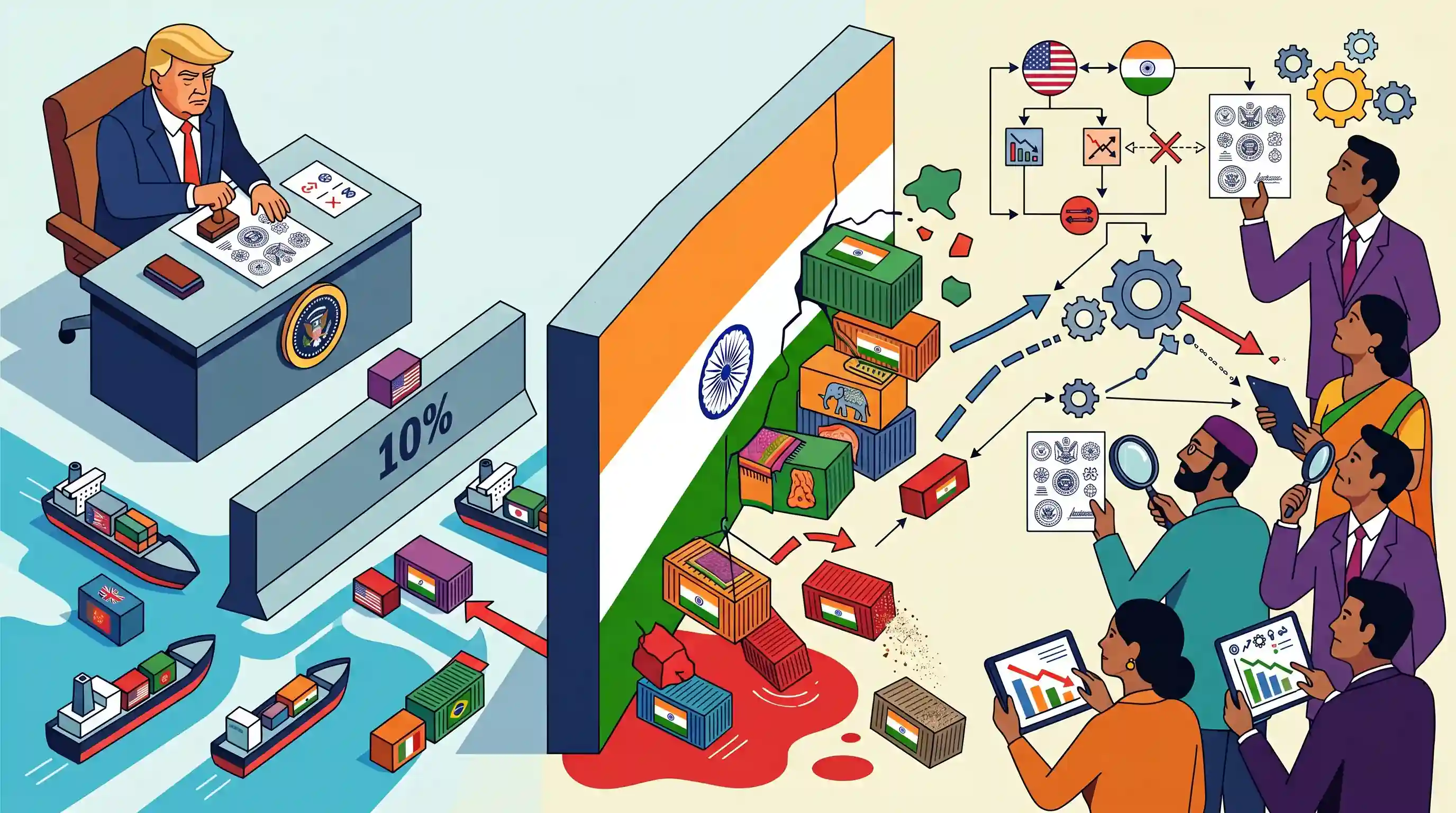
The Indian Commerce Ministry is currently examining the implications of an Executive Order by U.S. President Donald Trump imposing reciprocal tariffs on trading partners. The measure introduces a baseline 10% duty starting April 5, 2025, with India facing an additional 27% country-specific ad-valorem duty effective April 9, 2025. This significant protectionist move is expected to impact India-U.S. bilateral trade and export competitiveness.
Key Points
- U.S. President Donald Trump issued an Executive Order imposing reciprocal tariffs, applying additional ad-valorem duties of 10% to 50% on imports from trading partners.
- India is subjected to an additional 27% ad-valorem duty under Annex I of the Executive Order.
- The new baseline duty of 10% comes into effect on April 5, 2025, while the country-specific additional duties apply from April 9, 2025.
- India's Department of Commerce is carefully evaluating the potential economic impacts and implications of these substantial tariff barriers on bilateral trade.
Important Terms
Reciprocal Tariffs

A policy where a country matches the import duties that its trading partner charges on its goods, often used to force trade liberalization or penalize high-tariff nations.
UPSC context
GS Paper III: Economy (External Sector); tests knowledge of protectionism, trade wars, and challenges to the WTO multilateral framework.
Executive Order on reciprocal tariffs
A legally binding directive issued by the U.S. President to manage trade policy; in this context, EO 14257 (2025) mandated universal and country-specific duties based on trade deficits.
UPSC context
GS Paper II: International Relations; examines the executive powers of the U.S. President and their impact on bilateral trade with India.
Ad-valorem Duty
A tax or duty calculated as a fixed percentage of the estimated value of the goods being imported, rather than on their weight or quantity.
UPSC context
GS Paper III: Economy; fundamental concept in taxation and trade policy, essential for understanding export-import competitiveness.
Ministry of Commerce and Industry (India)
The nodal body (Department of Commerce) responsible for India's foreign trade policy, international trade negotiations (WTO, FTAs), and monitoring global economic developments to protect national interests.
UPSC context
GS Paper II: Statutory/Regulatory Bodies; tests understanding of the executive departments handling India's economic diplomacy and trade response.
U.S. Department of Commerce
The U.S. federal agency that works with businesses, universities, and communities to promote job creation and economic growth; it also enforces trade laws and investigates unfair trade.
UPSC context
GS Paper II: International Relations; relevant for tracking foreign regulatory actors that influence Indian exports and bilateral economic health.
Most Favoured Nation (MFN)
A foundational WTO principle requiring countries to treat all trading partners equally; reciprocal tariffs are often criticized as violating this non-discrimination rule.
UPSC context
GS Paper III: Economy (External Sector); critical for understanding the rules-based global trade order and current shifts toward plurilateralism.
Prelims Trap
"Reciprocal country-specific tariffs are a permitted exception under the WTO's Most-Favoured-Nation (MFN) rule."
Reciprocal tariffs violate GATT Article I. Permitted MFN exceptions are strictly FTAs, Customs Unions, and differential treatment for developing nations (GSP), not retaliatory tariffs.
Static Concepts Connected
What is the WTO's Most-Favoured-Nation (MFN) principle?
- Equal treatment: Mandates that any trade advantage or tariff cut granted to one nation must be unconditionally extended to all other WTO members.
- Valid exceptions: Regional Trade Agreements (FTAs/CEPA), Customs Unions, and Generalized System of Preferences (GSP) for developing nations are allowed under WTO rules.
What is the difference between Ad Valorem and Specific duties?
- Ad Valorem: A customs duty calculated as a fixed percentage of the total assessed financial value of the imported good.
- Specific duty: A fixed fee levied based on the physical unit, weight, or volume of the good, regardless of its market price.
Cross-Topic Patterns
Protectionism + MSME Employment
US tariffs heavily target labor-intensive surplus sectors like gems, jewellery, and textiles, threatening formal job creation and MSME credit health in India.
Trade Deficit + Currency Depreciation
A sudden drop in exports to India's largest trading partner (USA) could widen the Current Account Deficit, triggering Rupee depreciation and imported inflation.

A 2026 question mapping WTO MFN exceptions against protectionist reciprocal tariffs, or ad-valorem vs specific duties, is highly likely.
Linked PYQs · 2
Linked PYQs · 2
- 2025MainsGS3
What are the challenges before the Indian economy when the world is moving away from free trade and multilateralism to protectionism and bilateralism? How can these challenges be met?
- 2012MainsGS2
Discuss the likely negative impact of the protectionist measures proposed by the US on India's software industry.
