India Carbon Emissions Trends and Climate Commitments
Source:Indian Express ↗
Why It Matters
Essential for understanding India's evolving energy mix, carbon footprint trajectory, and progress toward global climate goals.
Summary
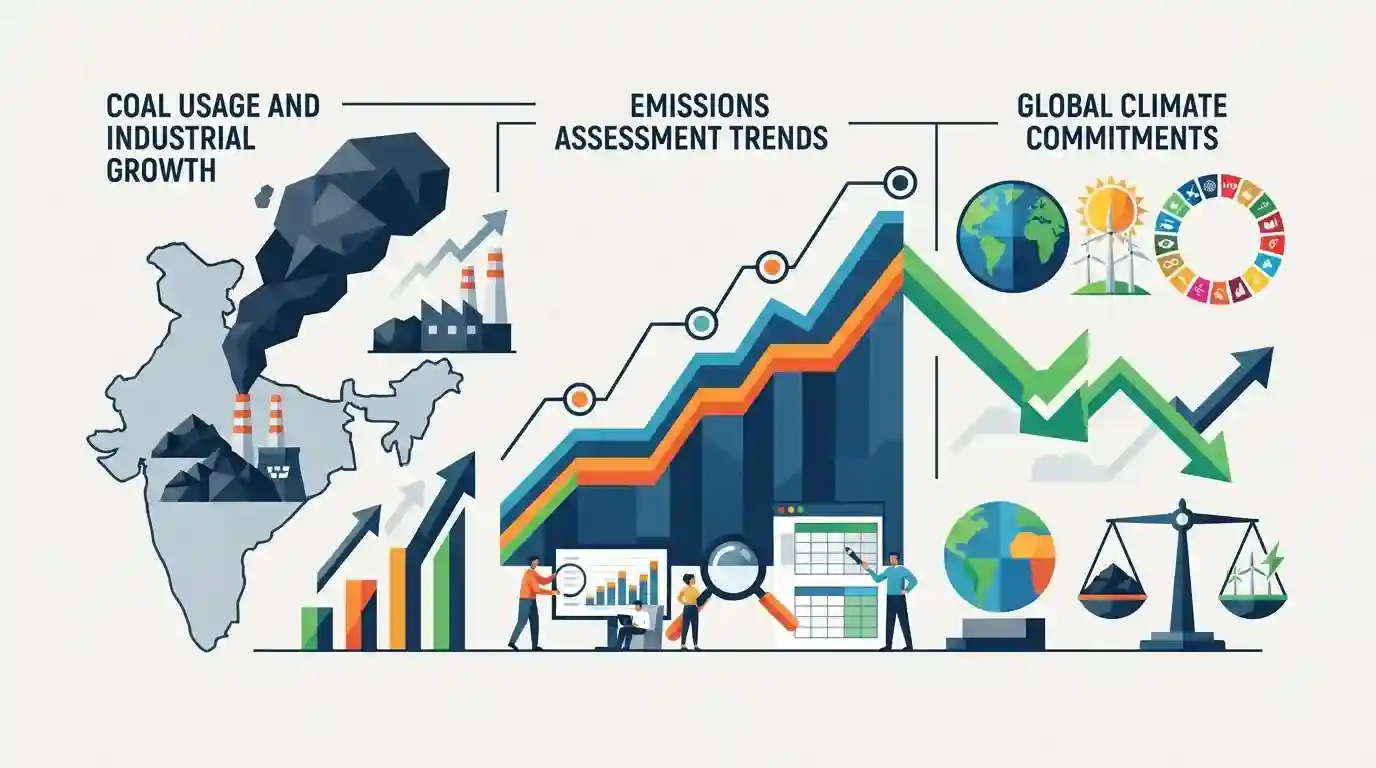
An analysis of India's carbon emissions trends, highlighting the interplay between coal usage, industrial growth, and global climate commitments as tracked by recent emissions assessments.
Key Points
- India's carbon dioxide emissions saw a notable slowdown or dip amid shifts in industrial growth and coal consumption patterns.
- The Global Carbon Project tracks global carbon budgets and annual emissions trajectories.
- Balancing economic growth aspirations with net-zero commitments remains a core challenge for India's energy policy.
Important Terms
Paris Agreement

A legally binding international treaty adopted in 2015 at COP21, aiming to limit global average temperature rise to well below 2°C above pre-industrial levels and pursue efforts to cap it at 1.5°C.
UPSC context
UPSC Mains GS Paper III: Environment, Conservation, and Climate Change international commitments and treaties.
Nationally Determined Contributions
Nationally determined climate action plans submitted by countries under the Paris Agreement to reduce greenhouse gas emissions and adapt to climate change impacts, updated every five years.
UPSC context
UPSC Mains GS Paper III: Environmental pollution, degradation, and India's nationally determined targets and policy measures.
Global Carbon Project
An international research project that tracks global greenhouse gas emissions and the carbon cycle, providing authoritative annual Global Carbon Budget estimates.
UPSC context
UPSC Prelims/Mains: Important global reports, environmental assessments, and climate science data tracking.
Static Concepts Connected
What is the Global Carbon Project and how does it estimate global carbon budgets?
- Establishment: International research project established in 2001 within the former Earth System Science Partnership.
- Core Function: Quantifies global greenhouse gas emissions and their causes, tracking carbon sinks in land and oceans.
- Key Output: Publishes the annual Global Carbon Budget report, a key scientific baseline for IPCC assessments.
Cross-Topic Patterns
Renewables Expansion vs Critical Mineral Dependencies
Rapid renewable capacity addition coincides with structural supply-chain vulnerabilities in critical minerals required for clean energy transitions.
Hard-to-Abate Industrial Growth vs NDC Targets
Hard-to-abate sectors like steel and cement drive industrial emissions while relying heavily on coal, complicating India's Nationally Determined Contributions under the Paris Agreement.

India's dual trajectory—coal-power drop alongside soaring industrial steel/cement emissions—is prime for UPSC statement-based Prelims.
Linked PYQs · 3
Linked PYQs · 3
- 2025MainsGS3
Write a review on India's climate commitments under the Paris Agreement (2015) and mention how these have been further strengthened in COP26 (2021). In this direction, how has the first Nationally Determined Contribution intended by India been updated in 2022?
- 2023MainsGS3
The Intergovernmental Panel on Climate Change (IPCC) has predicted a global sea level rise of about one metre by AD 2100. What would be its impact in India and the other countries in the Indian Ocean region?
- 2021MainsGS3
Describe the major outcomes of the 26th session of the Conference of the Parties (COP) to the United Nations Framework Convention on Climate Change (UNFCCC). What are the commitments made by India in this conference?
