STEM education and humanities balance in governance and NEP 2020
Source:Indian Express ↗
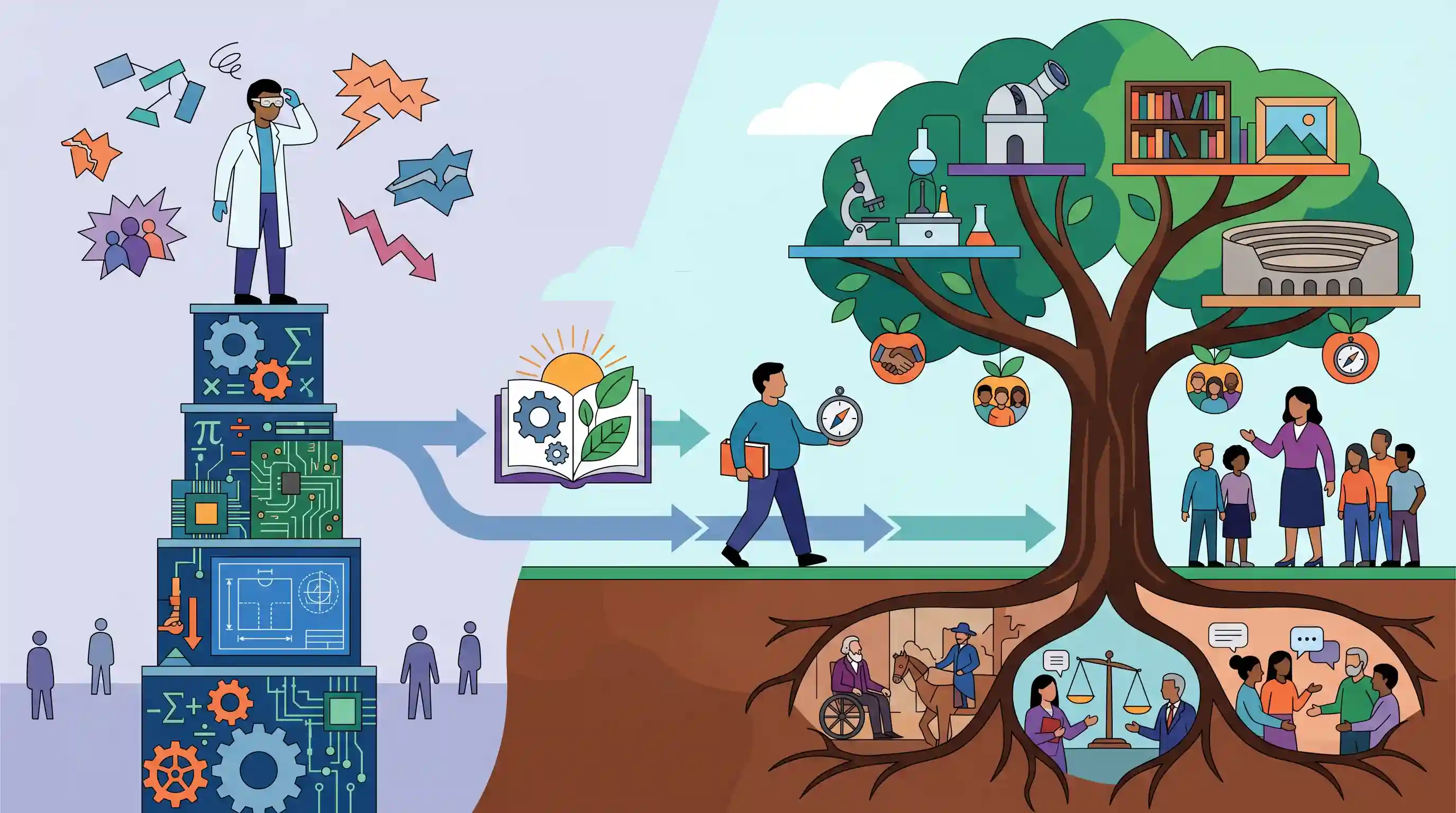
Why It Matters
It highlights the limitations of a purely technocratic approach to governance and underscores the necessity of multidisciplinary education (a core pillar of NEP 2020). This provides excellent fodder for GS-2 (Education, Human Resources), GS-4 (Ethics in Administration), and Essay topics on the true purpose of education and the balance between specialized knowledge and humanistic values.
Summary
The article critiques India's disproportionate focus on STEM (Science, Technology, Engineering, Mathematics) education at the expense of the humanities and social sciences. It argues that while placing scientists and technocrats in top leadership roles is often celebrated, technical expertise alone is insufficient for holistic governance and policymaking. True leadership requires deep "roots" in humanistic disciplines—such as history, philosophy, and sociology—to navigate complex societal dynamics, ethics, and human behavior. Emphasizing the need to move away from rigid academic silos, the author advocates for the swift implementation of the National Education Policy (NEP) 2020's multidisciplinary vision. Integrating liberal arts with scientific training is essential to produce empathetic, well-rounded leaders capable of addressing multifaceted modern challenges rather than relying solely on technological fixes.
Key Points
- India's prevailing education and policy ecosystem overly prioritizes STEM disciplines, often marginalizing the humanities and social sciences.
- Placing scientists and technocrats in top leadership positions is inadequate if they lack a foundational understanding of societal, historical, and ethical contexts.
- Complex contemporary challenges (like AI ethics, public health, and climate change) require a synthesis of technical know-how (the 'how') and humanistic insight (the 'why').
- A purely technocratic approach to governance can lead to policies that are technically sound but socially disconnected or unempathetic.
- The National Education Policy (NEP) 2020's vision for multidisciplinary education is crucial to bridging the gap between liberal arts and technical training, ensuring future leaders are well-rounded.
Important Terms
National Education Policy (NEP) 2020

A 2020 reform aimed at making Indian education holistic, multidisciplinary, and flexible, replacing the 1986 policy. It introduces a 5+3+3+4 structure and emphasizes critical thinking over rote learning.
UPSC context
GS Paper II: Social Sector/Education. Crucial for questions on human resource development and educational governance.
Technocracy
A system of governance where decision-making is led by technical experts or scientists based on specialized knowledge rather than broad humanistic or political experience.
UPSC context
GS Paper II: Governance; GS Paper IV: Ethics. Tests the balance between technical efficiency and empathetic public service.
Generalist vs. Specialist Debate
The longstanding debate in Indian administration regarding whether generalist civil servants (IAS) or domain experts (scientists/specialists) should occupy top leadership and policy-making positions.
UPSC context
GS Paper II: Role of civil services in a democracy. Essential for administrative reform topics.
Liberal Arts
An academic approach that integrates humanities, social sciences, and natural sciences to develop critical thinking, communication, and a holistic understanding of societal dynamics.
UPSC context
GS Paper II: Issues relating to development and management of Social Sector/Services relating to Education.
Multidisciplinary Education
A pedagogical framework mandated by NEP 2020 that removes rigid boundaries between science, commerce, and arts streams, allowing students a flexible choice of subjects.
UPSC context
GS Paper II: Education. Focuses on transforming the human resource pool to meet 21st-century challenges.
STEM Education
A curriculum focusing on Science, Technology, Engineering, and Mathematics, often prioritized in India as the primary path for national development and individual career success.
UPSC context
GS Paper III: Science and Technology. Relevant for discussions on innovation and skill development versus humanistic values.
Ministry of Education
The central government body responsible for formulating and implementing national education policies and overseeing primary to higher education across India.
UPSC context
GS Paper II: Governance/Ministries. Primary agency for executing national education reforms.
Prelims Trap
"NEP 2020 mandates the establishment of exclusive STEM-only universities to boost India's global competitiveness."
NEP 2020 explicitly advocates phasing out standalone technical institutes and transforming them into holistic multidisciplinary institutions (MERUs) by 2040, breaking down silos.
Static Concepts Connected
What is the Generalist vs. Specialist debate in Indian Administration?
- Generalist Advantage: Generalist administrators (like IAS) possess broad experiential perspectives to balance competing social, economic, and political interests in holistic policymaking.
- Specialist Need: Complex modern issues (climate change, cybersecurity, digital public infrastructure) require deep technical domain expertise, driving the push for lateral entry.
- 2nd ARC View: Recommended a domain-based competence framework, assigning officers to specialized domains after initial generalist years, blending both approaches.
What are the key provisions of NEP 2020 regarding Higher Education?
- Multidisciplinary Push: Transforming all higher education institutions into large, multidisciplinary universities and colleges (MERUs) by 2040, eliminating rigid academic silos.
- Flexible Curriculum: Introducing multiple entry/exit points and an Academic Bank of Credit (ABC) to seamlessly integrate vocational, technical, and liberal arts education.
- Regulatory Overhaul: Replacing fragmented regulators (like UGC, AICTE) with a single overarching umbrella body, the Higher Education Commission of India (HECI).
Cross-Topic Patterns
Lateral Entry vs. Holistic Governance
The debate over recruiting technocrats via lateral entry (GS2) often ignores the need for sociopolitical empathy, proving that technical mastery alone cannot solve human-centric policy issues.
Tech-Governance and AI Ethics
Deploying tech solutions like AI or biometric welfare systems strictly as STEM problems ignores bias and exclusion risks, requiring sociological and ethical guardrails (GS4).

Expect a GS4 or GS2 Mains question evaluating 'technocratic bias' in public policy and why ethics must anchor STEM-led lateral entry.
Linked PYQs · 3
Linked PYQs · 3
- 2020MainsGS2
National Education Policy 2020 is in conformity with the Sustainable Development Goal-4 (2030). It intends to restructure and reorient education system in India. Critically examine the statement.
- 2015MainsEssay
Education without values, as useful as it is, seems rather to make a man more clever devil.
- 2025MainsGS2
e-governance projects have a built-in bias towards technology and back-end integration than user-centric designs. Examine.
