Multilateralism Decline and India Response to Global Trade Sanctions
Source:The Hindu ↗
Why It Matters
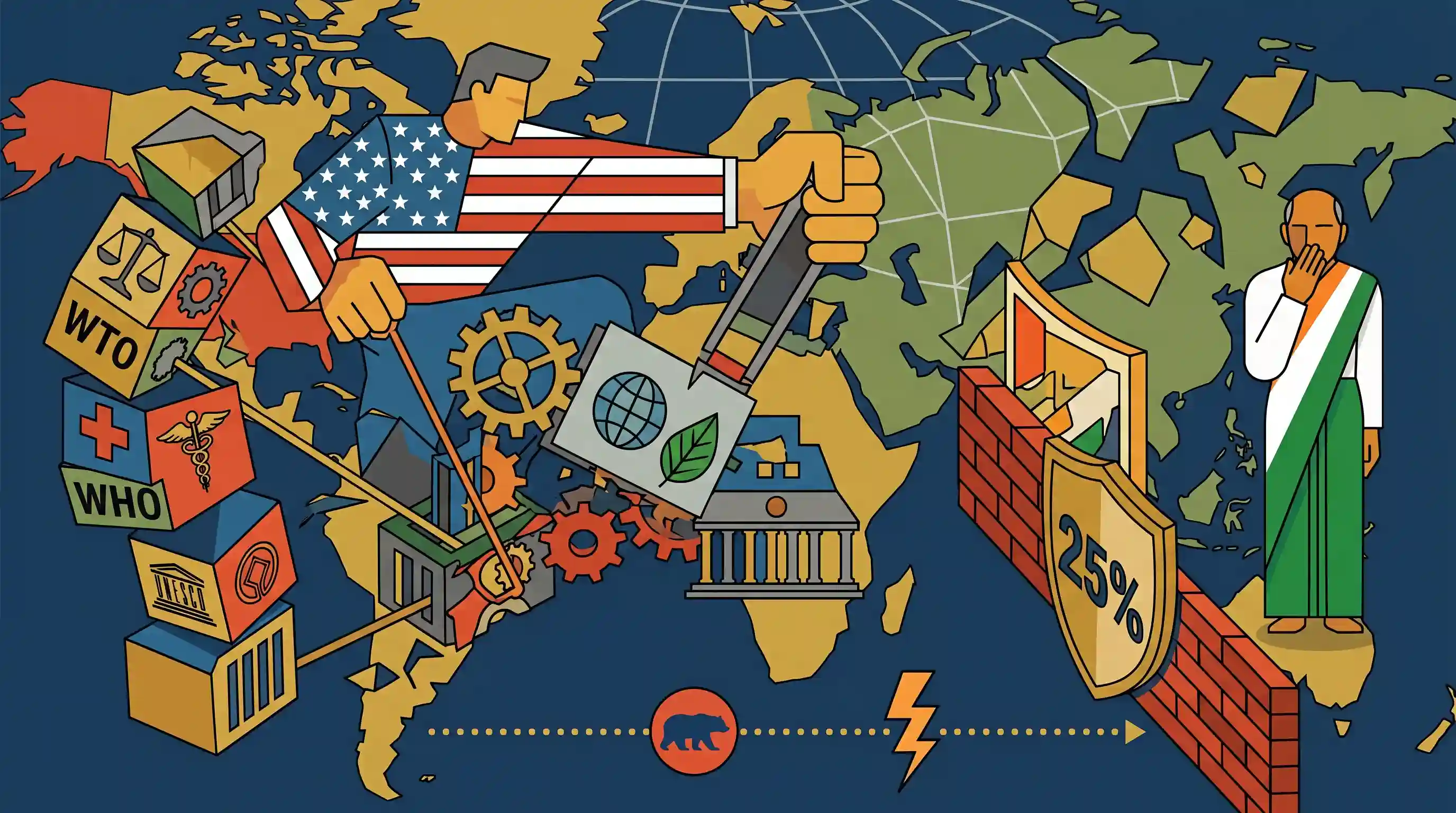
This article highlights the ongoing tension between unilateralism and multilateralism, a central theme in global geopolitics. It provides specific examples (US withdrawal from WHO, UNESCO, Paris Agreement; tariffs; CAATSA-like penalties) that are crucial for answering GS-2 questions on US-India ties, the relevance of global institutions like WTO, and the impact of trade wars.
Summary
The Congress party has criticized the Indian government for acting as a 'mute spectator' amid the US administration's efforts to dismantle multilateral institutions like the WTO, WHO, and UNESCO. Highlighting the US withdrawal from the Paris Climate Agreement and its shift towards unilateral decision-making, the opposition pointed out the direct economic impact on India, including a recent 25% tariff on Indian exports and penalties for defense and energy trade with Russia. The article underscores the broader geopolitical challenge India faces in responding to rising US protectionism and the erosion of the global multilateral framework while safeguarding its national interests.
Key Points
- The Congress party urged the Indian government not to remain a 'mute spectator' while the US systematically weakens key multilateral institutions like the WTO and WHO.
- The US administration has increasingly embraced unilateralism by withdrawing from international commitments such as the Paris Climate Agreement and UNESCO.
- The US has imposed punitive measures against India, including a 25% tariff on Indian exports and penalties for purchasing Russian military equipment and energy.
- India faces a complex diplomatic challenge in balancing its strategic bilateral ties with the US against unilateral trade actions and sanctions that harm its national interests.
Important Terms
World Trade Organization (WTO)

A global intergovernmental organization (est. 1995) that regulates international trade rules. It operates on principles like non-discrimination and reciprocity to ensure trade flows as smoothly and predictably as possible.
UPSC context
GS Paper 2/3: Essential for understanding global trade governance, India's trade disputes, and the 'Rules-Based International Order'.
Paris Climate Agreement
A legally binding 2015 international treaty aiming to limit global warming to well below 2°C, preferably 1.5°C. It utilizes 'Nationally Determined Contributions' (NDCs) for country-specific climate targets.
UPSC context
GS Paper 3: Core topic for Environment & Ecology; tests knowledge of international climate diplomacy and India’s 'Net Zero' commitments.
Multilateralism
Cooperation between three or more nations to address global issues based on shared norms. It is the cornerstone of the post-WWII international order, currently challenged by rising unilateralism.
UPSC context
GS Paper 2: Crucial for International Relations; tests ability to analyze the 'crisis of multilateralism' and India's role in global groupings.
Protectionism
Economic policy of restricting imports through tariffs or quotas to shield domestic industries from foreign competition. It is often contrasted with 'Free Trade'.
UPSC context
GS Paper 3: Relevant for Economy; covers 'Trade Wars' and how developed-country policies (like 'America First') impact Indian exports.
UNESCO
A UN specialized agency (est. 1945) promoting peace through international cooperation in education, sciences, and culture. It manages the World Heritage Site program.
UPSC context
GS Paper 1/2: Tests Art & Culture (Heritage Sites) and the effectiveness of international institutional frameworks.
World Health Organization (WHO)
The specialized UN agency responsible for international public health. It coordinates global responses to health emergencies and sets standards for disease control.
UPSC context
GS Paper 2: Relevant for Social Justice/Health and International Institutions; focuses on global health security and pandemic management.
Prelims Trap
"CAATSA is a UN-backed multilateral sanctions framework."
CAATSA is purely a US domestic federal law applied extraterritorially. India officially recognizes only UN-mandated multilateral sanctions, not unilateral ones.
Static Concepts Connected
Why is the WTO's dispute settlement mechanism currently paralyzed?
- Appellate Body: The highest adjudicatory body of the WTO requires a minimum quorum of three sitting members to hear and rule on trade dispute appeals.
- US Blockade: The US has systematically blocked the appointment of new Appellate Body members since 2019, rendering the mechanism defunct and stalling global trade justice.
- MPIA Alternative: Several nations formed the Multi-Party Interim Appeal Arbitration Arrangement (MPIA) as a workaround, but neither India nor the US participates in it.
What is CAATSA and how does it impact India?
- Core Objective: A US federal law designed to penalize countries engaging in significant transactions with the defense or intelligence sectors of Russia, Iran, or North Korea.
- India's Exposure: India's multi-billion dollar procurement of the S-400 Triumf missile defense system from Russia falls directly under CAATSA scrutiny, risking secondary economic sanctions.
- Waiver Provision: The US President can issue a waiver if penalizing the partner nation harms broader US strategic interests, an exception heavily debated for India.
Cross-Topic Patterns
Climate Finance & CBDR
US shifts on the Paris Agreement threaten the Common But Differentiated Responsibilities (CBDR) principle, severely widening the climate finance gap for developing nations like India.
Protectionism & GSP revocation
Recent arbitrary tariffs echo the 2019 US revocation of India's Generalized System of Preferences (GSP) status, illustrating a shift from WTO rules-based global trade to transactional bilateralism.

Expect a 2026 multi-statement Prelims question linking WTO Appellate Body paralysis, CAATSA, and India's stance on unilateral sanctions.
Linked PYQs · 4
Linked PYQs · 4
- 2018MainsGS2
What are the key areas of reform if the WTO has to survive in the present context of "Trade War', especially keeping in mind the interest of India?
- 2019MainsGS2
‘Too little cash, too much politics, leaves UNESCO fighting for life.’ Discuss the statement in the light of US' withdrawal and its accusation of the cultural body as being 'anti-Israel bias'.
- 2019MainsGS2
‘What introduces friction into the ties between India and the United States is that Washington is still unable to find for India a position in its global strategy, which would satisfy India's national self-esteem and ambitions.’ Explain with suitable examples.
- 2025MainsGS3
Write a review on India's climate commitments under the Paris Agreement (2015) and mention how these have been further strengthened in COP26 (2021). In this direction, how has the first Nationally Determined Contribution intended by India been updated in 2022?
