Global South Leadership and Strategic Autonomy Dilemmas
Source:Indian Express ↗
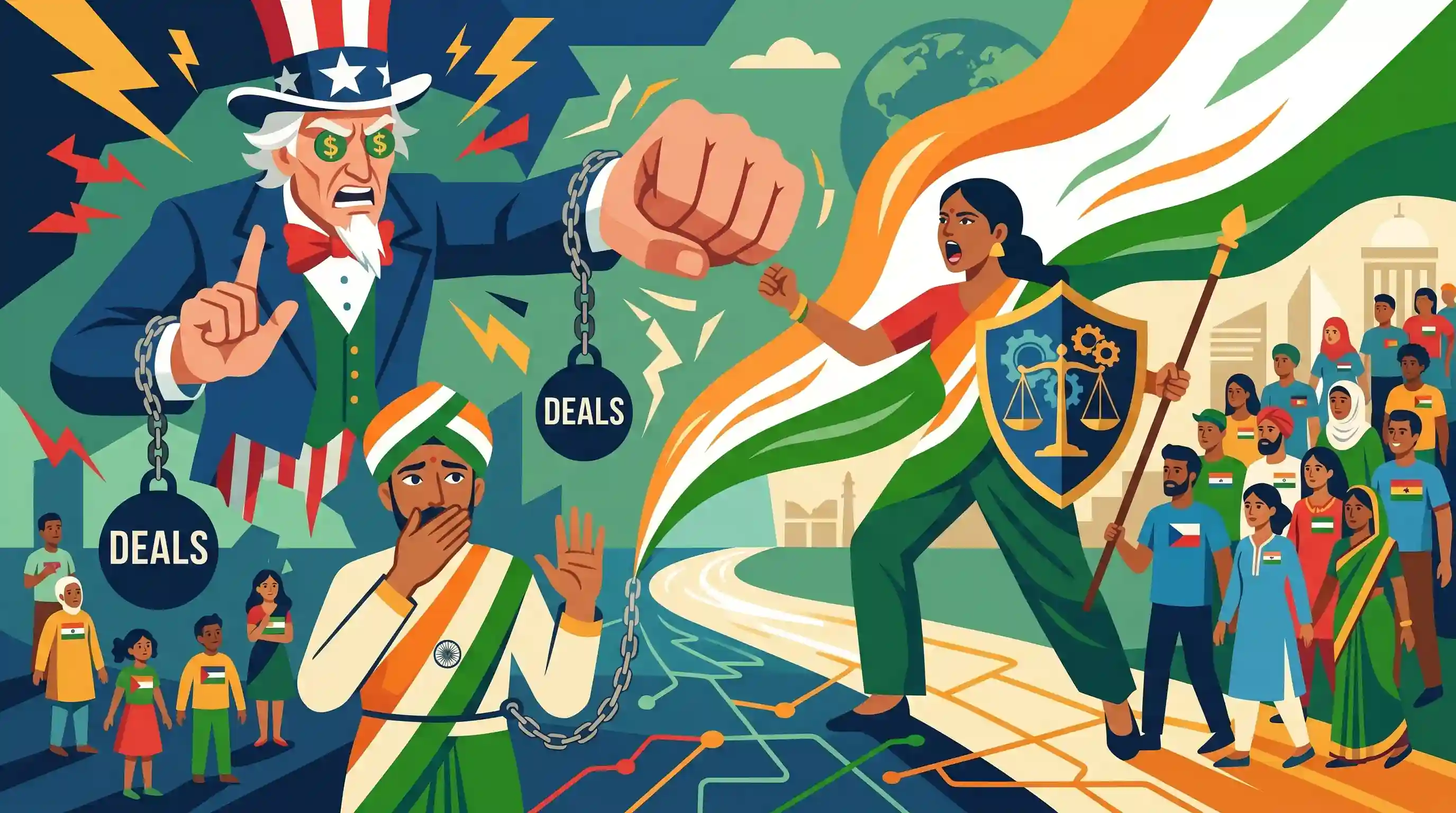
Why It Matters
Highlights the tension between India's pragmatic bilateral relations with the US and its larger global ambitions, directly addressing GS2 themes of India's role in the emerging world order and the impact of developed countries' policies on India's interests.
Summary
The article critiques India's cautious diplomatic silence in response to the transactional and aggressive foreign policy maneuvers of the United States under Donald Trump. It argues that avoiding confrontation to protect bilateral ties undermines India's aspirations to act as a credible global leader and a voice for the Global South. True strategic autonomy and global leadership require India to assertively defend the rules-based international order and resist superpower coercion.
Key Points
- The transactional and aggressive 'America First' foreign policy approach of the United States under Donald Trump poses challenges to a stable, rules-based international order.
- India's diplomatic silence in the face of superpower 'bullying', often justified by pragmatic bilateral considerations, undermines its aspirations to be a principled global leader ('Vishwa Guru').
- To effectively champion the interests of the Global South, India must demonstrate the willingness to resist coercion and defend international norms.
- True strategic autonomy requires moving beyond cautious balancing and proactively articulating an independent stance on disruptive global politics.
Important Terms
Global South

Developing and least-developed nations in Asia, Africa, and Latin America, characterized by shared colonial histories, socio-economic challenges, and a push for equitable global governance.
UPSC context
GS Paper II: International Relations. Tests India's leadership ambitions and its role as a bridge between developed and developing nations.
Strategic Autonomy
A state's capacity to pursue its national interests and make independent foreign policy decisions without being constrained by external powers or formal military alliances.
UPSC context
GS Paper II: Indian Foreign Policy. Essential for understanding India's shift from non-alignment to pragmatic engagement with multiple superpowers.
Rules-based International Order
A system of international relations governed by established laws, treaties, and shared norms (like the UN Charter) to ensure global stability and predictable state behavior.
UPSC context
GS Paper II: Global Institutions. Evaluates challenges posed by unilateralism and the shift toward power-driven geopolitics.
Transactional Diplomacy
A pragmatic diplomatic approach prioritizing short-term "deals" and immediate reciprocal gains over long-term strategic values, ideological alignment, or traditional alliance commitments.
UPSC context
GS Paper II: Bilateral Relations. Relevant for analyzing the shifting nature of US-India ties under different administrations.
Strategic Coercion
The practice of using economic or military pressure, such as unilateral tariffs or sanctions, to force another nation to change its sovereign policies.
UPSC context
GS Paper II: International Relations. Tests understanding of how trade and sanctions are weaponized in modern geopolitics.
Multi-alignment
A foreign policy strategy where a country maintains simultaneous, issue-based partnerships with multiple competing global powers to maximize its strategic options and national interest.
UPSC context
GS Paper II: Indian Foreign Policy. Covers India's evolution from Non-Alignment to active engagement with groups like QUAD and BRICS.
Prelims Trap
"The Global South refers exclusively to countries located in the Southern Hemisphere."
The Global South is an economic and geopolitical concept describing developing nations, not a geographical reality (e.g., Australia is in the South but excluded; India is in the North but included).
Static Concepts Connected
How does Strategic Autonomy differ from traditional Non-Alignment?
- Non-Alignment: Avoiding entanglement in superpower blocs during the Cold War, often accompanied by a strong ideological focus against imperialism.
- Strategic Autonomy: A post-Cold War approach of issue-based multi-alignment and pragmatic, interest-driven partnerships without formal military alliances.
- Modern Application: Actively participating in US-led groupings like the Quad while simultaneously maintaining deep energy and defense ties with Russia.
What are the defining pillars of a Rules-Based International Order (RBIO)?
- Multilateral Institutions: Global governance structured around shared, consensus-driven bodies like the UN, WTO, and IMF rather than unilateral dictates.
- Treaty Compliance: Strict adherence to global treaties and international law, such as relying on UNCLOS to resolve maritime disputes.
- Open Economic System: Commitment to predictable economic frameworks and resistance to unilateral protectionist tariffs or economic coercion.
Cross-Topic Patterns
US Protectionism & WTO Crisis
Unilateral US tariffs inherently conflict with WTO's Most Favoured Nation principles, tying GS2 foreign policy directly to GS3 trade issues, particularly the ongoing paralysis of the WTO's Appellate Body.
Strategic Autonomy vs. Global South Leadership
India's silence to preserve US ties often contradicts its 'Voice of Global South' role, linking bilateral pragmatism with broader multilateral leadership challenges in GS2 Mains.

Mains 2026 will likely test the tension between India's 'Strategic Autonomy' and its 'Global South' leadership amidst US protectionism.
Linked PYQs · 2
Linked PYQs · 2
- 2019MainsGS2
‘What introduces friction into the ties between India and the United States is that Washington is still unable to find for India a position in its global strategy, which would satisfy India's national self-esteem and ambitions.’ Explain with suitable examples.
- 2019MainsGS2
‘The long-sustained image of India as a leader of the oppressed and marginalised nations has disappeared on account of its new found role in the emerging global order.’ Elaborate.
