Clean Air Act and emission norms needed to tackle air pollution
Source:The Hindu ↗
Why It Matters
The article underscores the critical tension between economic development and environmental sustainability. It provides a comprehensive critique of current environmental policies (like GRAP and outdated NAAQS) and suggests necessary legislative overhauls (amending the Air Act 1981), making it highly relevant for questions on environmental governance, public health, and sustainable development.
Summary
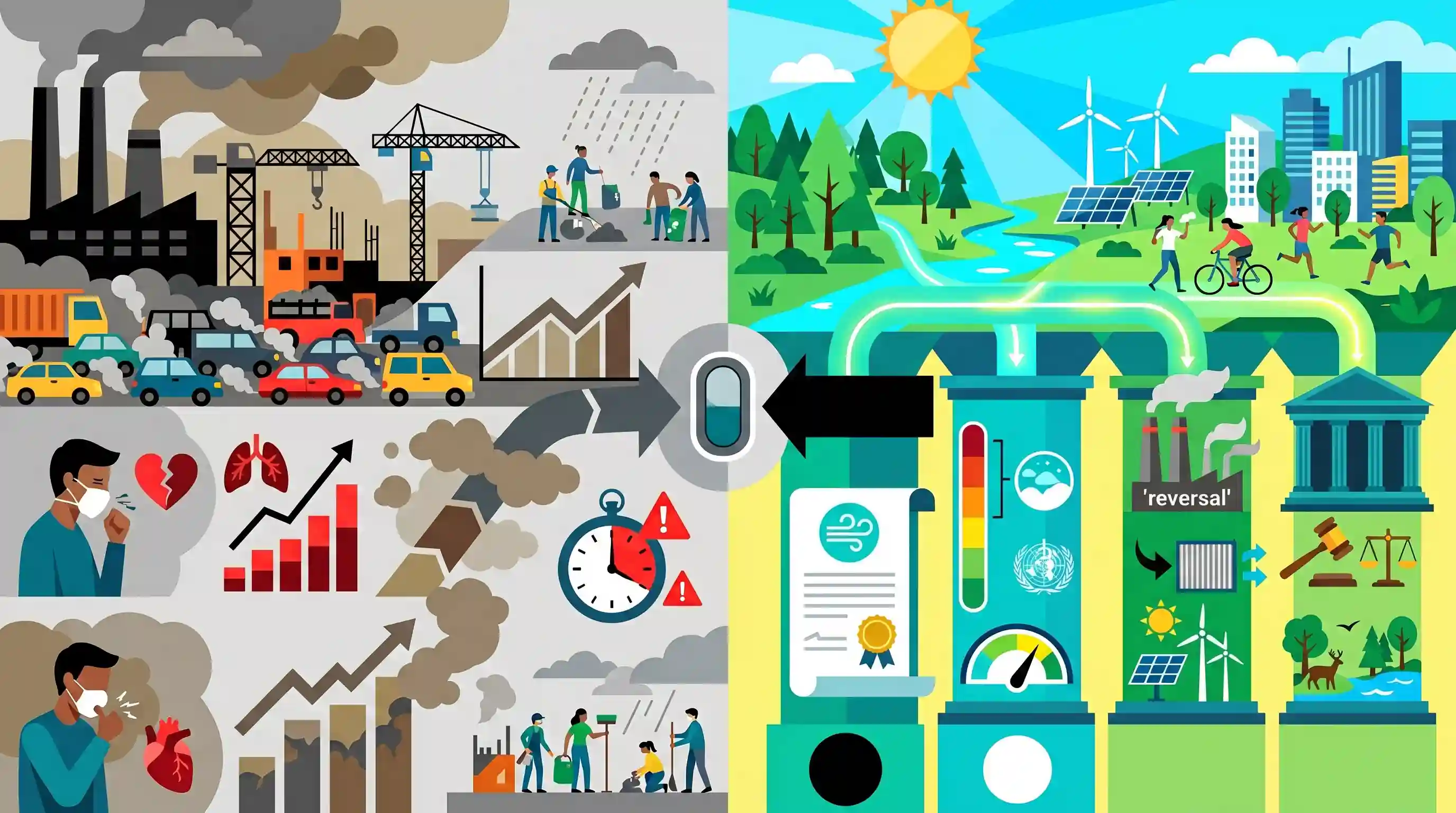
Congress General Secretary Jairam Ramesh criticized the government's approach to India's air pollution crisis, stating that the nation cannot 'pollute its way to prosperity.' Highlighting the reactive nature of the Graded Response Action Plan (GRAP) and citing studies linking air pollution to increased mortality (Lancet and NFHS-5 data), the Congress proposed comprehensive structural measures. These include enacting a new Clean Air Act, revising the National Ambient Air Quality Standards (NAAQS) to align with stricter WHO guidelines, reversing relaxed emission norms for power plants, and restoring the authority of the National Green Tribunal (NGT).
Key Points
- The Congress party criticized the government's handling of air pollution, emphasizing that India cannot prioritize economic prosperity over public health and environmental integrity.
- Current pollution control strategies, primarily the Graded Response Action Plan (GRAP), were criticized for being reactive and episodic rather than proactive and structural.
- Studies from the Lancet and IIPS (using NFHS-5 data) were cited, highlighting severe public health consequences, including increased adult and child mortality in non-attainment districts.
- Proposed interventions include revising the 2009 National Ambient Air Quality Standards (NAAQS) to align with stricter WHO guidelines and amending the Air (Prevention and Control of Pollution) Act, 1981.
- The party also called for restoring the authority of the National Green Tribunal (NGT) and rolling back relaxed emission norms for coal and thermal power plants.
Important Terms
Graded Response Action Plan (GRAP)

A stratified emergency response framework for Delhi-NCR that mandates specific anti-pollution measures across four stages based on the severity of the Air Quality Index (AQI).
UPSC context
GS III (Environment); relevant for urban pollution management, administrative interventions, and the role of the Commission for Air Quality Management (CAQM).
National Ambient Air Quality Standards (NAAQS)
Legal limits for 12 outdoor air pollutants—including PM2.5, SO2, and Lead—notified by the Central Pollution Control Board (CPCB) to safeguard public health and the environment.
UPSC context
GS III (Environment); tests knowledge of air quality benchmarks, CPCB's statutory powers, and the National Clean Air Programme (NCAP).
National Green Tribunal (NGT)
A specialized statutory tribunal established in 2010 to provide expeditious justice in cases involving environmental protection, forest conservation, and the enforcement of environmental legal rights.
UPSC context
GS II & III; critical for environmental governance, judicial activism, statutory bodies, and the "Polluter Pays" principle.
Air (Prevention and Control of Pollution) Act, 1981
The primary legislative framework in India enacted to prevent, control, and abate air pollution, granting the CPCB and SPCBs powers to set and enforce emission standards.
UPSC context
GS III (Environment); fundamental for environmental law, regulatory authorities, and the history of pollution control legislation in India.
WHO Air Quality Guidelines (AQG)
International health-based benchmarks updated in 2021 that recommend significantly stricter pollutant concentration limits than Indian standards to minimize global premature mortality.
UPSC context
GS III (Environment); used for comparative policy analysis and evaluating the health impact of domestic vs. global air quality standards.
National Family Health Survey (NFHS)
A comprehensive nationwide survey coordinated by the IIPS that provides reliable data on health, fertility, and mortality, including evidence on environmental risks like household air pollution.
UPSC context
GS I & II (Social Issues/Health); provides critical evidence for policy formulation, socio-economic analysis, and measuring the burden of disease.
Prelims Trap
"GRAP is a proactive, nationwide strategy implemented across all non-attainment cities."
GRAP is merely an episodic, emergency response framework strictly limited to the Delhi-NCR region and managed by the CAQM, not a nationwide strategy.
Static Concepts Connected
Who notifies NAAQS and what are its key inclusions and exclusions?
- Statutory Authority: Notified by the Central Pollution Control Board (CPCB) under the powers derived from the Air (Prevention and Control of Pollution) Act, 1981.
- Pollutants Covered: Covers 12 pollutants: PM10, PM2.5, SO2, NO2, CO, NH3, Ozone, Lead, Benzene, Benzo(a)pyrene, Arsenic, and Nickel.
- Crucial Exclusions: CO2 (Carbon Dioxide) and CH4 (Methane) are greenhouse gases and are NOT criteria pollutants measured under NAAQS.
Which environmental laws fall under the civil jurisdiction of the NGT?
- Legislative Scope: Enforces civil rights under 7 laws, including the Water Act, Air Act, Environment Protection Act, Forest Conservation Act, and Biological Diversity Act.
- Notable Exclusions: The Wildlife (Protection) Act, 1972 and the Forest Rights Act, 2006 fall completely outside the NGT's jurisdiction.
- Procedural Mandate: The tribunal is not bound by the Code of Civil Procedure, 1908, but strictly operates on the principles of natural justice.
Cross-Topic Patterns
Pollution as a human capital drag
High mortality in non-attainment cities directly undermines India's demographic dividend, linking environmental degradation (GS3) with social justice and public health outcomes (GS2).
Energy security vs. emission norms
Repeated extensions for Flue Gas Desulphurisation (FGD) installation highlight the policy friction between securing uninterrupted baseload thermal power and adhering to strict environmental compliance.

Expect a 2026 prelims question contrasting the jurisdiction of CAQM, CPCB, and NGT, alongside WHO vs NAAQS PM2.5 threshold differences.
Linked PYQs · 2
Linked PYQs · 2
- 2021MainsGS3
Describe the key points of the revised Global Air Quality Guidelines (AQGs) recently released by the World Health Organisation (WHO). How are these different from its last update in 2005? What changes in India's National Clean Air Programme are required to achieve these revised standards?
- 2022PrelimsGS1
In the context of WHO Air Quality Guidelines, consider the following statements: 1. The 24-hour mean of PM2.5 should not exceed 15 µg/m³ and annual mean of PM2.5 should not exceed 5 µg/m³. 2. In a year, the highest levels of ozone pollution occur during the periods of inclement weather. 3. PM10 can penetrate the lung barrier and enter the bloodstream. 4. Excessive ozone in the air can trigger asthma. Which of the statements given above are correct?
