Preventable Non-Communicable Diseases and Public Health Strategy
Source:Indian Express ↗
Why It Matters
Understanding the preventability of NCDs like cancer is critical for GS-2 (Issues relating to Health) and GS-3 (Science & Tech applications). As India's life expectancy grows, shifting health policies from curative to preventive measures is essential to manage the epidemiological transition and safeguard human capital.
Summary
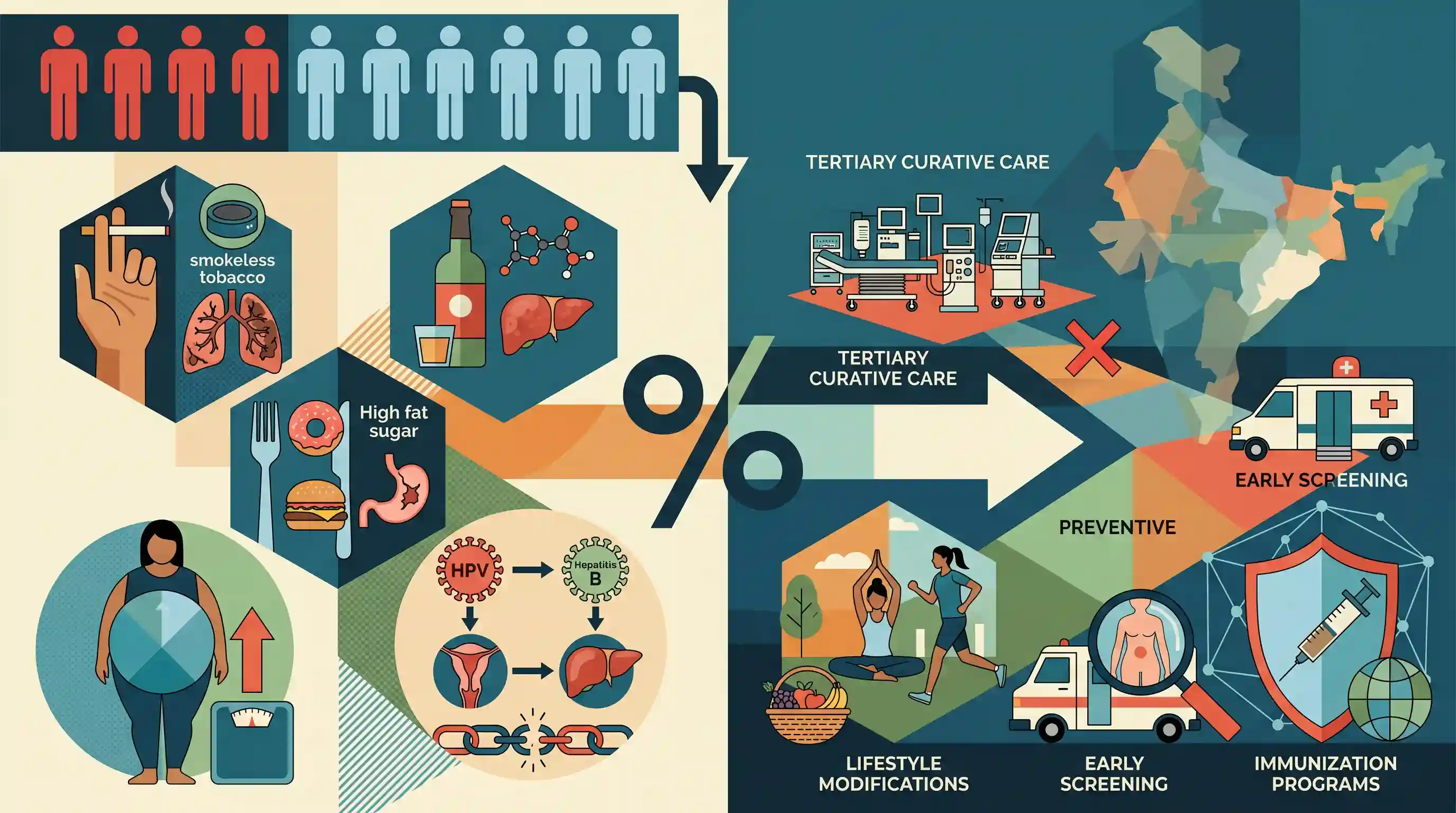
A new study highlights that four out of ten cancer cases in India are preventable, emphasizing the massive impact of modifiable risk factors on the nation's health burden. The leading causes of these preventable cancers include tobacco and alcohol consumption, unhealthy dietary habits, obesity, and oncogenic infections like HPV and Hepatitis. The data signals a critical need for India to strengthen its preventive public health infrastructure, emphasizing lifestyle modifications, early screening protocols, and immunization programs rather than relying solely on tertiary curative care.
Key Points
- A recent study reveals that approximately 40% of cancer cases among Indian men and women are entirely preventable.
- The high cancer burden is largely driven by modifiable lifestyle risk factors, including tobacco use, alcohol consumption, poor diet, and obesity.
- Preventable viral infections, such as Human Papillomavirus (HPV) and Hepatitis B/C, also contribute significantly to cervical and liver cancers respectively.
- The findings underscore the urgent need to pivot India's health policy focus towards preventive healthcare, community-level awareness, mass screening, and comprehensive vaccination drives (e.g., HPV and Hepatitis B vaccines).
- Tackling these modifiable risks is essential to reduce the economic and infrastructural strain on the public healthcare system caused by the rising non-communicable disease (NCD) burden.
Important Terms
National Programme for Prevention & Control of Non-Communicable Diseases (NP-NCD)

India’s flagship health initiative under the National Health Mission for screening and managing chronic illnesses. It focuses on health promotion, early diagnosis, and strengthening infrastructure for cancers and other lifestyle diseases.
UPSC context
GS Paper II (Health Policy); essential for questions on healthcare schemes and the burden of lifestyle diseases.
Non-Communicable Diseases (NCDs)
Chronic medical conditions that are not transmitted person-to-person. Often linked to lifestyle, they include cancer, diabetes, and cardiovascular diseases, accounting for roughly 66% of all deaths in India.
UPSC context
GS Paper II (Social Justice - Health); crucial for understanding India's demographic and epidemiological transition.
Indian Council of Medical Research (ICMR)
The apex body in India for formulating and promoting biomedical research. It manages the National Cancer Registry Programme (NCRP) and provides evidence-based data for national health policies.
UPSC context
GS Paper II (Statutory/Institutional Framework) and GS Paper III (Science & Technology); frequently tested for its role in public health emergencies.
World Health Organization (WHO)
The specialized UN agency responsible for international public health. It sets global standards for cancer prevention and monitors progress toward Sustainable Development Goal 3.4 (reducing NCD mortality).
UPSC context
GS Paper II (International Relations); relevant for global governance and health security.
National Cancer Registry Programme (NCRP)
A systematic surveillance initiative by ICMR since 1982 that collects data on cancer incidence and mortality. It provides the statistical foundation for India’s cancer control strategies.
UPSC context
GS Paper III (Health Infrastructure); vital for data-driven policy-making and understanding disease distribution.
Oncogenic Infections
Infections caused by viruses or bacteria, such as HPV (cervical cancer) and Hepatitis (liver cancer), that can trigger malignant cell growth. These are considered highly preventable through vaccination.
UPSC context
GS Paper III (Science & Technology - Health); important for understanding preventive biotechnology and immunization programs.
Prelims Trap
"NP-NCD mandates population-based screening for all major cancers including lung and liver."
False. The NP-NCD program mandates population-based screening for only three specific common cancers: oral, breast, and cervical (not lung or liver).
Static Concepts Connected
How do Virus-Like Particle (VLP) vaccines work?
- Mechanism: They mimic the outer protein shell of viruses to trigger a strong immune response but entirely lack viral genetic material (DNA/RNA).
- Safety profile: Because they cannot replicate or cause infections, they are highly safe and cannot trigger the disease they are designed to protect against.
- Notable Examples: India's indigenous HPV vaccine (Cervavac) and the widely used Hepatitis B vaccine utilize VLP technology.
What are the core mandates of the NP-NCD program?
- Target Diseases: Focuses on integrating interventions for Cardiovascular Diseases, Cancer, Chronic Respiratory Diseases, and Diabetes at the primary health level.
- Mass Screening: Mandates population-based screening for citizens above 30 years for hypertension, diabetes, and three cancers: oral, breast, and cervical.
- Infrastructure: Focuses on establishing dedicated NCD clinics at District Hospitals and Community Health Centres (CHCs) to decentralize care.
Cross-Topic Patterns
NCDs and Out-of-Pocket Expenditure
The shift from communicable to non-communicable diseases (NCDs) strains public infrastructure, making preventive screening critical to reducing India's catastrophic out-of-pocket health expenditures (OOPE).
Cervical Cancer & Female Workforce
Cervical cancer disproportionately affects women in their prime working years. The push for universal Cervavac vaccination intersects directly with protecting India's female workforce participation and demographic dividend.

A combined prelims question linking Cervavac's VLP technology, Hepatitis B transmission, and NP-NCD screening protocols is highly probable.
Linked PYQs · 5
Linked PYQs · 5
- 2024MainsGS2
In a crucial domain like the public healthcare system the Indian State should play a vital role to contain the adverse impact of marketisation of the system. Suggest some measures through which the State can enhance the reach of public healthcare at the grassroots level.
- 2020MainsGS2
In order to enhance the prospects of social development, sound and adequate health care policies are needed particularly in the fields of geriatric and maternal health care. Discuss.
- 2018MainsGS2
Appropriate local community-level healthcare intervention is a prerequisite to achieve 'Health for All' in India. Explain.
- 2022MainsGS3
The increase in life expectancy in the country has led to newer health challenges in the community. What are those challenges and what steps need to be taken to meet them?
- 2010PrelimsGS1
Consider the following statements: 1. Hepatitis B is several times more infectious than HIV/AIDS 2. Hepatitis B can cause liver cancer Which of the statements given above is/are correct?
