Civil nuclear cooperation and Canada uranium supply to India
Source:The Hindu ↗
Why It Matters
Civil nuclear cooperation is a core theme in UPSC, linking India's strategic foreign policy (managing its non-NPT status, securing NSG waivers) with its domestic energy security imperatives (three-stage nuclear programme and uranium imports).
Summary
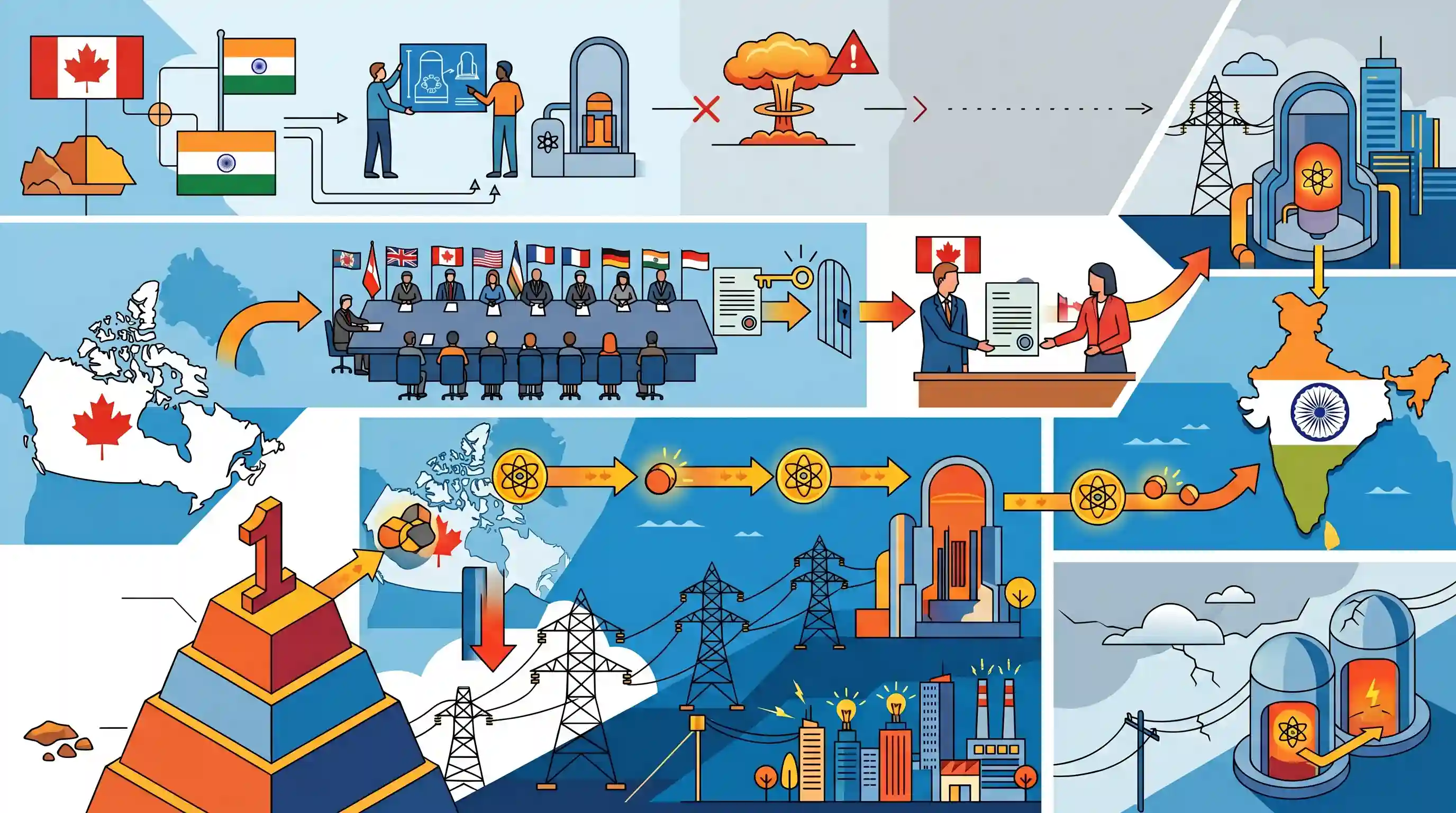
The article details the trajectory of India-Canada civil nuclear cooperation and its significance for India's nuclear energy ambitions. Historically, Canada assisted India's early nuclear programme but suspended cooperation after India's 1974 nuclear tests. Following the 2008 NSG waiver, relations normalized, culminating in a 2015 agreement for Canada to supply uranium to India. This uranium is vital for fueling India's Pressurised Heavy Water Reactors (PHWRs) under the first stage of its three-stage nuclear programme, helping secure India's energy needs despite its limited domestic uranium reserves and current diplomatic friction with Canada.
Key Points
- Canada was an early partner in India's nuclear journey, supplying the CIRUS research reactor, but severed ties following India's 1974 Pokhran nuclear tests.
- The 2008 Nuclear Suppliers Group (NSG) waiver, facilitated by the Indo-US nuclear deal, ended India's nuclear isolation and allowed it to resume global civil nuclear trade despite not being an NPT signatory.
- In 2015, India and Canada signed a landmark deal where Canadian firm Cameco agreed to supply 3,000 metric tonnes of uranium to power India's reactors.
- Imported uranium is critical to fuel India's Pressurised Heavy Water Reactors (PHWRs) in the first phase of its three-stage nuclear programme, bridging the gap caused by limited domestic reserves.
- The agreement highlights the intersection of energy security and geopolitics, especially relevant given the recent diplomatic tensions between India and Canada.
Important Terms
Three-Stage Nuclear Power Programme

Formulated by Homi Bhabha in 1954, this indigenous strategy aims for energy independence by utilizing India's thorium reserves through three stages: PHWRs (Uranium), Fast Breeder Reactors (Plutonium), and Thorium-based reactors.
UPSC context
GS Paper 3 (Science & Tech/Energy). Tests understanding of India's nuclear roadmap and indigenous self-reliance goals.
Nuclear Suppliers Group (NSG)
A 48-member multilateral export control regime that prevents nuclear proliferation by controlling exports of nuclear materials and technology. Formed in 1974, it granted India a landmark trade waiver in 2008.
UPSC context
GS Paper 2 (International Relations). Crucial for questions on India's global diplomatic status and nuclear commerce.
Treaty on the Non-Proliferation of Nuclear Weapons (NPT)
A 1968 global treaty aimed at preventing the spread of nuclear weapons. India is a non-signatory, criticizing its distinction between 'nuclear haves' and 'have-nots' as discriminatory.
UPSC context
GS Paper 2 (International Groupings). Tests knowledge of global non-proliferation regimes and India's principled foreign policy.
Indo-US Civil Nuclear Agreement (123 Agreement)
A 2008 watershed deal ending India’s nuclear isolation. India separated civil and military facilities under IAEA safeguards in exchange for full civil nuclear cooperation and an NSG trade waiver.
UPSC context
GS Paper 2 (Bilateral Relations). A foundation for India's modern strategic partnerships and energy security.
International Atomic Energy Agency (IAEA)
The UN-affiliated 'Atoms for Peace' organization (est. 1957) that promotes peaceful nuclear technology. It inspects and verifies that civilian nuclear facilities are not diverted for military use.
UPSC context
GS Paper 2 (International Organizations). Relevant for questions on global safety watchdogs and nuclear safeguards.
India-Canada Civil Nuclear Cooperation Agreement
A bilateral framework signed in 2010 allowing Canada to export uranium and nuclear technology to India. It restored ties severed after India's 1974 nuclear tests.
UPSC context
GS Paper 2 (Bilateral Relations). Highlights energy diplomacy and the role of imported uranium in India’s energy security.
Department of Atomic Energy (DAE)
Established in 1954 under the Prime Minister's direct charge, it is the nodal agency for nuclear technology development, power generation, and atomic research in India.
UPSC context
GS Paper 3 (Science & Tech). Important for understanding the institutional governance of India's atomic sector.
Prelims Trap
"India signed the Non-Proliferation Treaty (NPT) to secure the NSG waiver and place all its reactors under IAEA safeguards."
India received the 2008 NSG waiver without signing the NPT. It agreed only to separate its civilian and military facilities, placing civilian ones under IAEA safeguards.
Static Concepts Connected
What fuels are used in the three stages of India's nuclear programme?
- Stage 1 (PHWRs): Uses natural Uranium as fuel and heavy water as moderator/coolant. Yields Plutonium-239 as a byproduct.
- Stage 2 (FBRs): Uses Plutonium-239 and mixed oxide. Crucially, it converts India's abundant Thorium-232 into fissile Uranium-233.
- Stage 3 (AHWRs): Will use Uranium-233 and Thorium-232 to sustain the cycle, achieving true energy independence.
What are the core conditions of India's 2008 NSG waiver?
- Non-NPT Status: India is the only country granted a waiver to trade in civil nuclear technology without being a signatory to the NPT.
- Separation Plan: India was required to officially separate its civilian nuclear facilities from its strategic/military ones.
- IAEA Safeguards: Only the separated civilian nuclear facilities (and imported nuclear material) are subject to International Atomic Energy Agency inspections.
Cross-Topic Patterns
Diplomatic decoupling vs. Energy Security
Despite severe diplomatic friction over the Khalistan issue, energy treaties like the 2015 uranium pact remain ring-fenced. This highlights how strategic resource imports often endure acute bilateral political shocks.
Geography's dictate on Nuclear Diplomacy
India's domestic uranium (e.g., Jaduguda, Tummalapalle) is exceptionally low-grade. This geological limitation forces India to preserve domestic stocks for strategic use while relying heavily on foreign uranium for civilian power.

Expect a multi-statement Prelims question mixing Stage-1/Stage-2 fuel requirements with the scope of IAEA safeguards on imported reactors.
Linked PYQs · 3
Linked PYQs · 3
- 2011MainsGS2
Subsequent to the Nuclear Suppliers' Group (NSG) waiver in 2008, what are the agreements on nuclear energy that India has signed with different countries?
- 2017MainsGS3
Give an account of the growth and development of nuclear science and technology in India. What is the advantage of fast breeder reactor programme in India?
- 2012PrelimsGS1
To meet its rapidly growing energy demand, some opine that India should pursue research and development on thorium as the future fuel of nuclear energy. In this context, what advantage does thorium hold over uranium? 1. Thorium is far more abundant in nature than uranium. 2. On the basis of per unit mass of mined mineral, thorium can generate more energy compared to natural uranium. 3. Thorium produces less harmful waste compared to uranium. Which of the statements given above is/are correct?
