India Canada strategic reset and uranium supply agreement
Source:Indian Express ↗
Why It Matters
This development is highly relevant for GS-2 (Bilateral Relations) and GS-3 (Energy Security & Resources). It illustrates the resilience of strategic partnerships and the importance of foreign diplomacy in securing critical resources (uranium and critical minerals) required for national energy security and the transition to a green economy.
Summary
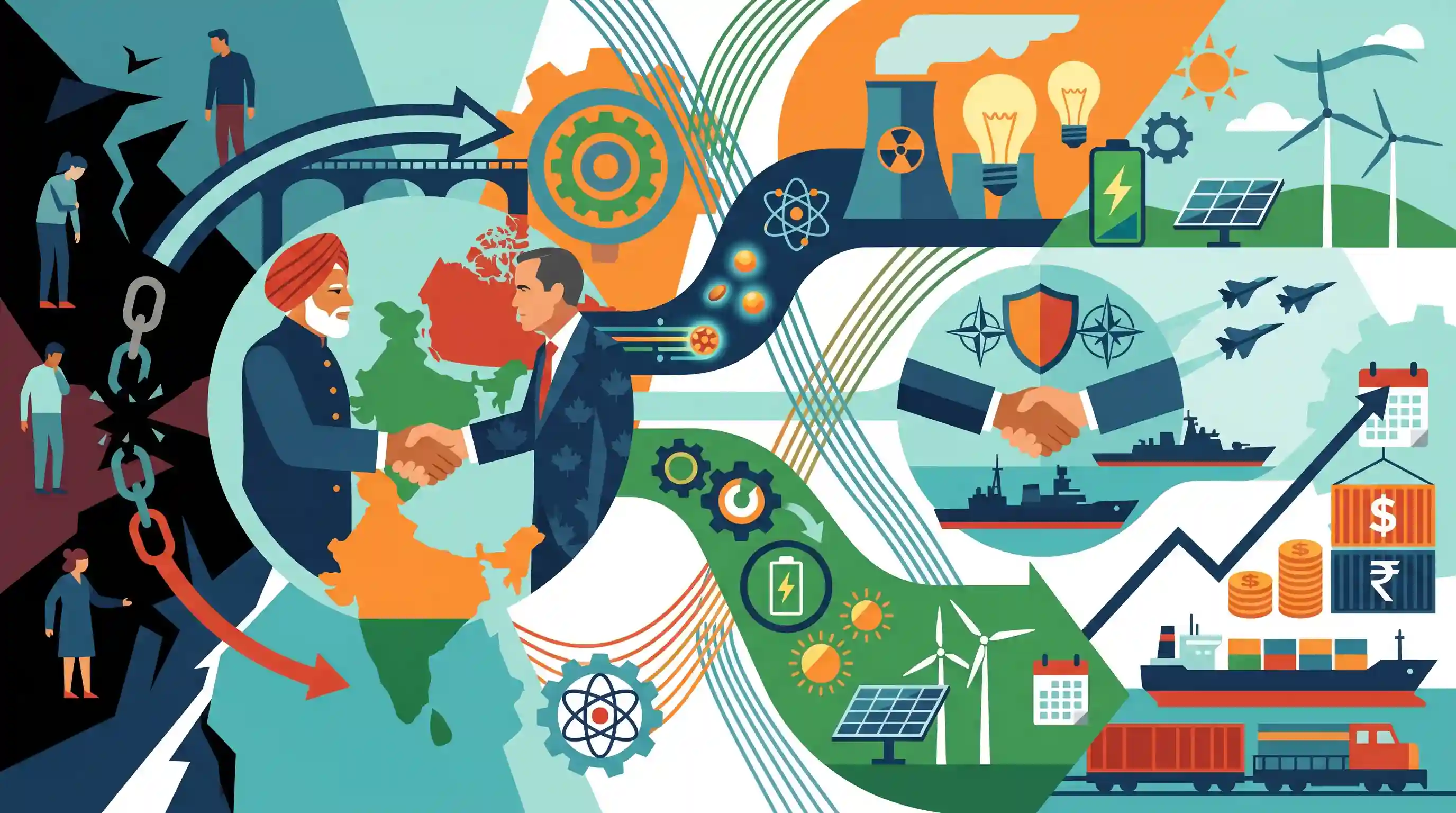
India and Canada have embarked on a major diplomatic and economic reset under the leadership of Prime Ministers Narendra Modi and Mark Carney. Moving past recent diplomatic strains, the two countries signed pivotal agreements including a uranium supply deal and a critical minerals pact, which are essential for India's nuclear power generation and green technology transition. Furthermore, the establishment of a Defence Dialogue and a commitment to reach $50 billion in bilateral trade by 2030 underscore a renewed focus on geoeconomic convergence and shared strategic interests.
Key Points
- India and Canada are officially resetting bilateral ties, moving past recent diplomatic tensions to focus on pragmatic geopolitical and economic cooperation.
- The leaders signed crucial agreements on uranium supply and critical minerals, directly supporting India's nuclear energy capacity and clean energy transition.
- A new Defence Dialogue was initiated, signalling an upgrade in strategic and security cooperation, likely with an eye on Indo-Pacific stability.
- The two nations set an ambitious target to achieve $50 billion in bilateral trade by 2030, seeking to leverage complementary economic strengths and diaspora networks.
Important Terms
Uranium Deal

A 10-year, $2.6 billion agreement with Canadian firm Cameco for 22 million pounds of uranium (2027–2035), supporting India’s goal of 100GW nuclear capacity by 2047.
UPSC context
GS Paper II (International Relations) and GS Paper III (Energy Security); critical for India’s civil nuclear energy expansion.
Critical Minerals Pact
A strategic memorandum of understanding aimed at securing supply chains for lithium, cobalt, and rare earths essential for India’s green energy transition and electric vehicle manufacturing.
UPSC context
GS Paper II (IR) and GS Paper III (Economy/Environment); concerns supply chain resilience and the clean energy transition.
India-Canada Defence Dialogue
A newly established formal mechanism for bilateral cooperation on maritime security, military-to-military exchanges, and defense industrial partnerships in the Indo-Pacific region.
UPSC context
GS Paper II (International Relations); focuses on maritime domain awareness and strategic convergence in the Indo-Pacific.
Comprehensive Economic Partnership Agreement (CEPA)
An ambitious bilateral trade agreement intended to reduce tariffs and boost investment, aiming to lift annual trade to $50 billion by 2030.
UPSC context
GS Paper III (Indian Economy) and GS Paper II (IR); represents a formal framework for deepening geoeconomic ties.
Strategic Reset
The diplomatic pivot initiated by PMs Modi and Carney in 2026 to move past the 2023–24 tensions and institutionalize ties through energy and security cooperation.
UPSC context
GS Paper II (IR); tests understanding of pragmatism in foreign policy and managing bilateral friction for national interest.
Prelims Trap
India has a Comprehensive Economic Partnership Agreement (CEPA) currently in effect with Canada.
India and Canada are currently negotiating an Early Progress Trade Agreement (EPTA) and CEPA. The $50 billion trade target is a future aspiration, not the result of an active FTA.
Static Concepts Connected
Why does India import Uranium despite having domestic reserves?
- Low Grade Ore: India's domestic reserves (e.g., Jaduguda, Tummalapalle) are generally of lower grade compared to global averages, making extraction economically intensive and insufficient for rising demand.
- 2008 NSG Waiver: The waiver enabled India to place civil reactors under IAEA safeguards, allowing legal uranium imports from countries like Canada, Kazakhstan, and Australia to fuel energy expansion.
What constitutes 'Critical Minerals' for India's strategic policy?
- Official Criteria: Minerals essential for economic development and national security, lacking viable substitutes, and prone to severe supply chain disruptions or geographic concentration.
- Green Transition: They form the bedrock of the clean energy transition, highly demanded for EV batteries (Lithium, Cobalt) and wind turbines (Rare Earth Elements).
Cross-Topic Patterns
Mineral Security in the Indo-Pacific
Canada’s critical minerals pact with India mirrors the Quad's broader geopolitical push to de-risk high-tech supply chains and secure rare earths away from Chinese dominance in the Indo-Pacific.
Diaspora: Trade Bridge vs. Security Flashpoint
While the 4-5% Indian diaspora drives the $50bn trade target, historical ethno-nationalist politics make this demographic both a soft-power bridge and a recurrent security flashpoint in bilateral ties.

Expect a 2026 Prelims question mixing India's uranium import sources (Canada, Australia, Kazakhstan) and critical mineral supply chains.
Linked PYQs · 5
Linked PYQs · 5
- 2020MainsGS2
Indian diaspora has a decisive role to play in the politics and economy of America and European Countries'. Comment with examples.
- 2023MainsGS2
Indian diaspora has scaled new heights in the West. Describe its economic and political benefits for India.
- 2023PrelimsGS1
Consider the following statements: Statement-I: India, despite having uranium deposits, depends on coal for most of its electricity production. Statement-II: Uranium, enriched to the extent of at least 60%, is required for the production of electricity. Which one of the following is correct in respect of the above statements?
- 2009PrelimsGS1
Which among the following has the world's largest reserves of Uranium?
- 2020PrelimsGS1
In India, why are some nuclear reactors kept under "IAEA Safeguards" while others are not?
