India and Canada Advance Negotiations on Comprehensive Trade Pact
Source:The Hindu ↗
Why It Matters
This article highlights India's active economic diplomacy and efforts to negotiate Comprehensive Economic Partnership Agreements (CEPAs) with developed Western nations. It is crucial for understanding the dynamics of India's bilateral trade targets, diversifying export baskets, securing supply chains (like pulses and fertilizers), and navigating geopolitical relationships through economic instruments.
Summary
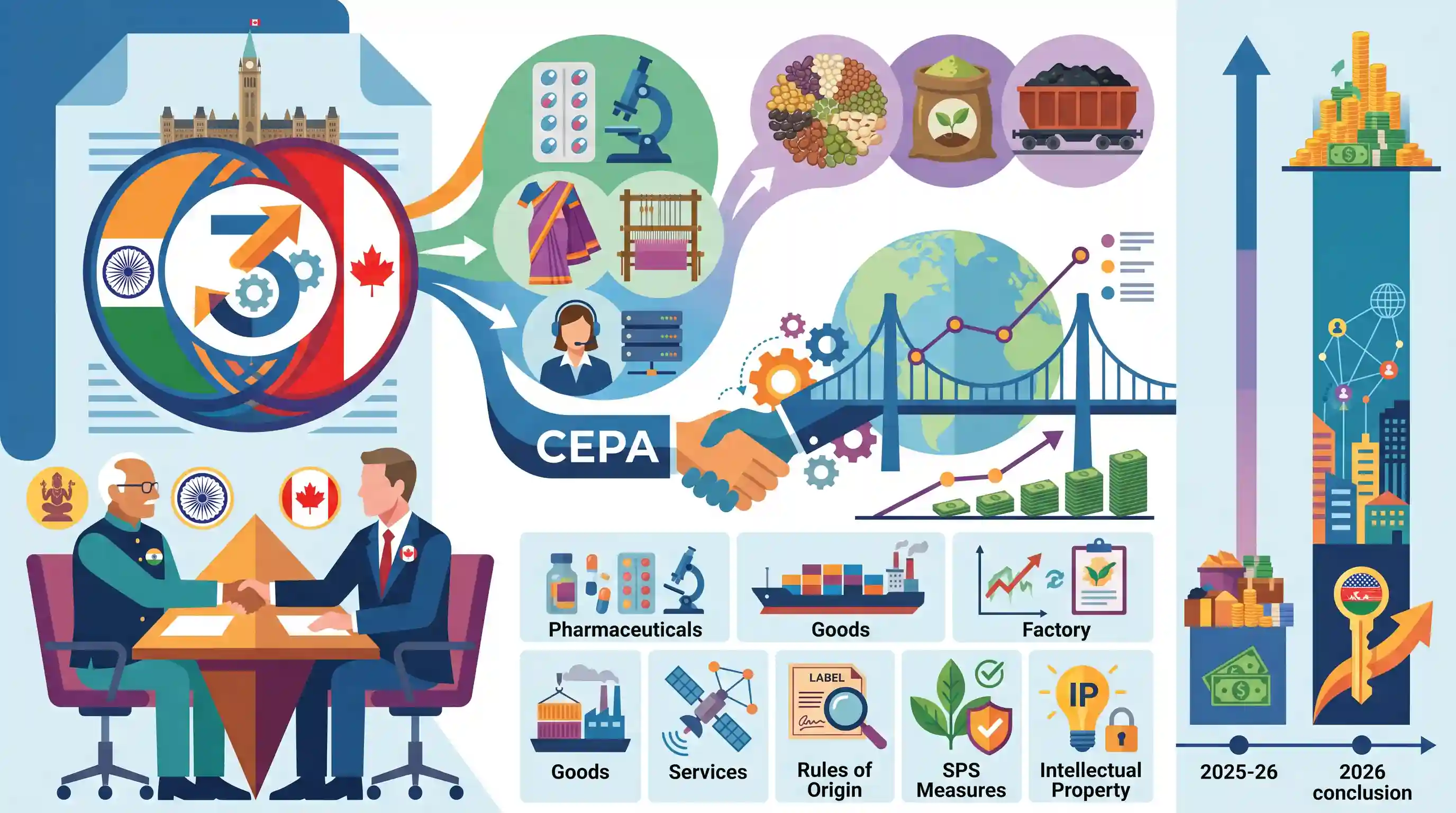
India and Canada concluded the third round of talks for a proposed Comprehensive Economic Partnership Agreement (CEPA) in Ottawa. Led by India's Joint Secretary Brij Mohan Mishra and Canada's Bruce Christie, the negotiations covered crucial sectors such as goods, services, rules of origin, SPS measures, and intellectual property. The nations aim to wrap up negotiations by 2026 and elevate bilateral trade to $50 billion by 2030, up from the current $7.95 billion in 2025-26. Key trade items involve pharmaceuticals, textiles, and services from India, and pulses, fertilizers, and coal from Canada.
Key Points
- India and Canada concluded the third round of negotiations for the proposed Comprehensive Economic Partnership Agreement (CEPA) in Ottawa, aiming to finalize the pact by 2026.
- The two nations have set an ambitious bilateral trade target of $50 billion by 2030. This requires a massive jump from the 2025-26 bilateral trade figure of $7.95 billion (which declined 8.22% from $8.66 billion in 2024-25).
- The CEPA negotiations involve comprehensive tracks including trade in goods, services, intellectual property (IP), rules of origin (RoO), sanitary and phytosanitary (SPS) measures, and technical barriers to trade (TBT).
- India's chief exports to Canada include pharmaceuticals, iron and steel, seafood, cotton garments, electronic goods, and chemicals. Key imports from Canada include pulses, pearls, semi-precious stones, coal, fertilizer, paper, and petroleum crude.
- The talks also focus on India's services sector exports, such as telecommunications, computer, and information services. Additionally, Canada hosts a strong Indian diaspora, including over 4,25,000 Indian students.
Important Terms
Comprehensive Economic Partnership Agreement (CEPA)

A comprehensive trade agreement between countries covering trade in goods, services, investment, intellectual property, and regulatory cooperation, offering deeper economic integration than traditional Free Trade Agreements.
UPSC context
GS Paper II (Bilateral Agreements) & GS Paper III. Crucial for understanding India's trade negotiations and export-led growth strategy.
Rules of Origin
Laws, regulations, and administrative determinations used to identify the "economic nationality" of imported goods, deciding if they qualify for preferential tariff treatments under trade agreements.
UPSC context
GS Paper III (Indian Economy). Key for understanding customs compliance (CAROTAR, 2020), trade diversion, and protection of domestic industries.
Sanitary and Phytosanitary (SPS) Measures
Biosecurity regulations and standards applied to protect human, animal, and plant life or health from risks like pests, diseases, toxins, or food-borne contaminants, governed by WTO rules.
UPSC context
GS Paper III (Agriculture) & GS Paper II (WTO). Essential for studying non-tariff barriers, global trade compliance, and agricultural exports.
Department of Commerce, India
A division of India's Ministry of Commerce and Industry responsible for formulating foreign trade policies, promoting exports, and negotiating bilateral and multilateral trade pacts.
UPSC context
GS Paper III (Indian Economy) & GS Paper II. Important for studying trade governance, export schemes, and international trade negotiations.
Bilateral Trade Agreement
A formal treaty between two sovereign nations designed to facilitate trade and investment by reducing or eliminating barriers like tariffs, import quotas, and non-tariff hurdles.
UPSC context
GS Paper II (Bilateral Agreements). Tests knowledge of India's strategic economic diplomacy and international trade integration.
Prelims Trap
India has achieved near self-reliance in potassic fertilizers, importing only nitrogenous raw materials from North American partners.
India actually remains 100% import-dependent for Muriate of Potash (MOP), with Canada serving as its single largest supplier (~25%), making agricultural inputs highly strategic.
Static Concepts Connected
What is the structural hierarchy and difference between PTA, FTA, CECA, and CEPA?
- PTA vs FTA: PTA reduces tariffs on a positive list of goods; FTA reduces or eliminates tariffs on a larger negative list of goods.
- CECA vs CEPA: CECA primarily focuses on tariff negotiation on goods; CEPA is broader, extensively covering services, investment, IPR, and regulatory cooperation.
- EPTA/Early Harvest: An interim trade agreement focusing on early harvest areas of convergence while more complex regulatory tracks are being finalized.
What are WTO's SPS and TBT agreements and how do they impact trade?
- SPS Agreement: Covers food safety and animal/plant health standards to prevent diseases, ensuring domestic regulations are not disguised protectionist tools.
- TBT Agreement: Covers technical regulations, standards, and conformity assessment procedures to ensure they do not create unnecessary obstacles to trade.
Cross-Topic Patterns
Pulses diplomacy & food security
India's balancing act between pulse imports (from Canada) and protecting domestic farmers via duties highlights the policy tension between food inflation and rural livelihood security.
Civil Nuclear Energy & Uranium security
Securing long-term uranium supply contracts with Canada is essential for India’s target of 100 GW nuclear power by 2047, linking bilateral diplomacy directly to energy transition.

UPSC 2026 may test India's 100% import dependency on Potash alongside the structural hierarchy of trade pacts like EPTA, CECA, and CEPA.
Linked PYQs · 1
Linked PYQs · 1
- 2018PrelimsGS1
Consider the following countries: 1. Australia 2. Canada 3. China 4. India 5. Japan 6. USA Which of the above are among the 'free-trade partners' of ASEAN?
