India and Canada Agree to Reset Ties on Security Cooperation
Source:The Hindu ↗
Why It Matters
The India-Canada relationship highlights the complexities of diaspora politics, state sovereignty, and international diplomacy. Understanding this reset is crucial for analyzing India's foreign policy approach to managing strategic partnerships amidst allegations of extraterritorial interference, as well as international intelligence sharing on transnational crime and terrorism.
Summary
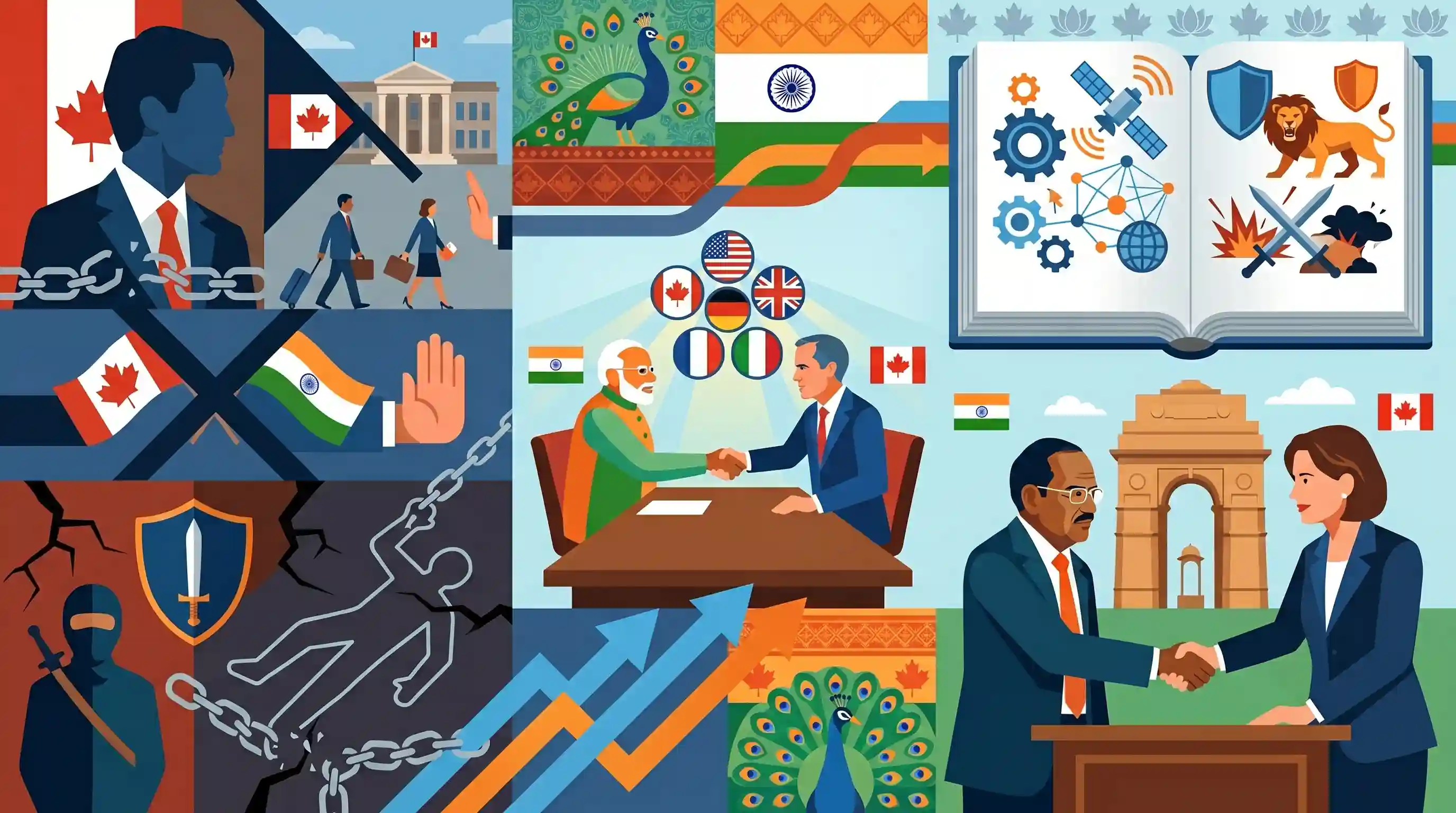
National Security Advisor Ajit Doval and his Canadian counterpart Nathalie Drouin held talks in New Delhi to reset India-Canada bilateral relations, agreeing to a "new chapter" focused on counter-terrorism and intelligence sharing. Ties had severely deteriorated following 2023 allegations by former Canadian PM Justin Trudeau regarding the killing of a Sikh separatist, which led to the mutual expulsion of diplomats. The relationship reset gained momentum following the election of Canadian PM Mark Carney, who met with PM Narendra Modi at the G-7 summit in June to pursue constructive steps toward stability and renewed security cooperation.
Key Points
- India and Canada's National Security Advisors (NSAs) met in New Delhi to rebuild trust and expand bilateral cooperation, signaling a formal reset in ties.
- The discussions prioritized security cooperation, focusing heavily on counter-terrorism, combating transnational organized crime, and intelligence exchanges.
- The diplomatic thaw follows a pivotal June meeting between PM Modi and newly elected Canadian PM Mark Carney at the G-7 summit in Kananaskis.
- Bilateral relations had previously hit rock bottom in 2023 due to allegations by former PM Justin Trudeau regarding the killing of Sikh separatist Hardeep Singh Nijjar, which led to mutual diplomatic expulsions.
Important Terms
National Security Advisor (NSA)

The chief advisor to the Prime Minister on national security and strategic affairs, heading the National Security Council (NSC) and coordinating intelligence across agencies.
UPSC context
GS Paper III (Internal Security) and Paper II (International Relations); tests knowledge of India's strategic decision-making architecture.
Ministry of External Affairs (MEA)
The central government ministry responsible for formulating and implementing India's foreign policy, managing diplomatic missions, and representing the nation in international organizations.
UPSC context
GS Paper II (International Relations); foundational for understanding India's engagement with the world and neighborhood.
Group of Seven (G-7)
An informal grouping of seven advanced economies—USA, UK, France, Germany, Italy, Japan, and Canada—that meets annually to discuss global security, economics, and climate.
UPSC context
GS Paper II (International Relations); focuses on international groupings and their impact on India's interests.
Indian Diaspora
The community of over 35 million people of Indian origin residing abroad, acting as a bridge for soft power, remittances, and political lobbying.
UPSC context
GS Paper II; specifically mentioned in the syllabus regarding the effect of foreign policies on India's interests.
Counter-terrorism
Measures including intelligence sharing, legal frameworks, and joint operations designed to prevent, combat, and eliminate terrorist activities and their support ecosystems.
UPSC context
GS Paper III (Internal Security); tests understanding of security challenges and international cooperation frameworks.
Liberal Party (Canada)
A major centrist political party in Canada; its domestic political priorities and engagement with the diaspora often shape Canada's bilateral stance toward India.
UPSC context
GS Paper II (Effect of policies and politics of developed countries); relevant for analyzing how foreign internal politics affects India.
Prelims Trap
Declaring a diplomat 'persona non grata' requires the host country to provide a formal justification.
Under Article 9 of the 1961 Vienna Convention, a host nation can declare a diplomat 'persona non grata' at any time and is explicitly NOT required to explain or justify its decision.
Static Concepts Connected
What are the rules for diplomatic expulsion under the Vienna Convention (1961)?
- Persona non grata: The host state can declare any diplomatic staff member unacceptable at any time without offering any explanation.
- Sending state obligations: Upon this declaration, the sending state must either recall the individual or formally terminate their diplomatic functions.
- Refusal consequences: If the sending state refuses or ignores the mandate, the host state can strip the diplomat's immunity.
What is the Five Eyes (FVEY) Intelligence Alliance?
- Post-WWII origins: Originated from the 1946 UKUSA Agreement, initially established to share signals intelligence (SIGINT) to counter the Soviet Union.
- Member nations: Comprises five Anglophone democracies bound by multilateral intelligence sharing: the US, UK, Canada, Australia, and New Zealand.
- Modern mandate: Jointly cooperates on espionage, counter-terrorism, and cyber-threat monitoring, which can complicate bilateral intelligence networks of non-member states.
Cross-Topic Patterns
Diaspora radicalization and internal security
The use of foreign soil to harbor separatist elements bridges GS-2 (Indian diaspora/IR) directly with GS-3 (Transnational organized crime and internal security linkages).
Political friction vs. institutional capital
Despite recent diplomatic downgrades, massive Canadian pension fund investments in Indian infrastructure continued seamlessly, highlighting how deep institutional capital often decouples from temporary geopolitical friction.

Prelims 2026 may test 'Five Eyes' vs 'Quad' intelligence mandates, alongside a Mains GS-2 question on diaspora radicalism affecting ties.
Linked PYQs · 3
Linked PYQs · 3
- 2020MainsGS2
Indian diaspora has a decisive role to play in the politics and economy of America and European Countries'. Comment with examples.
- 2022MainsGS3
Discuss the types of organised crimes. Describe the linkages between terrorists and organised crime that exist at the national and transnational levels.
- 2021MainsGS3
Analyse the complexity and intensity of terrorism, its causes, linkages and obnoxious nexus. Also suggest measures required to be taken to eradicate the menace of terrorism.
