India and Canada agree to resume free trade agreement negotiations
Source:The Hindu ↗
Why It Matters
The resumption of FTA/CEPA talks between India and Canada marks a significant development in bilateral relations, especially after recent diplomatic strains. For UPSC aspirants, this highlights the importance of economic diplomacy and strategic partnerships in securing critical minerals and advancing in emerging technologies (like AI) under frameworks such as the ACITI, bridging topics across GS2 (International Relations) and GS3 (Economy & Technology).
Summary
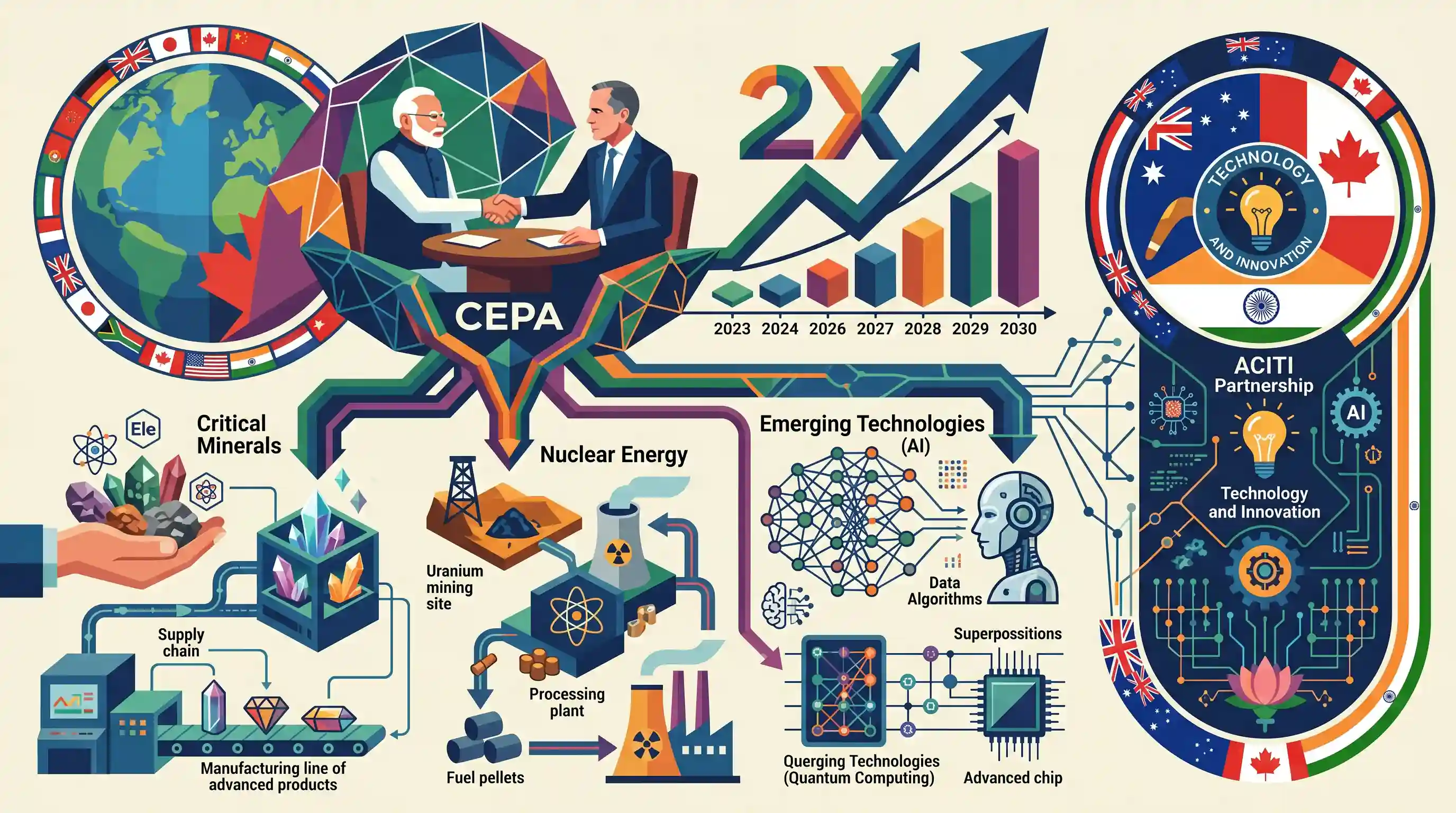
India and Canada have agreed to resume negotiations for a Comprehensive Economic Partnership Agreement (CEPA) following a meeting between Prime Ministers Narendra Modi and Mark Carney at the G-20 summit in Johannesburg. The leaders aim to double bilateral trade by 2030. Commerce and Industry Minister Piyush Goyal emphasised that the two nations are natural allies with tremendous potential for collaboration in critical minerals, nuclear energy (uranium supplies), and emerging technologies like AI and quantum computing. Additionally, the newly announced Australia-Canada-India Technology and Innovation (ACITI) partnership will be actively pursued to strengthen cooperation in these advanced sectors.
Key Points
- Prime Ministers Narendra Modi and Mark Carney agreed at the G-20 summit in Johannesburg to resume negotiations for a 'high-ambition' India-Canada Comprehensive Economic Partnership Agreement (CEPA).
- The two countries have set a target to double their bilateral trade by 2030, leveraging their complementary economic strengths.
- Union Minister Piyush Goyal highlighted significant potential for cooperation in critical minerals, nuclear energy (particularly uranium supplies), and supply chain diversification.
- Emerging technologies such as artificial intelligence (AI), data centres, quantum computing, and machine learning were identified as key focus areas for investment.
- The tri-nation Australia-Canada-India Technology and Innovation (ACITI) partnership will be taken forward to enhance cooperation in critical and emerging technologies.
Important Terms
Comprehensive Economic Partnership Agreement (CEPA)

An expansive bilateral trade agreement covering goods, services, investments, and regulatory cooperation. It offers deeper economic integration than a standard FTA by addressing a broader spectrum of partnership areas.
UPSC context
GS II & III; tests knowledge of trade architecture, economic diplomacy, and India’s efforts to deepen bilateral economic ties.
Free Trade Agreement (FTA)
A pact between nations to reduce or eliminate trade barriers like tariffs and quotas. It aims to increase the exchange of goods and services by providing preferential market access.
UPSC context
GS III; essential for understanding international trade dynamics, export-led growth, and India’s trade policy framework.
Australia-Canada-India Technology and Innovation (ACITI)
A trilateral partnership launched in 2025 focusing on critical minerals, green technology, and AI. It aims to build secure, democratic technology ecosystems and resilient supply chains between the three nations.
UPSC context
GS II; tests awareness of emerging trilateral groupings and India’s strategic collaboration in the technology domain.
Critical Minerals
Minerals like lithium, cobalt, and rare earths essential for modern electronics, green energy (EVs/batteries), and defense. They are strategic assets vital for economic and national security.
UPSC context
GS I & III; tests knowledge of resource distribution and supply chain resilience during the global energy transition.
G-20
A premier global forum comprising major economies, the EU, and the African Union. It addresses international financial stability, climate change mitigation, and sustainable development.
UPSC context
GS II; central to questions on multilateralism, global economic governance, and India's role in international leadership.
Prelims Trap
"ACITI is a major technological framework established under the Quad to counter China in the Indo-Pacific."
ACITI stands for Australia-Canada-India Technology and Innovation partnership. It is strictly a trilateral agreement and operates entirely independent of the Quad framework.
Static Concepts Connected
What distinguishes a CEPA from a traditional Free Trade Agreement (FTA)?
- Broader Scope: A CEPA comprehensively covers trade in goods, services, investments, and broad economic partnership, whereas traditional FTAs primarily focus on tariff reduction for physical goods.
- Regulatory Depth: CEPAs typically include extensive regulatory integration, such as mutual recognition agreements (MRAs), intellectual property rights frameworks, and deeper customs cooperation.
Where does India import its Uranium from to fuel its civil nuclear programme?
- Key Suppliers: India primarily sources its imported uranium from Kazakhstan, Canada, and Russia, facilitated by bilateral civil nuclear cooperation agreements.
- IAEA Safeguards: Because India is not a member of the NSG, all imported uranium is strictly restricted to civilian reactors placed under IAEA safeguards.
Cross-Topic Patterns
Critical Minerals + Trade Diversification
FTAs are increasingly functioning as strategic tools to secure critical mineral supply chains, pivoting away from Chinese import dependence towards resource-rich allies like Canada.
Nuclear Targets + Geopolitics
India's ambitious goal of 100 GW nuclear capacity by 2047 directly drives its diplomatic resets, leveraging long-term uranium agreements to bypass domestic supply constraints.

Expect a 2026 prelims pairing question matching new tech/supply chain partnerships (ACITI, iCET, MSP) with their specific member nations.
Linked PYQs · 5
Linked PYQs · 5
- 2016PrelimsGS1
The term 'Regional Comprehensive Economic Partnership' often appears in the news in the context of the affairs of a group of countries known as
- 2018PrelimsGS1
Consider the following countries: 1. Australia 2. Canada 3. China 4. India 5. Japan 6. USA Which of the above are among the 'free-trade partners' of ASEAN?
- 2011MainsGS2
Compared to the South Asian Free Trade Area (SAFTA), the Bay of Bengal Initiative for Multisectoral Technical and Economic Cooperation Free Trade Area (BIMSTEC FTA) seems to be more promising." Critically evaluate.
- 2025MainsGS2
India-Africa digital partnership is achieving mutual respect, co-development and long-term institutional partnerships. Elaborate.
- 2021MainsGS3
Discuss how emerging technologies and globalisation contribute to money laundering. Elaborate measures to tackle the problem of money laundering both at national and international levels.
