Leveraging Demographic Dividend Through Skilled Legal Migration
Source:Indian Express ↗
Why It Matters
It connects domestic demographic challenges with global geopolitical and economic opportunities, highlighting the role of international mobility agreements in addressing unemployment and maximizing the impact of the Indian diaspora.
Summary
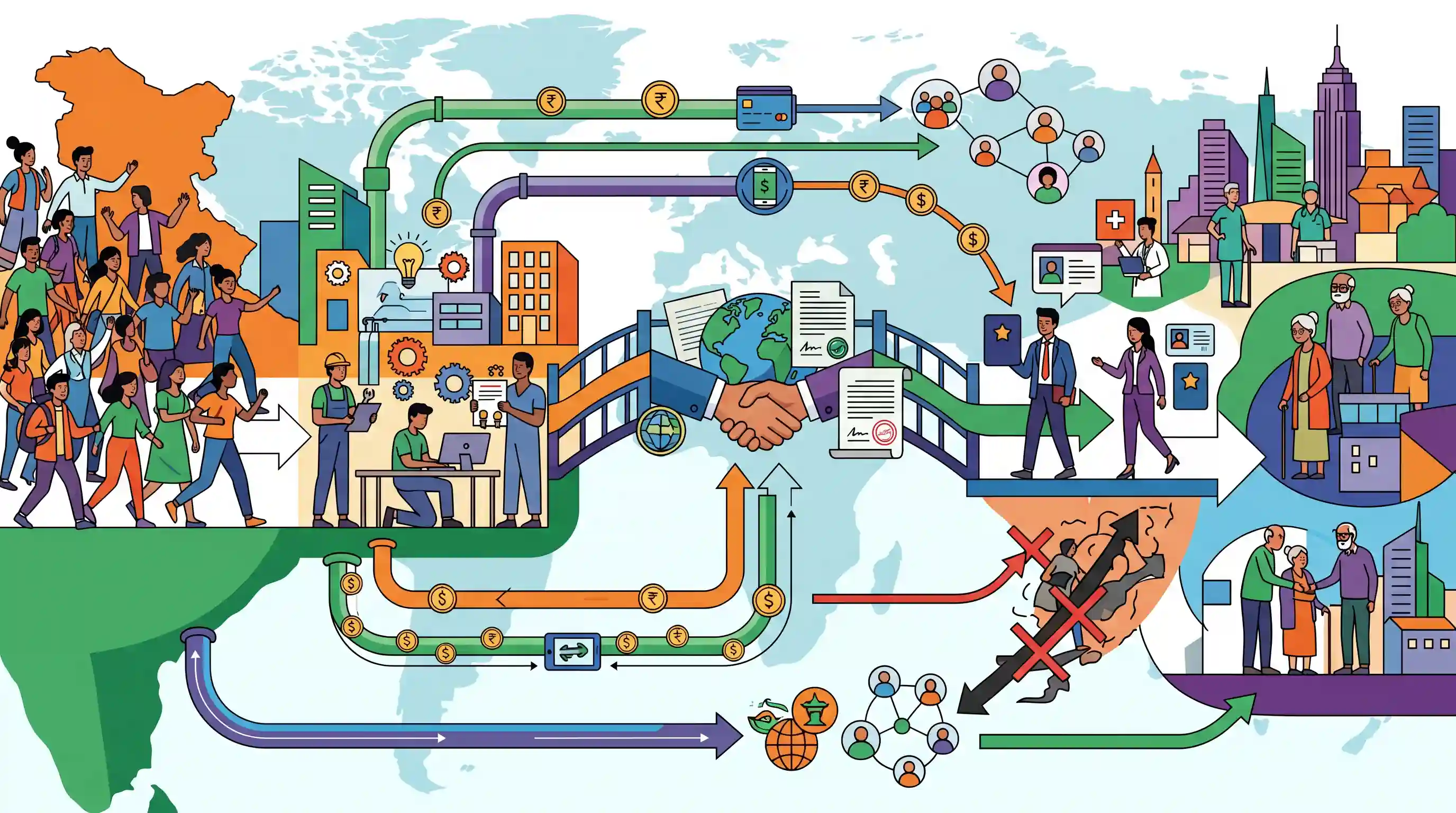
The article outlines a strategic approach for India to capitalize on its demographic dividend by actively facilitating the legal migration of its skilled workforce. As developed countries grapple with aging populations and labor shortages, India's surplus of young workers presents a mutually beneficial opportunity. By negotiating bilateral Migration and Mobility Partnership Agreements (MMPAs) and aligning domestic skilling initiatives with global standards, India can provide meaningful employment for its youth abroad. This strategy not only mitigates domestic unemployment challenges but also enhances remittance inflows and strengthens the global influence of the Indian diaspora, while curbing the dangers of illegal immigration.
Key Points
- India is currently experiencing a demographic dividend with a large youth population, while many developed nations are facing an aging population and a demographic winter.
- Facilitating legal migration and labor mobility agreements can help match India's surplus workforce with global labor shortages.
- Promoting safe, legal migration pathways reduces the risks of human trafficking and exploitation associated with illegal immigration.
- To fully leverage this opportunity, India must align its domestic skill development programs with international standards and language requirements.
- A formalized legal migration framework will not only provide employment to India's youth but also boost economic growth through increased remittances and global diaspora influence.
Important Terms
Demographic Dividend

The economic growth potential resulting from a shift in a population's age structure, specifically when the working-age population (15–64) is larger than the non-working-age dependent population.
UPSC context
GS Paper 1 (Population) & GS 3 (Economy). Tests understanding of human capital, employment challenges, and the 'demographic time bomb' risk.
Migration and Mobility Partnership Agreements (MMPA)
Comprehensive bilateral frameworks between India and foreign nations (e.g., Germany, Italy) to facilitate the legal and orderly movement of students, professionals, and workers while jointly combating irregular migration.
UPSC context
GS Paper 2 (International Relations). Crucial for questions on bilateral diplomacy, labor mobility, and managing the global Indian workforce.
Indian Diaspora
The global community of over 30 million people of Indian ancestry living abroad, including Non-Resident Indians (NRIs) and Persons of Indian Origin (PIOs), acting as a bridge for soft power.
UPSC context
GS Paper 2 (International Relations). Tests the diaspora's role in foreign policy, economic influence, and 'Brain Gain' strategies.
Remittances
Funds sent by migrant workers to their home country. India is the world's leading recipient, with these inflows serving as critical 'macroeconomic ballast' for the balance of payments.
UPSC context
GS Paper 3 (Economy). Important for understanding external sector stability, current account deficit management, and household welfare.
Skill India Mission
A flagship government initiative launched in 2015 to empower Indian youth with market-relevant vocational training and certifications to bridge the industry-skill gap and enhance global employability.
UPSC context
GS Paper 3 (Employment & Infrastructure). Evaluates government interventions in human resource development and the mission's alignment with international labor standards.
Ministry of External Affairs (MEA)
The central government agency responsible for India’s foreign relations, diaspora engagement, and the negotiation of international treaties like migration agreements and social security pacts.
UPSC context
GS Paper 2 (Polity/Governance). Relevant for understanding the institutional framework governing overseas citizens and the execution of foreign policy.
Prelims Trap
"India has the highest percentage of its population migrating abroad globally."
India has the highest absolute number of migrants/diaspora globally, but as a percentage of its total population, it remains remarkably low (~1.3%) compared to peers like Mexico or the Philippines.
Static Concepts Connected
What constitutes a demographic dividend and when does India's window close?
- Working-age ratio: Occurs when the working-age population (typically 15-59 years) exceeds the dependent population (children and elderly).
- Dependency ratio: Characterized by a falling dependency ratio, which traditionally boosts national savings and investment rates.
- Duration: India's window began around 2005-06, is projected to peak around 2041, and will likely close by 2055-56.
How are inward remittances classified in India's Balance of Payments (BoP)?
- Current Account: Remittances are recorded in the Current Account, not the Capital Account.
- Invisibles / Transfers: They are specifically categorized under 'Invisibles' as private current transfers (unrequited transfers).
- Trade Deficit Buffer: These massive inflows act as a critical macroeconomic buffer, helping to offset India's chronic merchandise trade deficit.
Cross-Topic Patterns
MMPAs & WTO GATS Mode 4
Bilateral MMPAs are India's strategic workaround to stalled WTO GATS Mode 4 negotiations, securing temporary movement of natural persons (professionals) without needing a comprehensive Free Trade Agreement.
Remittances vs FDI Trends
While FDI into India heavily fluctuates with global monetary tightening, remittances from the diaspora show immense resilience and counter-cyclical stability, acting as a buffer against macroeconomic shocks.

Expect a 2026 prelims statement linking MMPAs with WTO GATS Mode 4, or a Mains question on leveraging diaspora as geopolitical soft power.
Linked PYQs · 4
Linked PYQs · 4
- 2014MainsGS3
While we flaunt India's demographic dividend, we ignore the dropping rates of employability. What are we missing while doing so? Where will the jobs that India desperately needs come from? Explain.
- 2020MainsGS2
Indian diaspora has a decisive role to play in the politics and economy of America and European Countries'. Comment with examples.
- 2017MainsGS2
Indian diaspora has an important role to play in South-East Asian countries' economy and society. Appraise the role of Indian diaspora in South-East Asia in this context.
- 2024MainsGS1
What is the concept of a 'demographic winter'? Is the world moving towards such a situation? Elaborate.
