Science Based Targets initiative urges Indian corporate climate action
Source:The Hindu ↗
Why It Matters
The article provides key insights into corporate climate action and the role of international bodies like SBTi in standardizing emission targets. This is crucial for GS-3 answers on India's transition to a low-carbon economy, net-zero commitments, green supply chains, and the evolving ESG landscape for businesses.
Summary
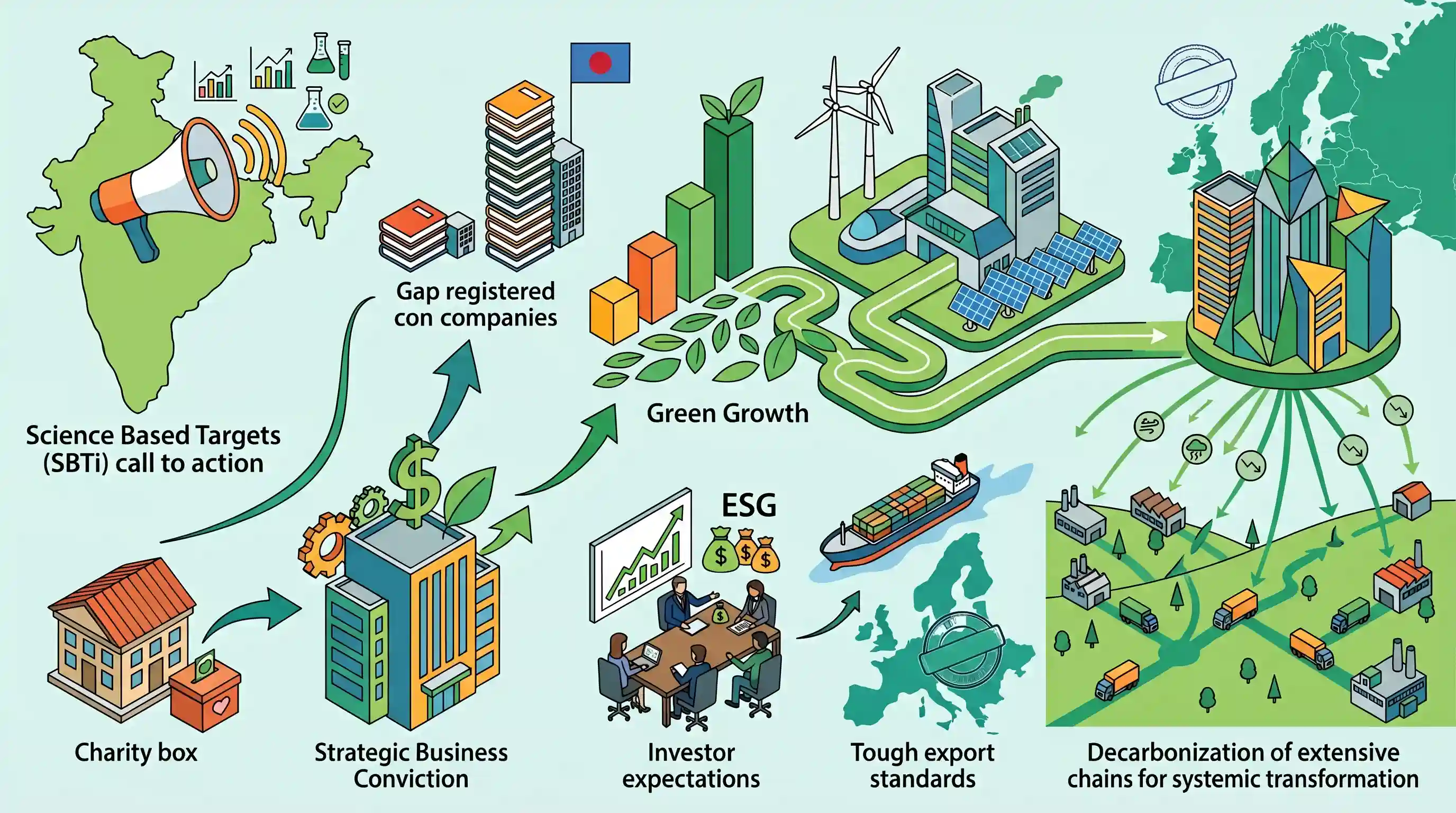
The Science Based Targets initiative (SBTi) is urging Indian businesses to significantly scale up their climate commitments by adopting science-aligned emissions reduction targets. Top executives emphasized that climate action must transition from traditional Corporate Social Responsibility (CSR) to strategic business conviction. India currently has fewer than 500 companies registered with SBTi, compared to Japan's 2,000, indicating untapped potential. Adopting 'green growth' is vital for Indian corporations to maintain low-carbon competitiveness, meet investor expectations, and align with strict export market standards in Europe. Furthermore, large conglomerates have a pivotal role as 'multipliers' in decarbonizing their extensive supply chains to foster systemic climate transformation.
Key Points
- The Science Based Targets initiative (SBTi) was established in 2015 by the UN, CDP, WRI, WWF, and We Mean Business to help companies set science-aligned emission reduction targets.
- While over 10,000 global companies representing 30% of global greenhouse gas emissions are part of SBTi, India has fewer than 500 registered companies, showing massive room for improvement.
- Indian corporates must shift from viewing climate action as traditional CSR to treating it as a strategic conviction for long-term low-carbon competitiveness.
- Large manufacturers are urged to manage supply chain emissions by activating thousands of smaller suppliers to adopt green practices.
- Transitioning to green growth and reducing emissions is becoming a business necessity for Indian firms to align with investor expectations and European export market requirements.
Important Terms
Science Based Targets initiative (SBTi)

A partnership between CDP, UNGC, WRI, and WWF that helps companies set greenhouse gas emission reduction targets aligned with the 1.5°C Paris Agreement goal.
UPSC context
GS3 (Environment/Economy): Relevant for corporate climate action, Paris Agreement compliance, and India’s Net Zero 2070 targets.
CDP (Carbon Disclosure Project)
A global non-profit disclosure system that helps companies, cities, and regions measure and manage their environmental impacts, particularly climate change, water security, and deforestation.
UPSC context
GS3 (Environmental Governance): Tests understanding of global mechanisms for carbon accounting, transparency, and corporate climate accountability.
World Resources Institute (WRI)
A global research organization established in 1982 that works at the intersection of environment and development to improve lives while protecting nature.
UPSC context
GS3 (Environment): A key source for global environmental data and reports often cited in sustainable development topics.
Green Growth
An economic strategy fostering development while ensuring natural assets provide essential services, aiming to decouple growth from environmental degradation.
UPSC context
GS3 (Economic Development): A pillar of India's 2023-24 Union Budget and central to achieving 'Panchamrit' goals.
ESG (Environmental, Social, and Governance)
A framework for evaluating corporate performance across Environmental, Social, and Governance pillars, focusing on measurable risk management and long-term value.
UPSC context
GS3/GS4 (Economy & Ethics): Tests the shift from profit-only to value-based corporate governance and sustainable investment.
Corporate Social Responsibility (CSR)
A company's commitment to ethical and socially responsible operations; in India, mandated by Section 135 of the Companies Act 2013.
UPSC context
GS4/GS3 (Ethics & Governance): Relevant for statutory mandates and the ethical duty of corporations toward society.
UN Global Compact (UNGC)
A voluntary UN initiative encouraging businesses to adopt and report on sustainable and socially responsible policies based on ten universal principles.
UPSC context
GS2/GS3 (International Organizations): Highlights the role of multi-stakeholder partnerships in achieving Sustainable Development Goals (SDGs).
Prelims Trap
"SBTi is a legally binding international treaty for member nations under the UNFCCC."
SBTi is a voluntary framework for private corporations, not a binding treaty for sovereign states. It was formed by NGOs and the UN Global Compact.
Static Concepts Connected
What are Scope 1, 2, and 3 emissions in corporate carbon accounting?
- Scope 1: Direct greenhouse gas emissions from sources that are owned or controlled by the company (e.g., factory exhaust, company vehicles).
- Scope 2: Indirect emissions originating from the generation of purchased energy, such as electricity, steam, or cooling consumed by the reporting company.
- Scope 3: All other indirect emissions occurring in a company’s value chain, including upstream supply chain operations and downstream product usage.
How does SEBI's BRSR differ from traditional CSR under the Companies Act?
- BRSR (ESG): A mandatory disclosure framework for the top 1,000 listed entities, integrating ESG (Environmental, Social, Governance) metrics into core business strategy and risk assessment.
- Traditional CSR: A statutory obligation under the Companies Act 2013 requiring certain profitable companies to spend 2% of their net profits on specific social or environmental projects.
Cross-Topic Patterns
Corporate climate targets & EU CBAM
Adopting SBTi frameworks directly helps Indian manufacturers mitigate the upcoming financial impacts and stringent compliance norms of the EU's Carbon Border Adjustment Mechanism (CBAM).
ESG metrics driving Green Finance
Verifiable science-based targets are rapidly becoming prerequisites for Indian conglomerates to access international green finance and attract ESG-focused Foreign Portfolio Investors (FPIs).

Scope 3 emissions and SEBI's BRSR framework will likely feature as paired statements in a 2026 Prelims environment/economy question.
Linked PYQs · 2
Linked PYQs · 2
- 2019MainsGS3
It is argued that the strategy of inclusive growth is intended to meet the objectives of inclusiveness and sustainability together. Comment on this statement.
- 2021PrelimsGS1
The 'Common Carbon Metric', supported by UNEP, has been developed for
