Maritime Security and Diplomatic Protests Over Trade Routes
Source:The Hindu ↗
Why It Matters
The Strait of Hormuz is a vital global chokepoint through which a significant portion of the world's oil passes. Disruptions here directly threaten India's energy security, inflate crude oil prices, and impact the broader economy. For UPSC aspirants, this highlights the intersection of international relations, maritime security, and economic stability.
Summary
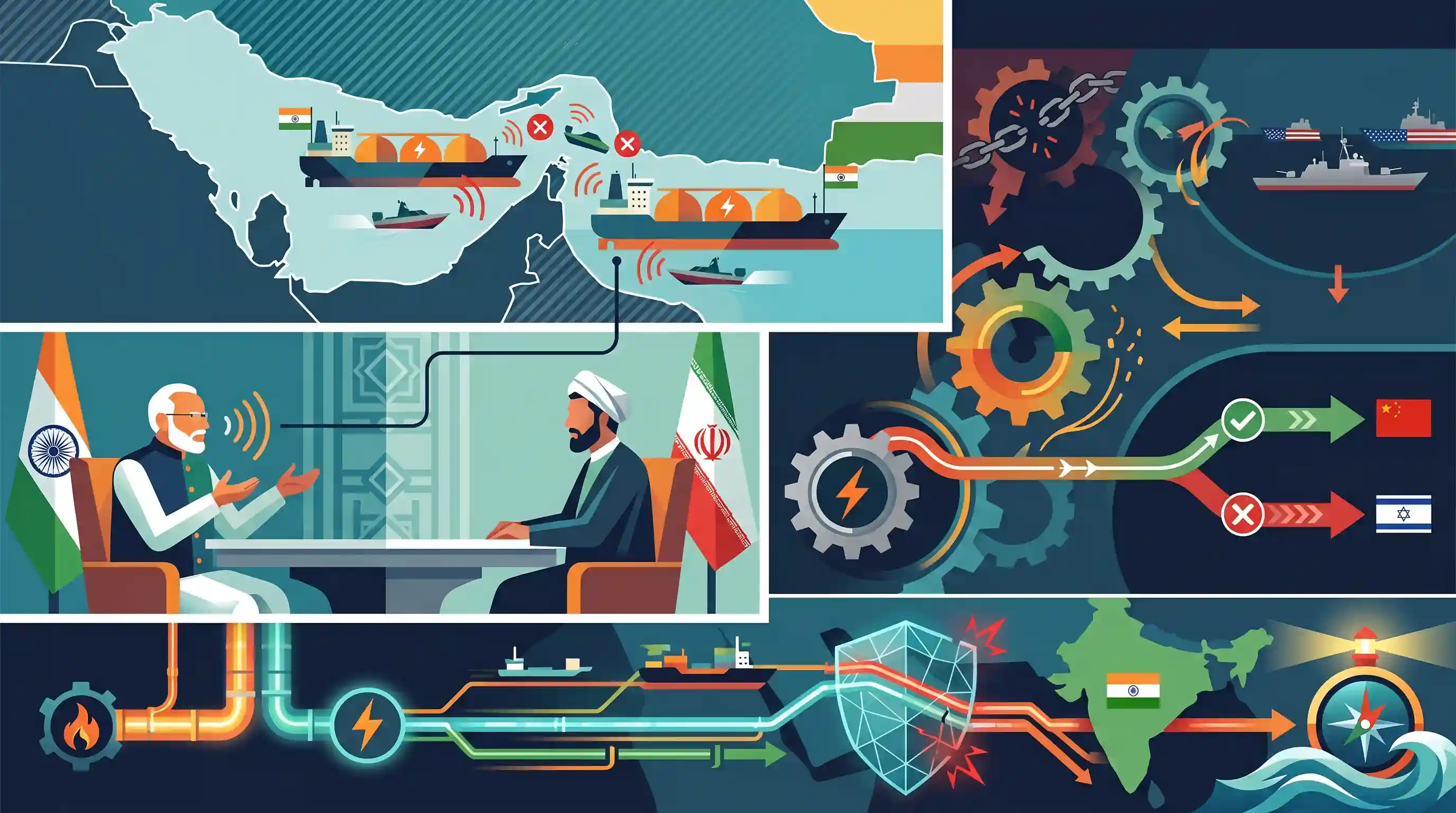
India called in the Iranian envoy to express serious concern after the Islamic Revolutionary Guard Corps (IRGC) prevented two Indian-bound energy-carrying vessels from transiting the Strait of Hormuz. The diplomatic intervention by Foreign Secretary Vikram Misri highlighted India's priority regarding the safety of merchant shipping. The disruption comes in the wake of a collapsed ceasefire between the U.S. and Iran, with the IRGC citing retaliation against U.S. naval blockades of Iranian ships. Iran has threatened to restrict Western and Israeli-linked vessels while allowing passage for China-bound ships. The event highlights the severe risks that Middle Eastern geopolitical tensions pose to global freedom of navigation and India's critical energy supply chains.
Key Points
- India officially conveyed deep concern to Iran after two Indian-bound oil tankers were prevented from crossing the Strait of Hormuz by the Islamic Revolutionary Guard Corps (IRGC).
- Indian Foreign Secretary Vikram Misri met Iranian Ambassador Mohammad Fathali to emphasize the critical need for the safety of merchant shipping and mariners.
- The blockade marks the end of a fortnight-long U.S.-Iran ceasefire, with Iran justifying its actions as a response to the U.S. Navy's blockade of Iranian vessels, which it termed piracy.
- Iran indicated that ships belonging to the U.S., Israel, and Western countries would face restrictions in the Strait, while China-bound vessels would be permitted to pass.
- The incident underscores the vulnerability of India's energy security to geopolitical conflicts in the Middle East and highlights the strategic importance of maritime chokepoints like the Strait of Hormuz.
Important Terms
Islamic Revolutionary Guard Corps (IRGC)

A parallel Iranian military branch established in 1979 to protect the clerical regime. It operates independently of the regular army and controls the elite Quds Force.
UPSC context
GS-II (International Relations); key actor in Middle East geopolitics, proxy warfare, and India-Iran maritime security dynamics.
Strait of Hormuz
A narrow waterway connecting the Persian Gulf and Gulf of Oman. It is the world's most critical oil transit chokepoint, handling ~20% of global oil trade.
UPSC context
GS-II/GS-III; vital for India's energy security as nearly half of its crude oil imports pass through this route.
UNCLOS (United Nations Convention on the Law of the Sea)
The 1982 'Constitution for the Oceans' providing a legal framework for maritime zones, navigation rights, and the protection of marine environments.
UPSC context
GS-II/GS-III; foundational treaty for international maritime law, territorial claims, and freedom of navigation disputes.
Freedom of Navigation (FON)
The international law principle ensuring ships from any sovereign state can traverse the high seas without interference, codified under Article 87 of UNCLOS.
UPSC context
GS-II; critical for global trade, maritime security, and India's strategic interests in the Indo-Pacific and West Asia.
Foreign Secretary
The senior-most diplomat and administrative head of India's Ministry of External Affairs (MEA), responsible for advising on foreign policy and managing diplomatic relations.
UPSC context
GS-II; central to India's diplomatic machinery; tests knowledge of India's foreign policy executive and MEA structure.
Maritime Chokepoint
A narrow, strategically significant maritime passage that connects larger bodies of water. Control or disruption of these points can impact global trade.
UPSC context
GS-I (Geography) / GS-III (Security); key for understanding global logistics vulnerabilities and strategic maritime geography.
Prelims Trap
"Under UNCLOS, bordering states like Iran have the right to suspend 'transit passage' in the Strait of Hormuz during regional conflicts."
Unlike 'innocent passage' in territorial waters, the 'transit passage' regime in international straits (like Hormuz) guarantees continuous transit. Under UNCLOS, it cannot be legally suspended.
Static Concepts Connected
How do 'Transit Passage' and 'Innocent Passage' differ under UNCLOS?
- Transit Passage: Applies to international straits (e.g., Hormuz). Allows continuous transit, submerged submarines, and aircraft overflight. Crucially, it cannot be temporarily suspended by coastal states.
- Innocent Passage: Applies to territorial waters. Submarines must navigate on the surface and show their flag. Can be temporarily suspended by the coastal state for security reasons.
Which countries border the critical maritime chokepoints of the Middle East?
- Strait of Hormuz: Connects the Persian Gulf to the Gulf of Oman. Bordered by Iran to the north and Oman (the Musandam Peninsula enclave) to the south.
- Bab-el-Mandeb: Connects the Red Sea to the Gulf of Aden. Bordered by Yemen on the Arabian Peninsula, and Djibouti and Eritrea in the Horn of Africa.
Cross-Topic Patterns
Energy Security & Strategic Reserves
Disruptions in the Strait of Hormuz underscore India's structural vulnerability, accelerating the need for Phase II of the Indian Strategic Petroleum Reserves (ISPRL) to buffer against geopolitical supply shocks.
Chabahar Port & Maritime Vulnerability
While India invests in Chabahar Port and INSTC for Central Asian access, these strategic connectivity projects cannot substitute the vulnerable oceanic transit of crude oil out of the Persian Gulf.
IFC-IOR & Maritime Domain Awareness
This incident highlights the utility of the Information Fusion Centre for the Indian Ocean Region (IFC-IOR) in Gurugram, which tracks maritime incidents, piracy, and blockades to ensure freedom of navigation.

Expect a 2026 Prelims question combining UNCLOS 'transit passage' rules with the exact bordering geography of the Strait of Hormuz.
Linked PYQs · 5
Linked PYQs · 5
- 2025MainsGS2
"Energy security constitutes the dominant kingpin of India's foreign policy, and is linked with India's overarching influence in Middle Eastern countries.” How would you integrate energy security with India's foreign policy trajectories in the coming years?
- 2018MainsGS2
In what ways would the ongoing US-Iran Nuclear Pact Controversy affect the national interest of India? How should India respond to this situation?
- 2017MainsGS2
The question of India's Energy Security constitutes the most important part of India's economic progress. Analyze India's energy policy cooperation with West Asian countries.
- 2022PrelimsGS1
The term "Levant" often heard in the news roughly corresponds to which of the following regions?
- 2023MainsGS2
‘Sea is an important Component of the Cosmos’ Discuss in the light of the above statement the role of the IMO (International Maritime Organisation) in protecting environment and enhancing maritime safety and security.
