India Diplomacy on Pakistan Crackdown in Occupied Kashmir
Source:The Hindu ↗
ఇది ఎందుకు ముఖ్యం
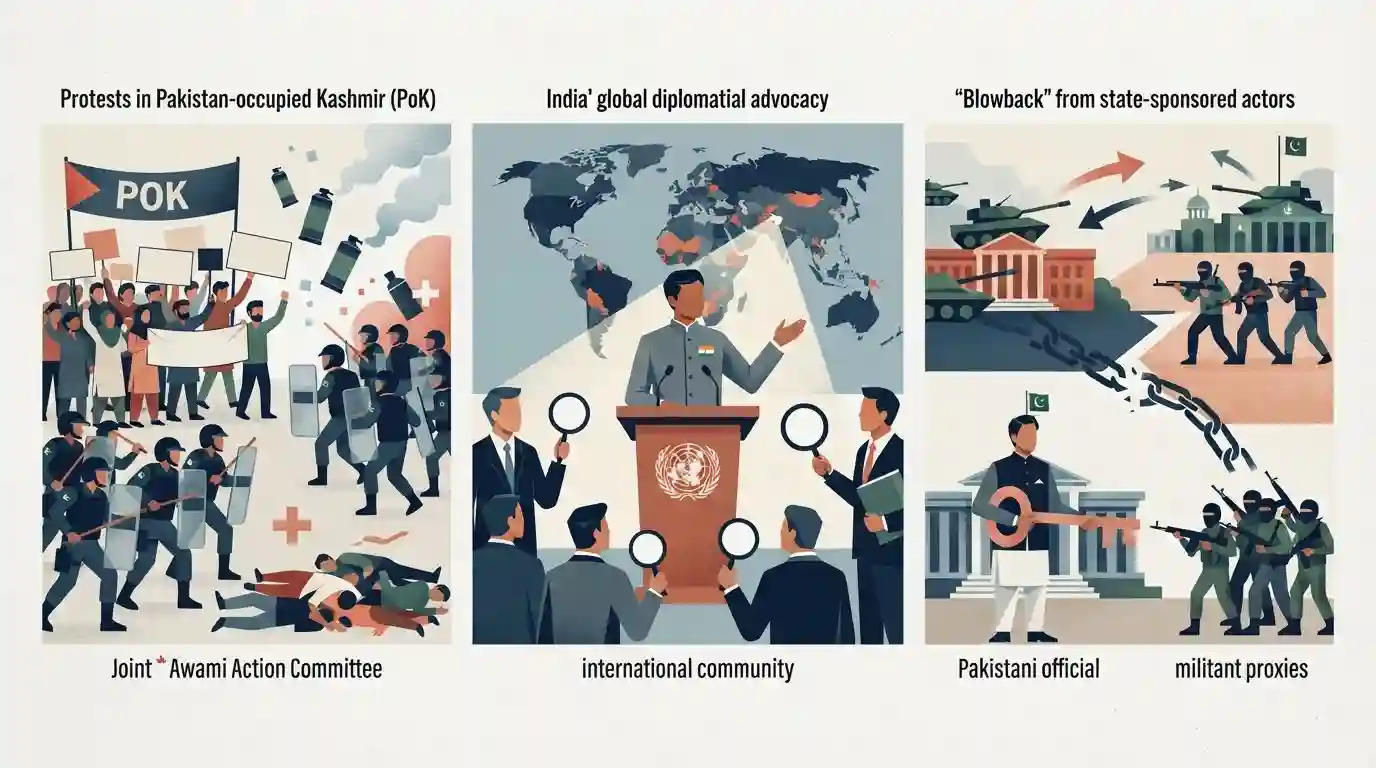
The article is significant for UPSC aspirants as it highlights India's proactive diplomatic strategy to draw global attention to the territorial dispute and human rights issues in Pakistan-occupied Kashmir (PoK). Furthermore, it provides excellent fodder for GS3 Internal Security answers by demonstrating the 'blowback' effect of proxy warfare—how cultivating non-state actors (mujahideen) for cross-border terrorism eventually threatens the patron state's own internal security.
సారాంశం
India has formally called upon the international community to scrutinise and hold Pakistan accountable for its brutal crackdown on peaceful protesters in Pakistan-occupied Kashmir (PoK). The protests, spearheaded by the Joint Awami Action Committee (JAAC), stem from grievances over inflated living costs, administrative apathy, and discrimination. As Pakistani security forces killed around 40 individuals during the unrest, India's MEA strongly condemned the human rights violations. Crucially, India also highlighted admissions by Pakistani officials that armed mujahideen, initially cultivated to target India, are now fighting the Pakistani state itself, providing a stark example of the blowback from state-sponsored terrorism.
ముఖ్య అంశాలు
- Massive protests are ongoing in Pakistan-occupied Kashmir (PoK), led by the Joint Awami Action Committee (JAAC), over inflated living costs, political discrimination, and administrative apathy.
- India's Ministry of External Affairs has urged the international community to scrutinize Pakistan's ruthless crackdown on these peaceful protesters, which has led to approximately 40 deaths.
- Pakistan's Defence Minister has labeled the protesting civilians as enemies, effectively ruling out any dialogue.
- A Special Assistant to the Pakistani Prime Minister admitted that armed mujahideen, originally trained to target India, have now turned their guns inward against the Pakistani state, illustrating the severe blowback of state-sponsored terrorism.
ముఖ్యమైన పదాలు
Pakistan-occupied Kashmir (PoK)

The region of the former princely state of Jammu and Kashmir currently under Pakistani administrative control, which India officially claims as an integral part of its sovereign territory.
UPSC context
Relevant for GS Paper II (International Relations) and GS Paper III (Internal Security) regarding India-Pakistan border disputes.
Joint Awami Action Committee (JAAC)
An alliance of activist groups in Pakistan-occupied Kashmir that spearheads public protests and movements demanding political rights, administrative accountability, and relief from high living costs.
UPSC context
GS Paper II (India and its Neighborhood - Relations) regarding regional instability and human rights issues in PoK.
Ministry of External Affairs (MEA)
The government agency responsible for conducting India's relations with foreign nations, formulating foreign policy, and representing the nation's interests at international forums.
UPSC context
Relevant for GS Paper II (International Relations) as the primary executive body for foreign policy formulation.
State-Sponsored Terrorism
Active financial, logistical, or military support provided by a sovereign state to violent non-state actors or terrorist groups to achieve strategic foreign policy objectives.
UPSC context
Critical for GS Paper III (Internal Security) and GS Paper II (Bilateral Relations) regarding cross-border terrorism.
ప్రిలిమ్స్ ఉచ్చు
UNSC Resolution 47 mandates an unconditional and immediate plebiscite in Jammu & Kashmir.
UNSC Res 47 requires a sequential three-step process, starting with Pakistan withdrawing all tribesmen and nationals. The plebiscite condition was never triggered because Pakistan failed this prerequisite.
అనుసంధానమైన స్థిర భావనలు
How does India legally and constitutionally assert its sovereignty over Pakistan-occupied Kashmir (PoK)?
- Instrument of Accession: Signed in October 1947 by Maharaja Hari Singh, it forms the foundational legal basis of India's sovereignty over the entire J&K territory.
- 1994 Parliamentary Resolution: A unanimous 1994 Parliamentary resolution declaring the entire J&K an integral part of India, demanding Pakistan immediately vacate occupied territories.
- J&K Reorganisation Act: Under Section 14(4) of the 2019 Act, 24 vacant seats are reserved in the J&K Legislative Assembly specifically for PoK, maintaining constant legal territorial claims.
Which agreements mandate the bilateral resolution of India-Pakistan disputes, precluding third-party mediation?
- Simla Agreement: Signed in 1972, it legally binds both nations to settle differences peacefully through bilateral negotiations, effectively superseding UN-mediated or third-party interventions.
- Lahore Declaration (1999): Reiterated the commitment to the Simla Agreement's bilateral framework, cementing that the J&K issue must be resolved without external mediation.
అంతర-అంశ నమూనాలు
State-Sponsored Terrorism and FATF
Pakistan's admission of blowback from armed mujahideen highlights internal security threats (GS3) and justifies India's historical push for FATF scrutiny over state-sponsored terror financing.
Global Scrutiny vs Bilateralism
India invoking international scrutiny for PoK human rights marks a tactical shift from strictly bilateral framing (Simla Agreement) to actively internationalizing Pakistan's internal governance failures.

Expect a Prelims question on the sequential conditions of UNSC Resolution 47 and the 24 reserved PoK seats in the J&K Reorganisation Act.
అనుసంధాన PYQలు · 3
అనుసంధాన PYQలు · 3
- 2015MainsGS2
Terrorist activities and mutual distrust have clouded India-Pakistan relations. To what extent the use of soft power like sports and cultural exchanges could help generate goodwill between the two countries? Discuss with suitable examples.
- 2020MainsGS3
Analyze internal security threats and transborder crimes along Myanmar, Bangladesh and Pakistan borders including Line of Control (LoC). Also discuss the role played by various security forces in this regard.
- 2021MainsGS3
Analyse the multidimensional challenges posed by external state and non-state actors, to the internal security of India. Also discuss measures required to be taken to combat these threats.
