India Bangladesh Border Security and Repatriation of Immigrants
Source:The Hindu ↗
Why It Matters
Highlights the persistent security and demographic challenges posed by illegal cross-border migration, and demonstrates how local state actions (like border pushbacks in Assam) can directly impact bilateral relations and border management diplomacy with neighboring countries.
Summary
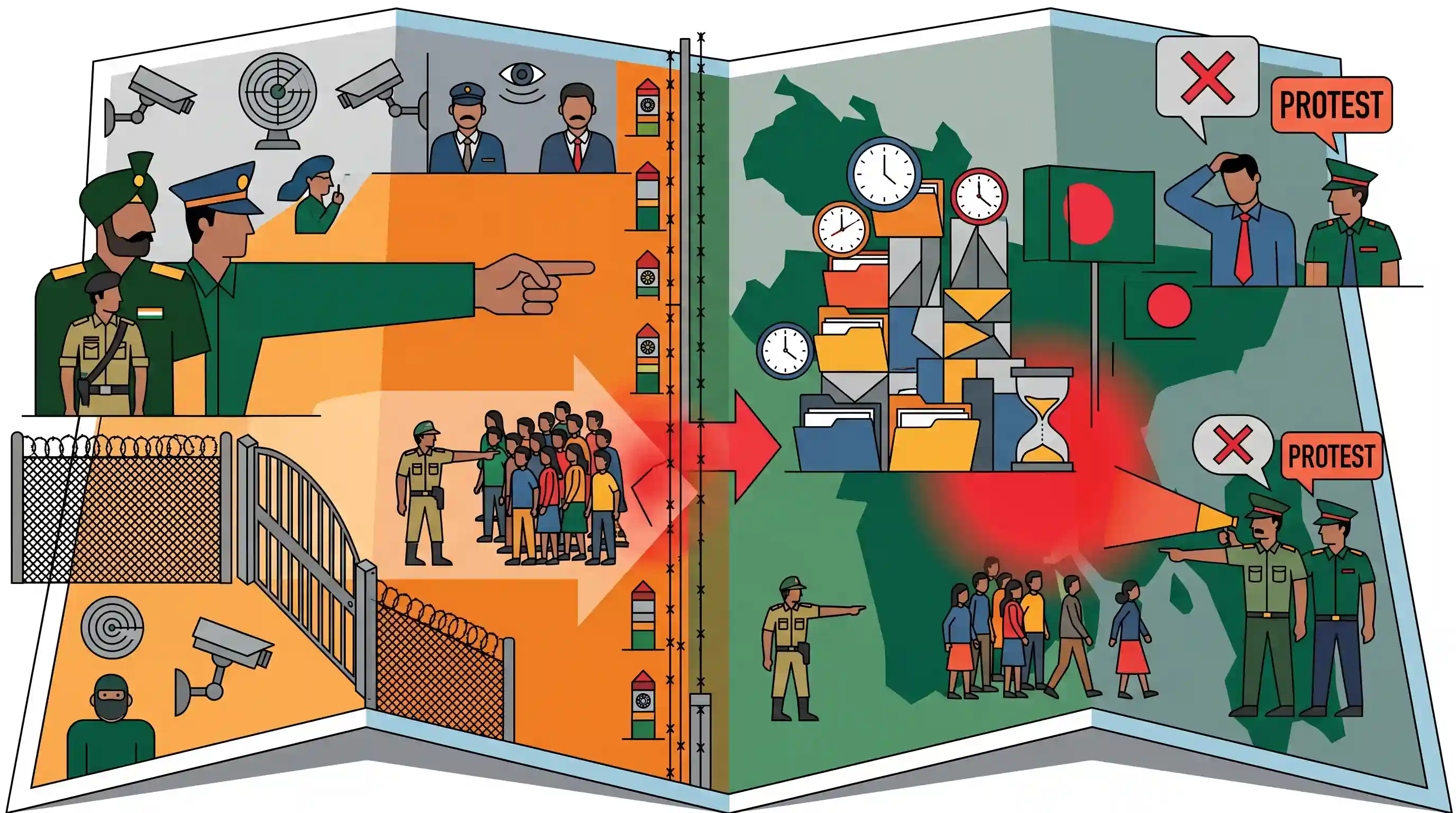
India is urging Bangladesh to cooperate on the repatriation of illegal immigrants, noting that over 2,862 cases of nationality verification have been pending with Dhaka, some for more than five years. The diplomatic push comes after Bangladesh's Foreign Minister protested alleged "push-ins" of individuals by Indian border guards, triggered by Assam's recent pushback of 20 foreign nationals. The Ministry of External Affairs reaffirmed India's strict policy of deporting illegal foreign nationals in accordance with domestic laws and bilateral mechanisms, highlighting the ongoing friction surrounding cross-border migration management.
Key Points
- India has called for Bangladesh's cooperation in repatriating illegal immigrants, highlighting that 2,862 nationality verification cases remain pending with Dhaka.
- The MEA confirmed India's policy to systematically repatriate illegal foreign nationals under Indian laws, procedures, and bilateral frameworks.
- Bangladesh Foreign Minister Khalilur Rahman protested alleged 'push-ins' of individuals by Indian border forces, responding to recent actions taken by Assam.
- Assam Chief Minister Himanta Biswa Sarma announced the recent pushback of 20 foreign nationals into Bangladesh, escalating cross-border rhetoric.
Important Terms
Ministry of External Affairs (MEA)

The Union government department responsible for managing India's foreign relations, diplomatic missions, and international treaties, including the formal repatriation processes of foreign nationals.
UPSC context
GS Paper II: International Relations and governance. Tests understanding of diplomatic channels in resolving bilateral migration and security disputes.
Bharatiya Janata Party (BJP)
A major national political party in India; currently the ruling party, known for its strict stance on illegal immigration and border security, particularly in Assam and West Bengal.
UPSC context
GS Paper II: Political parties and pressure groups. Tests knowledge of policy stances influencing internal security and neighborhood relations.
Repatriation
The formal legal process of returning an individual to their country of origin after their nationality has been verified and legal procedures are completed.
UPSC context
GS Paper II & III: International Relations and Internal Security. Tests mechanisms for managing illegal migration and refugee issues.
Pushback
An informal, extra-legal action where border forces return suspected illegal immigrants across the international boundary without formal detention, court proceedings, or diplomatic verification.
UPSC context
GS Paper III: Border Management and Security. Tests understanding of border policing strategies and their legal/ethical implications.
Nationality Verification
A diplomatic procedure where a country confirms the citizenship of an individual, serving as a mandatory prerequisite for their formal repatriation from a foreign nation.
UPSC context
GS Paper II: International Relations. Tests knowledge of bilateral mechanisms and challenges in consulate-level cooperation.
Border Management
The strategic supervision of national boundaries through security forces, infrastructure (fencing), and technology (surveillance) to prevent illegal entry, smuggling, and cross-border crimes.
UPSC context
GS Paper III: Internal Security. Tests familiarity with agencies like BSF and frameworks like the Comprehensive Integrated Border Management System (CIBMS).
Prelims Trap
"State governments possess independent statutory authority under the Foreigners Act to deport illegal migrants."
Deportation power strictly vests with the Central Government under Section 3 of the Foreigners Act, 1946. States only exercise delegated powers to detect and detain.
Static Concepts Connected
How is the deportation of illegal immigrants legally managed in India?
- Foreigners Act, 1946: Empowers the Central Government with absolute statutory authority to detect, detain, and deport undocumented foreign nationals.
- Foreigners Tribunals: Established via the 1964 Order, these quasi-judicial bodies determine whether a suspected individual qualifies as a foreigner under Indian law.
- Passport Act, 1920: Mandates that all foreign nationals entering India must possess valid travel documents, penalizing illegal entry.
What mechanisms secure India's complex riverine borders with Bangladesh?
- CIBMS: A comprehensive technological system creating a 'virtual fence' via sensors and cameras in unfenced, difficult terrains.
- BOLD-QIT: A specific CIBMS project deployed in Assam's Dhubri (Brahmaputra river) using microwave data networks to intercept infiltration.
- CBMP: A 2011 bilateral framework synchronizing the efforts of India's BSF and Border Guard Bangladesh to curb cross-border crimes.
Cross-Topic Patterns
Border Security + Demographic Shifts
The issue connects internal security (border porosity) with political geography, specifically how unchecked migration impacts local demography and triggers protective state mechanisms like the NRC in Assam.
Deportation + Non-Refoulement Principle
India's strict deportation stance frequently intersects with international human rights, testing the customary bounds of the non-refoulement principle since India is not a signatory to the 1951 Refugee Convention.

The procedural difference between formal 'deportation' under the Foreigners Act and informal border 'pushbacks' is highly likely for 2026.
Linked PYQs · 2
Linked PYQs · 2
- 2016MainsGS3
Border management is a complex task due to difficult terrain and hostile relations with some countries. Elucidate the challenges and strategies for effective border management.
- 2020MainsGS3
For effective border area management, discuss the steps required to be taken to deny local support to militants and also suggest ways to manage favourable perception among locals.
