India PMI shows fastest business activity growth and rising prices
Source:The Hindu ↗
Why It Matters
Understanding high-frequency indicators like the PMI is essential for UPSC candidates tracking India's economic recovery. Furthermore, the divergence between official headline inflation and survey-based business price pressures directly touches upon the RBI's challenges in monetary policymaking and inflation targeting—a recurring theme in both Prelims and Mains (GS3).
Summary
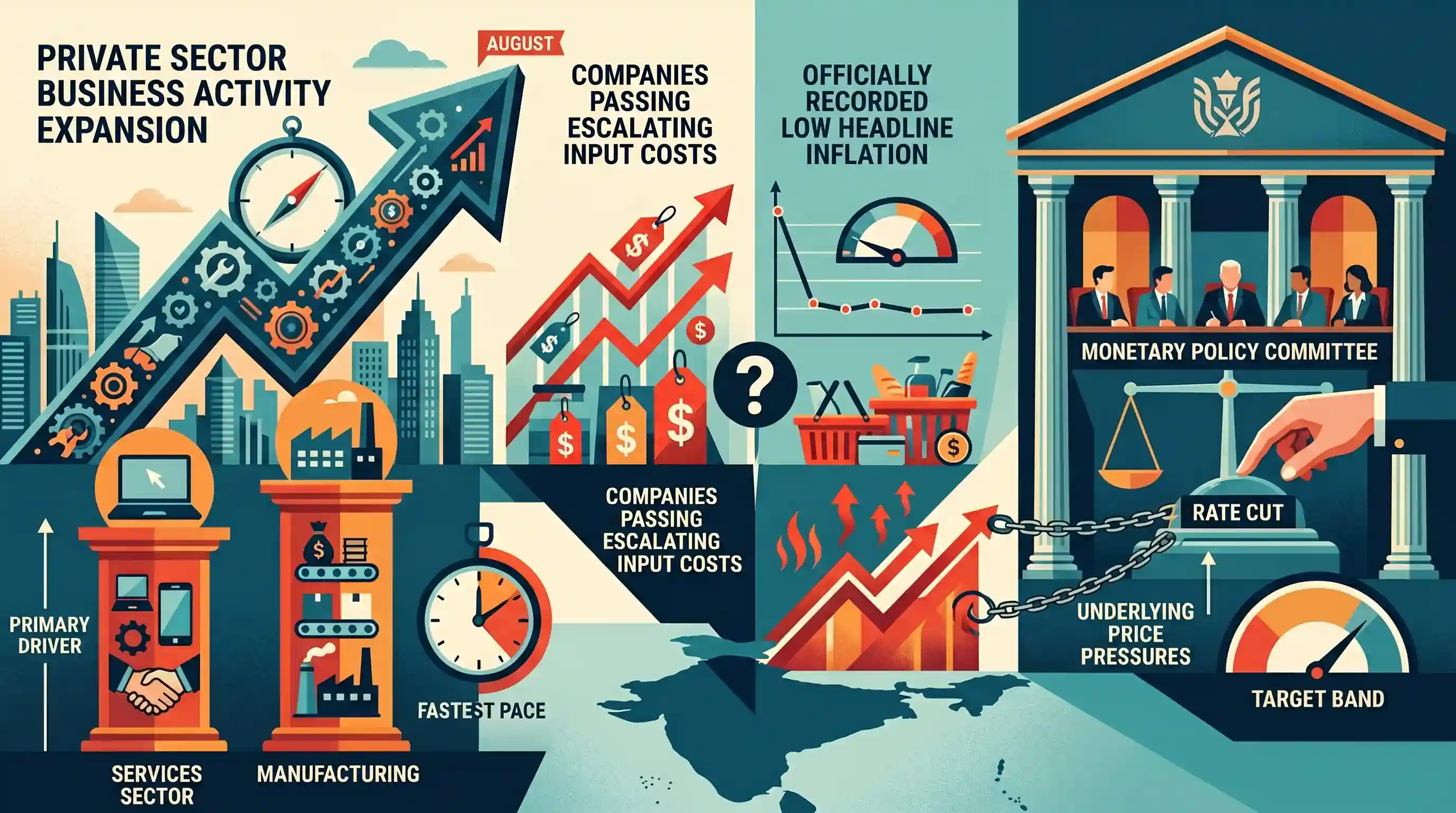
According to the HSBC flash India Composite Purchasing Managers' Index (PMI) compiled by S&P Global, India's private sector business activity expanded at the fastest pace in over two decades in August. The surge was primarily driven by the services sector, alongside solid manufacturing performance. However, the survey also indicated a sharp rise in output prices as companies passed escalating input costs onto consumers. This inflationary signal from businesses contrasts with the officially recorded eight-year low headline inflation rate of 1.55%, presenting a complex macroeconomic scenario. The presence of underlying price pressures complicates the Reserve Bank of India's (RBI) potential decisions on interest rate cuts, as the Monetary Policy Committee seeks to durably anchor inflation within its 2-6% target band before easing policy.
Key Points
- India's private sector business activity expanded at the fastest pace in at least two decades in August, per the HSBC flash India Composite PMI.
- Growth was led by the services sector, which hit its highest level since April 2004, while manufacturing growth remained robust despite a slight moderation.
- Firms reported a sharp rise in output prices, actively passing increased input costs onto consumers to protect margins.
- The survey's inflationary signals contrast with recent official data showing inflation falling to an eight-year low of 1.55%.
- These underlying price pressures complicate the RBI Monetary Policy Committee's outlook on initiating interest rate cuts, as it targets a sustainable 4% inflation rate.
Important Terms
Purchasing Managers' Index (PMI)

A survey-based economic indicator gauging the health of the manufacturing and services sectors. A reading above 50 indicates expansion, while below 50 signals contraction, serving as a leading indicator of GDP growth.
UPSC context
GS Paper 3: Indian Economy. Crucial for understanding high-frequency data, economic cycles, and private sector health versus official GDP.
Monetary Policy Committee (MPC)
A statutory six-member body (3 from RBI, 3 government-appointed) chaired by the RBI Governor. It determines the benchmark interest rate (Repo Rate) to maintain price stability while supporting growth.
UPSC context
GS Paper 3: Monetary Policy. Important for Prelims (composition/mandate) and Mains (policy transmission/inflation targeting).
Reserve Bank of India (RBI)
India’s central bank and regulatory body, mandated to manage the nation's currency, money supply, and credit system. It acts as the 'lender of last resort' and manages foreign exchange reserves.
UPSC context
GS Paper 3: Banking & Monetary Policy. Fundamental for understanding institutional frameworks and macroeconomic stability.
Headline Inflation
The raw inflation figure derived from the Consumer Price Index (CPI), representing total inflation. Unlike 'Core Inflation,' it includes volatile categories like food and energy prices, reflecting actual cost-of-living.
UPSC context
GS Paper 3: Indian Economy. Tests understanding of different inflation measures and their impact on monetary policy decisions.
S&P Global
A leading American financial information and analytics firm. It provides essential market data, including sovereign credit ratings and the global compilation of Purchasing Managers' Indices (PMI).
UPSC context
General awareness of international economic institutions and data providers that influence global investor sentiment and domestic policy.
Prelims Trap
PMI is an official index compiled by the NSO to measure the absolute volume of industrial production.
PMI is a private, survey-based indicator (S&P Global) capturing month-on-month business sentiment. The NSO publishes the Index of Industrial Production (IIP) for actual physical volumes.
Static Concepts Connected
How does PMI differ from the Index of Industrial Production (IIP)?
- Publisher: PMI is compiled by private entities (like S&P Global), while IIP is published by the National Statistical Office (NSO) under MoSPI.
- Nature of Data: PMI is survey-based, measuring qualitative month-on-month sentiment changes; IIP measures the actual physical volume of production.
- Sectoral Coverage: PMI provides separate indices for both Manufacturing and Services, whereas IIP exclusively covers Mining, Manufacturing, and Electricity.
What influences the RBI's Flexible Inflation Targeting (FIT)?
- Core vs Headline: Though RBI officially targets headline CPI, core inflation and rising input costs (flagged in PMI) heavily influence MPC rate-cut decisions to prevent unanchoring expectations.
- Statutory Mandate: The FIT framework (4% with a 2-6% band) is a statutory mandate introduced via the 2016 amendment to the Reserve Bank of India Act, 1934.
Cross-Topic Patterns
Services-led vs Manufacturing growth
PMI services hitting 2004 highs highlights India's structural 'service-led growth' model, often debated in Mains against the necessity of 'Make in India' manufacturing jobs.
Headline CPI vs Cost-Push divergence
While official CPI hit an 8-year low, PMI shows soaring input costs. This divergence between statistical headline inflation and underlying cost-push pressures frequently appears in Prelims.

Expect a 2026 Prelims multi-statement question contrasting PMI's private survey methodology with IIP's official volume data.
Linked PYQs · 3
Linked PYQs · 3
- 2024MainsGS3
What are the causes of persistent high food inflation in India? Comment on the effectiveness of the monetary policy of the RBI to control this type of inflation.
- 2022PrelimsGS1
In India, which one of the following is responsible for maintaining price stability by controlling inflation?
- 2022PrelimsGS1
With reference to the Indian economy, consider the following statements: 1. If the inflation is too high, Reserve Bank of India (RBI) is likely to buy government securities. 2. If the rupee is rapidly depreciating, RBI is likely to sell dollars in the market. 3. If interest rates in the USA or European Union were to fall, that is likely to induce RBI to buy dollars. Which of the statements given above are correct?
