Mumbai Ahmedabad High Speed Rail Project Progress and Trials
Source:Indian Express ↗
Why It Matters
Highlights India's progress in developing high-speed rail infrastructure, which has significant implications for regional connectivity, industrial corridor development, and technological modernization of transport.
Summary
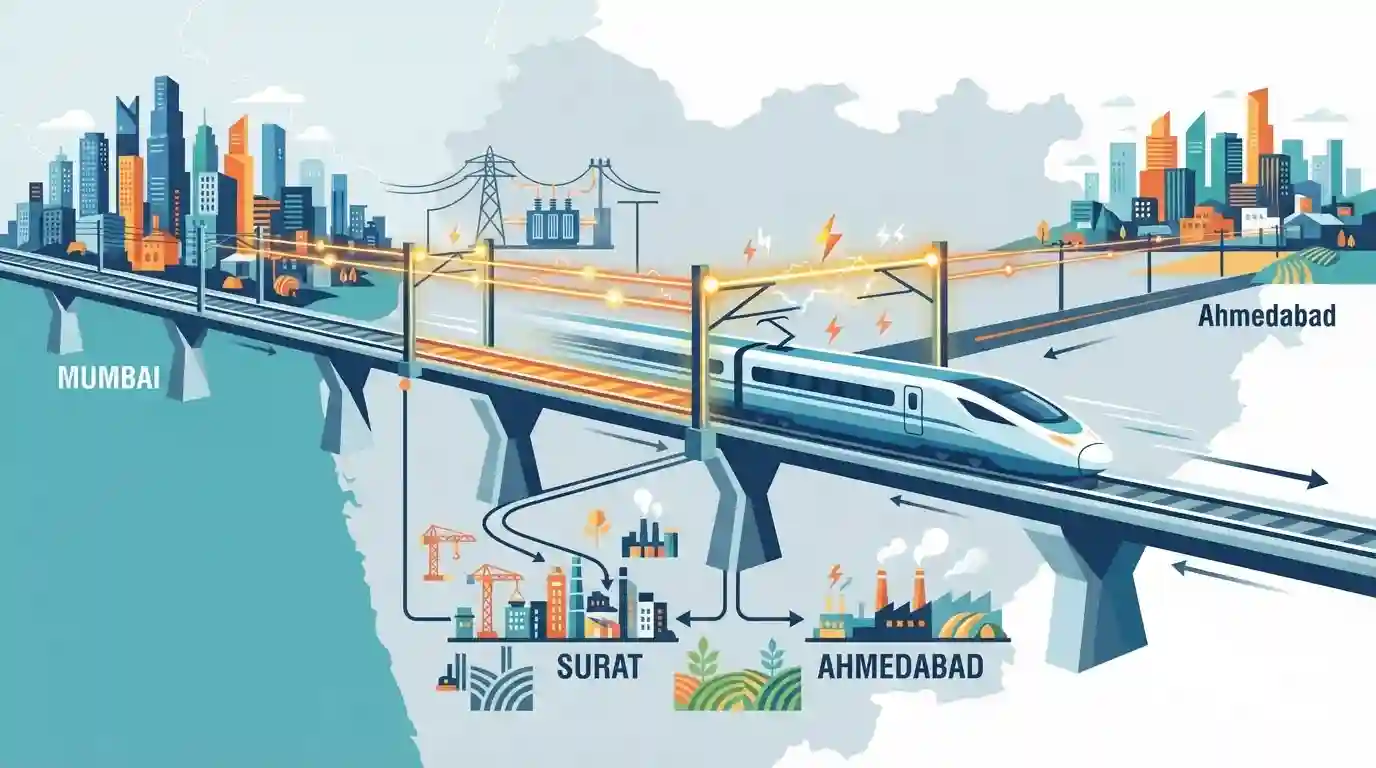
The overhead electrical system between Surat and Bilimora for India's maiden bullet train project has been successfully energised, paving the way for upcoming trial runs on the high-speed rail corridor being developed between Mumbai and Ahmedabad.
Key Points
- The overhead electrical system for the Surat-Bilimora section of India's first bullet train project has been successfully energised.
- This marks a crucial step ahead of trial runs planned for the section.
- The project is being executed by the National High Speed Rail Corporation Limited (NHSRCL) along the Mumbai-Ahmedabad corridor.
Important Terms
Mumbai Ahmedabad High Speed Rail Project

India's maiden high-speed rail corridor linking Mumbai and Ahmedabad, spanning 508 km, developed with Japanese Shinkansen technology to enable travel speeds of up to 320 km/h.
UPSC context
UPSC GS Paper III (Infrastructure, Transport, Economic Development); tests knowledge of mega transport projects and technology transfer.
National High Speed Rail Corporation Limited (NHSRCL)
A joint sector company under the Ministry of Railways tasked with designing, executing, and implementing India's high-speed rail corridor projects.
UPSC context
UPSC GS Paper III (Infrastructure/Institutions); tests institutional frameworks governing major national infrastructure projects.
Prelims Trap
India's maiden bullet train project is fully operational across the entire Mumbai-Ahmedabad corridor through domestic public sector funding.
Aspirants often assume the entire 508 km Mumbai-Ahmedabad bullet train corridor is fully operational or funded entirely through domestic budgetary allocations, missing the JICA ODA loan component and phased testing.
Static Concepts Connected
What are the key institutional and financial features of High-Speed Rail (HSR) projects in India?
- Executing Agency: NHSRCL is a joint sector company of the Central Government and participating State Governments (Gujarat and Maharashtra).
- Bilateral Funding: The project uses Japan's Shinkansen technology and is financed substantially through soft loans (ODA) from the Japan International Cooperation Agency (JICA).
- Traction System: The corridor employs a 2x25 kV overhead traction system designed for high-speed stability and efficient power transmission.
Cross-Topic Patterns
HSR Financing & Fiscal Deficit Implications
High-Speed Rail projects involve massive long-term capital investments, raising questions on fiscal deficit, public debt sustainability, and project viability under Indian Railways capital expenditure.
Bilateral ODA Loans & Strategic Partnerships
The MAHSR project relies heavily on Japanese Official Development Assistance (ODA) loans through the JICA, tying bilateral diplomacy with infrastructure development.

MAHSR 508km corridor features (JICA funding, 2x25 kV OHE system, NHSRCL role) are prime targets for matching statements in prelims.
Linked PYQs · 2
Linked PYQs · 2
- 2021MainsGS3
“Investment in infrastructure is essential for more rapid and inclusive economic growth.” Discuss in the light of India's experience.
- 2022MainsGS3
Why is Public Private Partnership (PPP) required in infrastructural projects ? Examine the role of PPP model in the redevelopment of Railway Stations in India.
