Parliamentary debate addresses concerns over US-India trade pact
Source:Indian Express ↗
Why It Matters
The article touches upon the critical intersections of foreign policy, bilateral trade negotiations, and emerging technologies. For UPSC aspirants, it provides a practical case study on the challenges of maintaining strategic autonomy in energy sourcing, negotiating equitable tariffs to protect domestic manufacturing, and safeguarding data sovereignty amidst the global AI race.
Summary
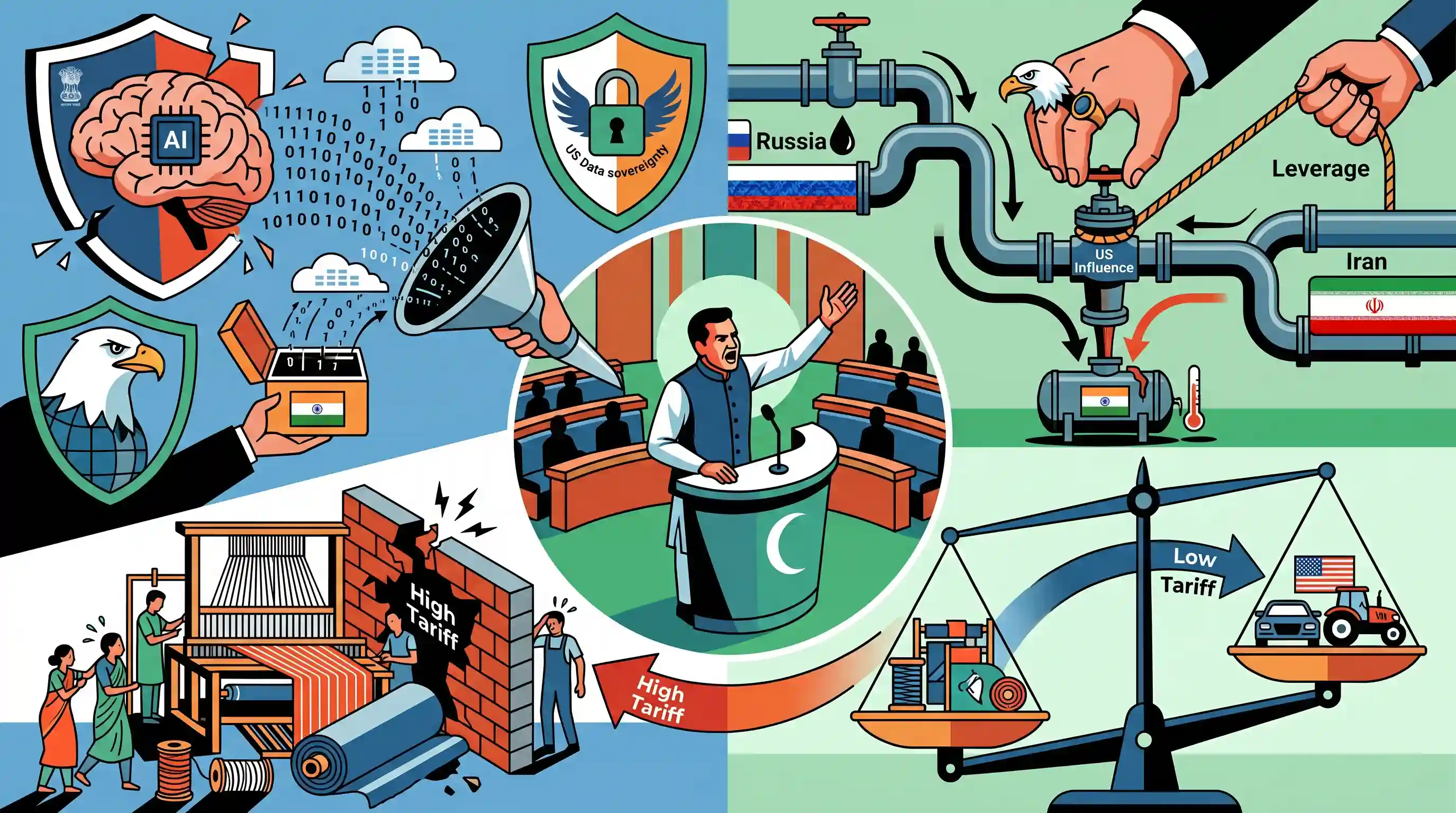
During a Lok Sabha address, Rahul Gandhi heavily criticized the recent India-US trade deal, alleging that India succumbed to American pressure at the cost of its domestic interests. He raised concerns over three primary areas: the loss of data sovereignty, asserting that India surrendered control over digital trade rules and its highly valuable data crucial for Artificial Intelligence; the threat to strategic autonomy and energy security, claiming the US now holds leverage over India's oil purchases from Russia and Iran; and the economic detriment to domestic industries due to asymmetrical tariff structures that favor US imports while harming local sectors like textiles.
Key Points
- Opposition leader Rahul Gandhi alleged that the recent India-US trade deal compromises India's data sovereignty by ceding control over digital trade rules and the data generated by its 1.4 billion citizens.
- He argued that the deal compromises India's strategic autonomy and energy security by allegedly allowing the US to monitor and dictate India's oil imports from countries like Russia and Iran.
- Gandhi criticized the tariff structure of the deal, claiming it reduced US tariffs to zero while Indian tariffs surged to 18%, adversely affecting domestic manufacturing sectors such as the Gurugram textile industry.
- Highlighting the Economic Survey's recognition of global instability, he emphasized the strategic value of Indian data as the 'petrol' for Artificial Intelligence in the ongoing US-China technological rivalry.
Important Terms
Strategic Autonomy

A foreign policy doctrine where a nation makes independent decisions on international affairs and defense, remaining free from external pressures or binding alliance obligations.
UPSC context
GS Paper II (International Relations); central to India's 'multi-alignment' strategy and balancing ties with global superpowers like the US and Russia.
Data Sovereignty
The principle that data generated within a country's borders is subject to the laws and jurisdiction of that nation, often involving localization requirements to protect national interests.
UPSC context
GS Paper III (IT, AI, and Security); critical for analyzing digital trade rules, personal data protection, and the 'AI economy.'
Energy Security
The uninterrupted availability of energy sources at an affordable price, ensuring that geopolitical shifts or import dependencies do not compromise national economic stability.
UPSC context
GS Paper III (Infrastructure/Energy); tested in the context of global supply chain disruptions, oil import diversification, and strategic petroleum reserves.
Tariffs
Taxes or duties imposed by a government on imported goods to protect domestic industries from foreign competition and generate revenue.
UPSC context
GS Paper III (Indian Economy); relevant to trade wars, Free Trade Agreements (FTAs), and the protection of labor-intensive sectors like textiles.
India-US Trade Relations
Bilateral economic negotiations aimed at reducing barriers to goods, services, and digital trade between the world's largest economy and its most populous democracy.
UPSC context
GS Paper II (Bilateral Agreements); tests understanding of economic diplomacy, trade deficits, and the convergence of strategic interests versus domestic protectionism.
Lok Sabha
The directly elected Lower House of the Indian Parliament, serving as the principal forum for legislation and holding the executive accountable through debates.
UPSC context
GS Paper II (Polity); foundational for understanding parliamentary oversight, the role of the Leader of Opposition, and the legislative process.
Prelims Trap
India is bound by WTO mandates to permit unhindered cross-border data flows in bilateral trade deals.
India has consistently refused to sign binding multilateral e-commerce rules at the WTO that mandate free data flows, preferring to retain sovereign control over digital trade.
Static Concepts Connected
What constitutes 'Data Sovereignty' in the context of India's tech policies?
- Data Localization: Mandating that critical personal or financial data generated by Indian citizens must be stored on servers physically located within India's borders.
- AI and Innovation: Retaining sovereign control over massive datasets to train indigenous AI models, preventing foreign tech monopolies from exclusively exploiting India's digital resources.
- Legal Jurisdiction: Ensuring Indian data is governed solely by domestic laws (like the DPDP Act), shielding it from extraterritorial surveillance laws of other nations.
How does India exercise Strategic Autonomy in energy security?
- Import Diversification: Expanding crude oil suppliers across geopolitical divides (e.g., US, Russia, Middle East) to insulate the economy from regional supply shocks.
- Bypassing Sanctions: Using alternative payment mechanisms like Rupee-Rouble trade to sustain critical imports from sanctioned nations without triggering secondary Western sanctions.
- Prioritizing Economics: Refusing to adhere to geopolitical dictates (like price caps) when they conflict with the domestic need to control inflation and secure affordable energy.
Cross-Topic Patterns
Data Localization vs. FTA Digital Chapters
Developed nations push for free data flows in FTAs, directly conflicting with India’s Data Protection framework that seeks to localize critical citizen data for security and AI development.
Geopolitics of Oil Imports and Inflation
India’s energy security choices heavily influence its bilateral trade negotiations, forcing a delicate balancing act between fostering US strategic partnerships and maintaining domestic inflation control via discounted Russian crude.

Expect a 2026 GS-2 Mains question linking data sovereignty in FTAs with national security and AI advancement amid tech rivalry.
Linked PYQs · 4
Linked PYQs · 4
- 2025MainsGS2
"Energy security constitutes the dominant kingpin of India's foreign policy, and is linked with India's overarching influence in Middle Eastern countries.” How would you integrate energy security with India's foreign policy trajectories in the coming years?
- 2014MainsGS2
The aim of Information Technology Agreements (ITAs) is to lower all taxes and tariffs on information technology products by signatories to zero. What impact would such agreements have on India's interests?
- 2018MainsGS3
How would the recent phenomena of protectionism and currency manipulations in world trade affect macroeconomic stability of India?
- 2025MainsGS2
"With the waning of globalization, post-Cold War world is becoming a site of sovereign nationalism.” Elucidate.
