India adopts broader diagnostic approach to tackle anaemia
Source:The Hindu ↗
Why It Matters
The shift in diagnostic methodologies (from NFHS capillary to DABS-I venous sampling) represents a crucial advancement in evidence-based policymaking. Additionally, the evolution of the Anaemia Mukt Bharat strategy to include hemoglobinopathies and broader nutritional deficiencies is highly relevant for GS2 Health and Governance questions regarding malnutrition and public health interventions.
Summary
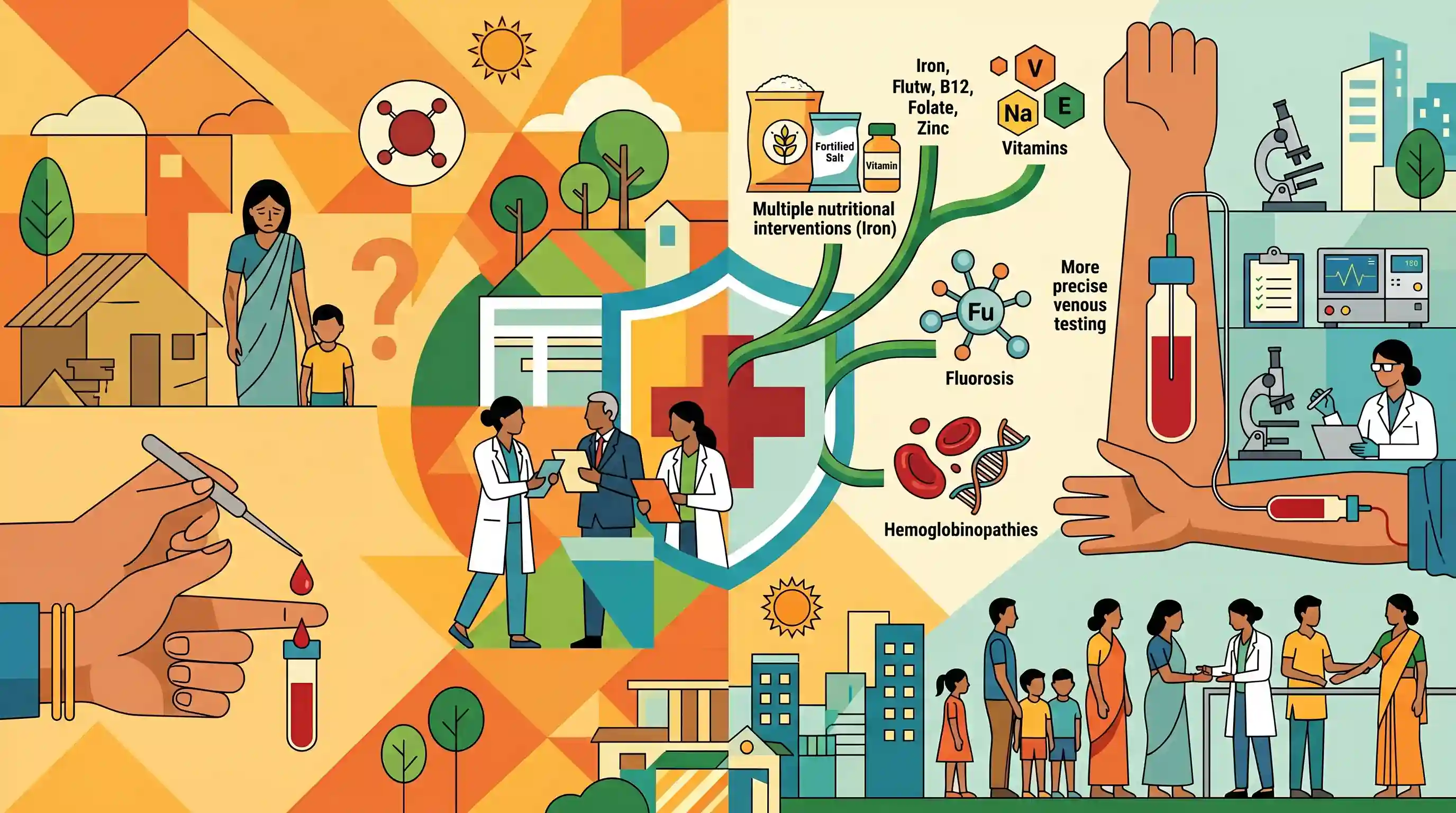
India is broadening its approach to tackling anaemia beyond mere iron deficiency, recognizing its complex etiology that includes deficiencies in vitamins B12, folate, and zinc, as well as non-nutritional causes like fluorosis and hemoglobinopathies. The Anaemia Mukt Bharat (AMB) strategy under POSHAN Abhiyaan is central to this holistic public health effort. Furthermore, to ensure accurate measurement of anaemia prevalence, the government is shifting its diagnostic approach: data collection via the Diet and Biomarkers Survey in India (DABS-I) utilizing venous blood samples will replace the less precise capillary blood method previously used in the National Family Health Survey (NFHS).
Key Points
- India is expanding its strategy to combat anaemia by recognizing it as a multi-factorial issue, moving beyond the traditional focus solely on iron deficiency.
- The updated approach targets other nutritional deficiencies, including vitamins B12, folate, and zinc, which are crucial for red blood cell formation.
- Non-nutritional causes of anaemia, such as fluorosis, hemoglobinopathies (like sickle cell disease and thalassemia), and poor water, sanitation, and hygiene (WASH) conditions are being systematically addressed.
- To improve the accuracy of public health data, India is shifting from the capillary blood sampling method used in the National Family Health Survey (NFHS) to venous blood sampling under the comprehensive Diet and Biomarkers Survey in India (DABS-I).
Important Terms
Anaemia Mukt Bharat (AMB)

A national strategy launched in 2018 under POSHAN Abhiyaan to reduce anaemia prevalence by 3% annually using a "6x6x6" strategy (six target groups, interventions, and institutional mechanisms).
UPSC context
GS Paper II (Health/Social Justice); tests understanding of multi-pronged public health interventions and lifecycle-based strategies.
POSHAN Abhiyaan
India's flagship National Nutrition Mission (2018) aiming to reduce stunting, undernutrition, and anaemia through inter-ministerial convergence and a technology-driven monitoring approach.
UPSC context
GS Paper II (Issues relating to hunger/poverty); central to achieving SDG 2 and enhancing human capital.
Diet and Biomarkers Survey in India (DABS-I)
A comprehensive survey by ICMR-NIN using venous blood samples and biomarkers to map dietary intake and nutritional status across India with high diagnostic precision.
UPSC context
GS Paper II (Health/Governance); highlights shifts in data methodology for evidence-based policymaking and addressing micronutrient deficiencies.
National Family Health Survey (NFHS)
A periodic, nationally representative household survey providing critical data on fertility, maternal/child health, and nutrition, coordinated by the International Institute for Population Sciences (IIPS).
UPSC context
GS Paper II (Social Justice/Health); primary evidence source for evaluating health outcomes and development indicators.
National Sickle Cell Anaemia Elimination Mission
A mission launched in 2023 targeting the elimination of sickle cell disease as a public health problem by 2047, primarily through screening in tribal areas.
UPSC context
GS Paper II (Health/Tribal Welfare); addresses hereditary blood disorders and equitable health access for vulnerable communities.
National Institute of Nutrition (NIN)
India's premier public health and nutrition research center under the ICMR, responsible for dietary guidelines, nutrient requirements, and conducting national biomarker surveys.
UPSC context
GS Paper II (Health/Research Institutions); crucial for scientific framing of national nutrition standards and policy.
Prelims Trap
Anaemia in India is exclusively caused by iron deficiency, which the Anaemia Mukt Bharat strategy targets.
While iron deficiency is a major cause, anaemia is multi-factorial. The AMB strategy explicitly targets other nutritional deficiencies (B12, folate) and non-nutritional causes (fluorosis, malaria, sickle cell).
Static Concepts Connected
How do genetic hemoglobinopathies differ from acquired nutritional anaemia?
- Nutritional Anaemia: Caused by deficiencies in micronutrients (Iron, Vitamin B12, Folate, Zinc) essential for red blood cell synthesis.
- Sickle Cell Disease: An inherited structural genetic defect causing red blood cells to become rigid, sticky, and sickle-shaped.
- Thalassemia: An inherited quantitative genetic defect that reduces the production of alpha or beta globin chains in hemoglobin.
What is the 6x6x6 strategy of Anaemia Mukt Bharat (AMB)?
- Six Beneficiaries: Targets six groups: Children (6-59 months, 5-9 years, 10-19 years), Women of reproductive age, Pregnant women, and Lactating women.
- Six Interventions: Includes prophylactic Iron and Folic Acid (IFA) supplementation, deworming, delayed cord clamping, and testing/treatment of anaemia.
- Six Mechanisms: Involves inter-departmental convergence, National/State hubs, supply chain monitoring, and leveraging the digital dashboard for monitoring.
Cross-Topic Patterns
Health Data Methodology & Governance
The transition from NFHS (capillary blood) to DABS-I (venous blood) highlights a growing focus on statistical accuracy in governance, reflecting how precise health metrics drive evidence-based policymaking and scheme funding.
Water Quality and Disease Burden
Linking fluorosis-induced anaemia to groundwater contamination connects public health outcomes (POSHAN) directly with environmental geography and water, sanitation, and hygiene (WASH) initiatives like the Jal Jeevan Mission.

A 2026 Prelims question will likely contrast the etiology of nutritional anaemia (B12/Folate/zinc) with genetic hemoglobinopathies.
Linked PYQs · 4
Linked PYQs · 4
- 2023PrelimsGS1
Consider the following statements in the context of interventions being undertaken under Anaemia Mukt Bharat Strategy: 1. It provides prophylactic calcium supplementation for pre-school children, adolescents and pregnant women. 2. It runs a campaign for delayed cord clamping at the time of child-birth. 3. It provides for periodic deworming to children and adolescents. 4. It addresses non-nutritional causes of anaemia in endemic pockets with special focus on malaria, hemoglobinopathies and fluorosis. How many of the statements given above are correct?
- 2017PrelimsGS1
Which of the following are the objectives of 'National Nutrition Mission'? 1. To create awareness relating to malnutrition among pregnant women and lactating mothers. 2. To reduce the incidence of anaemia among young children, adolescent girls and women. 3. To promote the consumption of millets, coarse cereals and unpolished rice. 4. To promote the consumption of poultry eggs. Select the correct answer using the code given below:
- 2024MainsGS2
Poverty and malnutrition create a vicious cycle, adversely affecting human capital formation. What steps can be taken to break the cycle ?
- 2017MainsGS3
Stem cell therapy is gaining popularity in India to treat a wide variety of medical conditions including Leukaemia, Thalassemia, damaged cornea and severe burns. Describe briefly what stem cell therapy is and what advantages it has over other treatments?
