India Potential Mediatory Role in Israel Palestine Conflict
Source:Indian Express ↗
Why It Matters
India's relationship with the Middle East is a cornerstone of its foreign policy (energy security, diaspora, defense). The article highlights India's transition from non-alignment to multi-alignment (de-hyphenation) and its potential future role as a global peacemaker, which is highly relevant for GS Paper 2 (International Relations).
Summary
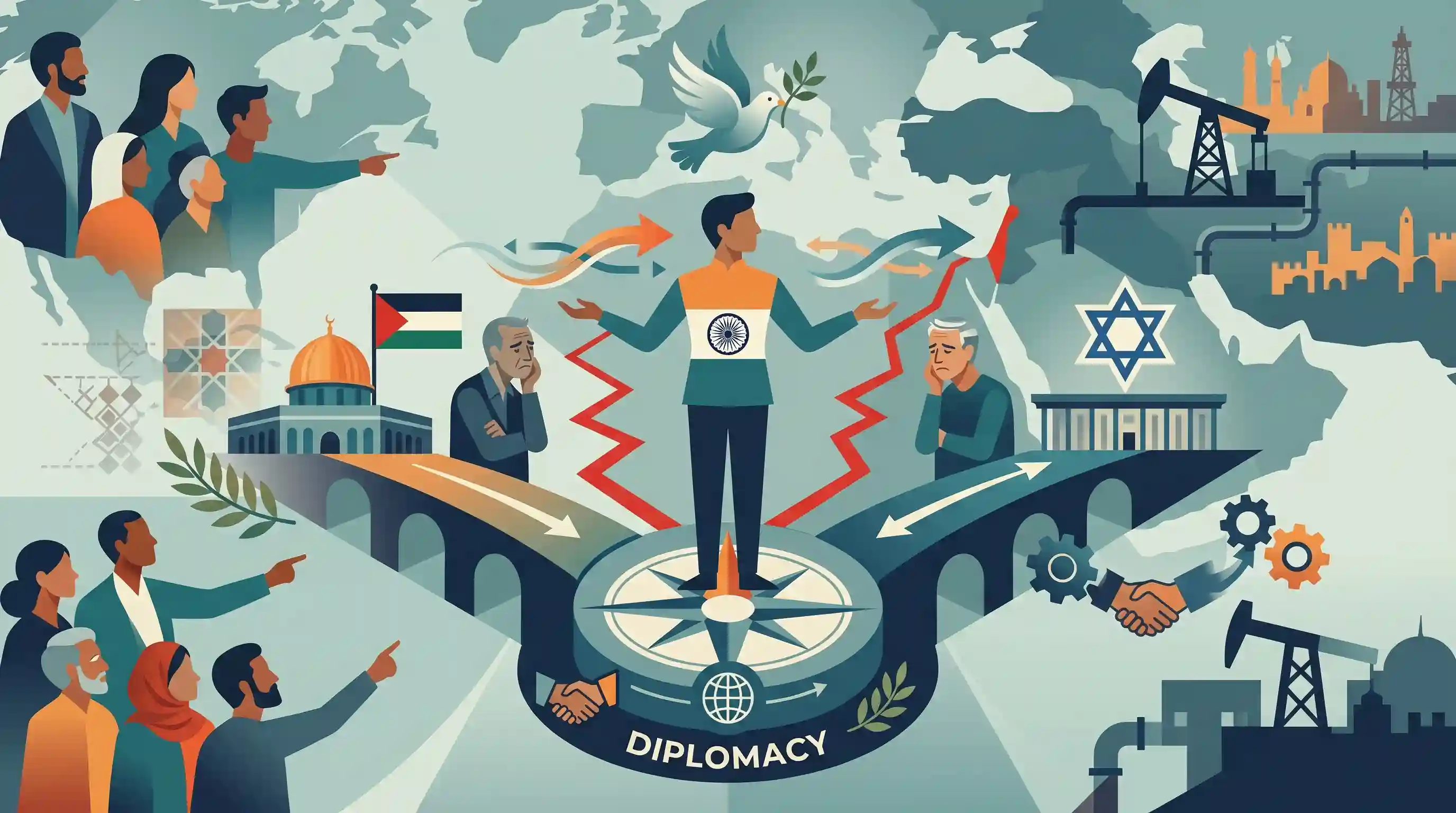
A diplomatic appeal has been made for India to play a mediatory role between Israel and Palestine to help end the ongoing conflict and occupation. Drawing upon India's historical support for the Palestinian cause alongside its deep strategic ties with Israel, stakeholders are urging New Delhi to leverage its position as a trusted voice. The call reflects growing international expectations of India to actively participate in global conflict resolution, utilizing its 'de-hyphenation' policy to foster dialogue and peace in West Asia.
Key Points
- Appeals have been made for India to act as a mediating bridge in the Israel-Palestine conflict to help end the occupation.
- India's unique diplomatic leverage comes from its successful 'de-hyphenation' policy, maintaining deep independent ties with both Israel and Palestine.
- The call reflects international expectations of India leveraging its rising diplomatic clout as a leader of the Global South to participate actively in conflict resolution.
- The ultimate goal of such mediation would be to establish peace, address humanitarian crises, and push forward a viable two-state solution.
Important Terms
Two-state solution

A proposed framework for resolving the Israel-Palestine conflict by establishing an independent Palestinian state alongside the State of Israel, ensuring peace and mutual recognition.
UPSC context
GS Paper II (International Relations). Crucial for understanding India’s consistent diplomatic stance on West Asian stability.
De-hyphenation policy
A foreign policy strategy where India manages its bilateral relations with Israel and Palestine independently, ensuring engagements with one do not adversely affect the other.
UPSC context
GS Paper II. Tests understanding of India’s strategic autonomy and pragmatic shift in West Asian diplomacy.
Global South
A term referring to developing and less-developed nations, primarily in the Southern Hemisphere, characterized by shared historical experiences of colonialism and current developmental challenges.
UPSC context
GS Paper II. Relevant for India’s leadership role and its "Voice of Global South" initiative.
Abraham Accords
A series of normalization agreements between Israel and several Arab nations (e.g., UAE, Bahrain), brokered by the U.S. in 2020, reshaping regional geopolitics.
UPSC context
GS Paper II. Significant for analyzing the shifting regional alliances that provide India greater diplomatic space.
Look West Policy
India’s strategic initiative to deepen economic, energy, and security engagements with West Asian nations, moving beyond its historical focus on the "Look East" policy.
UPSC context
GS Paper II. Essential for discussing India’s regional outreach and its tri-directional focus on Saudi Arabia, Iran, and Israel.
I2U2 Grouping
A mini-lateral grouping consisting of India, Israel, the UAE, and the USA, focusing on joint investments in water, energy, transportation, space, health, and food security.
UPSC context
GS Paper II. Often called the "West Asian Quad," it represents India’s growing strategic footprint in the region.
Prelims Trap
India's 'de-hyphenation' policy requires an equal balancing of diplomatic visits and aid between Israel and Palestine.
De-hyphenation means treating relations as independent, mutually exclusive tracks based on their own merits. It explicitly eliminates the compulsion to artificially balance interactions equally.
Static Concepts Connected
What is India's 'De-hyphenation' policy in West Asia?
- Independent Tracks: Treating diplomatic and strategic ties with Israel and Palestine as mutually exclusive, evaluating each relationship purely on its own standalone merits.
- Ending the Balance: It formally eliminates the traditional diplomatic compulsion to balance a high-level visit or agreement with Israel by simultaneously appeasing the Palestinian leadership.
- Pragmatic Diplomacy: Enables deep strategic and defense partnerships with Israel without officially diluting India's developmental aid and historical support for the Palestinian cause.
How has India historically engaged with the Palestinian cause?
- Early Opposition: India historically opposed the partition, voting against the 1947 UN General Assembly resolution that partitioned Palestine.
- PLO Recognition: India was the first non-Arab State to recognize the Palestine Liberation Organization (PLO) as the sole representative of the Palestinians in 1974.
- Sovereign Statehood: India officially recognized the State of Palestine in 1988 and consistently advocates for a Two-State Solution at multilateral forums.
Cross-Topic Patterns
West Asian minilaterals vs. Global South
India's mediation capabilities reflect a complex multi-alignment strategy, balancing its involvement in US-backed minilaterals (I2U2) and economic corridors (IMEEC) with its traditional credibility as a leader of the Global South.
Map-reading the Levant geography
UPSC frequently tests geopolitical crises via physical geography. Expect map-based Prelims questions identifying the Mediterranean coastline, Golan Heights, Gulf of Aqaba, and borders of the Gaza Strip and West Bank.

Expect a GS2 Mains question evaluating the success of India's 'de-hyphenation' policy amidst escalating multi-front wars in West Asia.
Linked PYQs · 3
Linked PYQs · 3
- 2018MainsGS2
“India’s relations with Israel have, of late, acquired a depth and diversity, which cannot be rolled back.” Discuss.
- 2022PrelimsGS1
The term "Levant" often heard in the news roughly corresponds to which of the following regions?
- 2023PrelimsGS1
Consider the following pairs: Regions often mentioned in news Reason for being in news 1. North Kivu and Ituri : War between Armenia and Azerbaijan 2. Nagorno-Karabakh : Insurgency in Mozambique 3. Kherson and Zaporizhzhia : Dispute between Israel and Lebanon How many of the above pairs are correctly matched?
