Cargo Ship Attack in Strait of Hormuz
Source:The Hindu ↗
Why It Matters
The Strait of Hormuz is a crucial chokepoint for global oil transit. Disruptions in this region severely threaten India's energy security, domestic inflation, and maritime trade, while testing India's diplomatic agility and naval capacity to act as a net security provider.
Summary
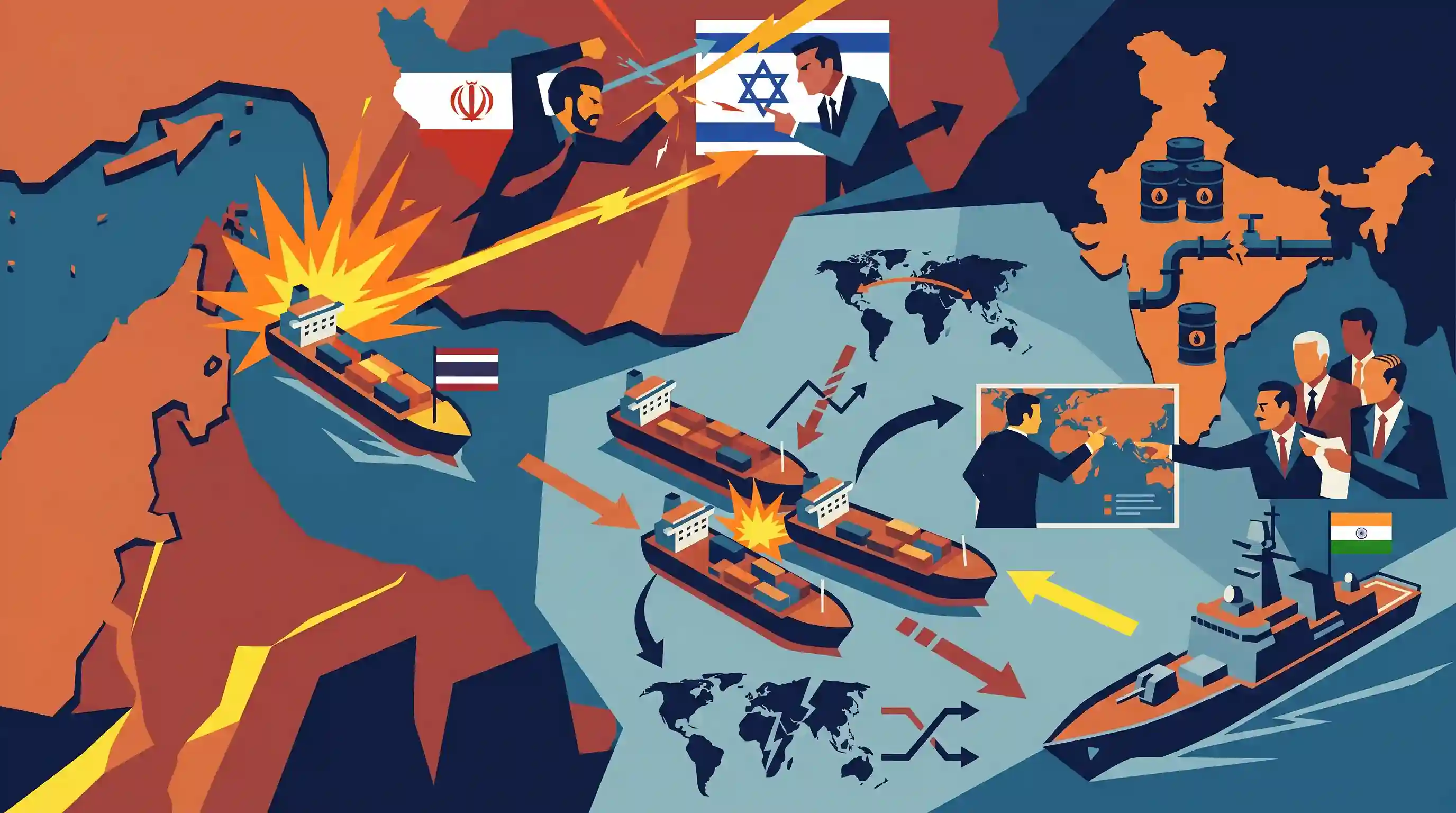
An India-bound Thai-flagged cargo ship was attacked in the Strait of Hormuz amid escalating geopolitical conflicts in the Middle East involving Iran and Israel. The incident underscores the vulnerability of critical maritime chokepoints and the subsequent risks to global trade and India's energy security. In response to the growing threats to commercial shipping in the Persian Gulf, the Indian government is evaluating the deployment of the Indian Navy to escort stranded vessels, reflecting its role in ensuring regional maritime security.
Key Points
- A Thai-flagged cargo ship, the Mayuree Naree, bound for Kandla, India, was attacked in the Strait of Hormuz, disrupting vital maritime trade routes.
- The attack is part of an escalating regional conflict involving Iran and Israel, posing direct threats to shipping lanes and the global energy economy.
- The Strait of Hormuz is a critical maritime chokepoint for global oil exports; disruptions here directly jeopardize India's energy security.
- In response to the crisis, the Indian government is reportedly considering deploying the Indian Navy to escort stranded merchant vessels in the Persian Gulf.
Important Terms
Strait of Hormuz

A critical maritime chokepoint between the Persian Gulf and the Gulf of Oman through which approximately 20-25% of global oil and LNG trade passes.
UPSC context
GS Paper 1 (Geography) and GS Paper 2 (International Relations); critical for understanding global energy trade and maritime security.
Indian Navy
The maritime branch of the Indian Armed Forces responsible for ensuring regional maritime security and acting as a 'net security provider' in the Indian Ocean.
UPSC context
GS Paper 3 (Internal Security) and GS Paper 2 (IR); tests India's strategic role in the Indian Ocean Region (IOR).
Operation Urja Suraksha
A specific 2026 Indian Navy initiative launched to protect India-bound tankers and cargo ships in the Strait of Hormuz amid escalating regional conflicts.
UPSC context
GS Paper 3 (Security) and GS Paper 2 (IR); relevant for current affairs questions on India’s naval responses to energy crises.
U.K. Maritime Trade Operations (UKMTO)
A Royal Navy-led information conduit that provides maritime security updates and coordinates communication between commercial merchant vessels and global military forces.
UPSC context
GS Paper 2 (International Relations); focuses on international cooperation mechanisms for maritime trade safety and threat reporting.
Freedom of Navigation
A core principle of international maritime law (UNCLOS) asserting that ships from any state shall not suffer interference from other states while in international waters.
UPSC context
GS Paper 2 (IR/Polity); tests knowledge of international conventions like UNCLOS and legal disputes in strategic waterways.
Energy Security
The reliable and affordable supply of energy; for India, this is intrinsically linked to the stability of West Asian maritime chokepoints.
UPSC context
GS Paper 3 (Economy/Infrastructure); crucial for analyzing India's strategic reserves and economic vulnerability to supply chain disruptions.
Omani Navy
The naval component of the Sultanate of Oman, which frequently collaborates with international navies for search-and-rescue and security operations in the Strait of Hormuz.
UPSC context
GS Paper 2 (IR); relevant for bilateral maritime cooperation and regional security architecture in the Western Indian Ocean.
Prelims Trap
"Coastal states can legally suspend 'transit passage' through international straits like Hormuz during security crises under UNCLOS."
UNCLOS guarantees the 'right of transit passage' through international straits. Unlike 'innocent passage' in territorial waters, transit passage cannot be unilaterally suspended by coastal states.
Static Concepts Connected
What are the key maritime chokepoints of the Middle East?
- Strait of Hormuz: Connects the Persian Gulf to the Gulf of Oman and Arabian Sea. Bordered by Iran, Oman, and the UAE.
- Bab el-Mandeb: Connects the Red Sea to the Gulf of Aden. Bordered by Yemen, Djibouti, and Eritrea.
What framework governs navigation through international straits?
- Transit Passage: Under UNCLOS, all ships and aircraft enjoy the right of continuous and expeditious transit passage through international straits.
- Operation Sankalp: An Indian Navy mission launched in 2019 to escort merchant vessels in the Persian Gulf, leveraging UNCLOS to protect trade.
Cross-Topic Patterns
Chokepoints and Strategic Reserves
Disruptions in Hormuz directly test India's Strategic Petroleum Reserves (SPR) capacity and accelerate the push for alternate fuels like green hydrogen to offset crude import vulnerabilities.
Net Security Provider doctrine
India's deployment to escort non-Indian flagged (Thai) but India-bound vessels cements its evolution from a regional observer to a proactive 'net security provider' in the IOR.

Map-based matching questions linking Middle East straits to bordering nations and UNCLOS maritime passage rules are highly likely in 2026.
Linked PYQs · 5
Linked PYQs · 5
- 2025MainsGS2
"Energy security constitutes the dominant kingpin of India's foreign policy, and is linked with India's overarching influence in Middle Eastern countries.” How would you integrate energy security with India's foreign policy trajectories in the coming years?
- 2017MainsGS2
The question of India's Energy Security constitutes the most important part of India's economic progress. Analyze India's energy policy cooperation with West Asian countries.
- 2025MainsGS3
Why is maritime security vital to protect India's sea trade? Discuss maritime and coastal security challenges and the way forward.
- 2022MainsGS3
What are the maritime security challenges in India ? Discuss the organisational, technical and procedural initiatives taken to improve the maritime security.
- 2024PrelimsGS1
Consider the following statements : Statement-I : Sumed pipeline is a strategic route for Persian Gulf oil and natural gas shipments to Europe. Statement-II : Sumed pipeline connects the Red Sea with the Mediterranean Sea. Which one of the following is correct in respect of the above statements?
