Opposition Opposes Proposed Bill on Jailed Ministers
Source:The Hindu ↗
Why It Matters
The debate over the 130th Amendment Bill touches directly upon the Representation of the People Act and constitutional provisions for disqualification, which are frequent UPSC themes. The allegations of electoral roll manipulation in Bihar also highlight the critical role of the Election Commission in maintaining free and fair elections, a core tenet of the basic structure doctrine.
Summary
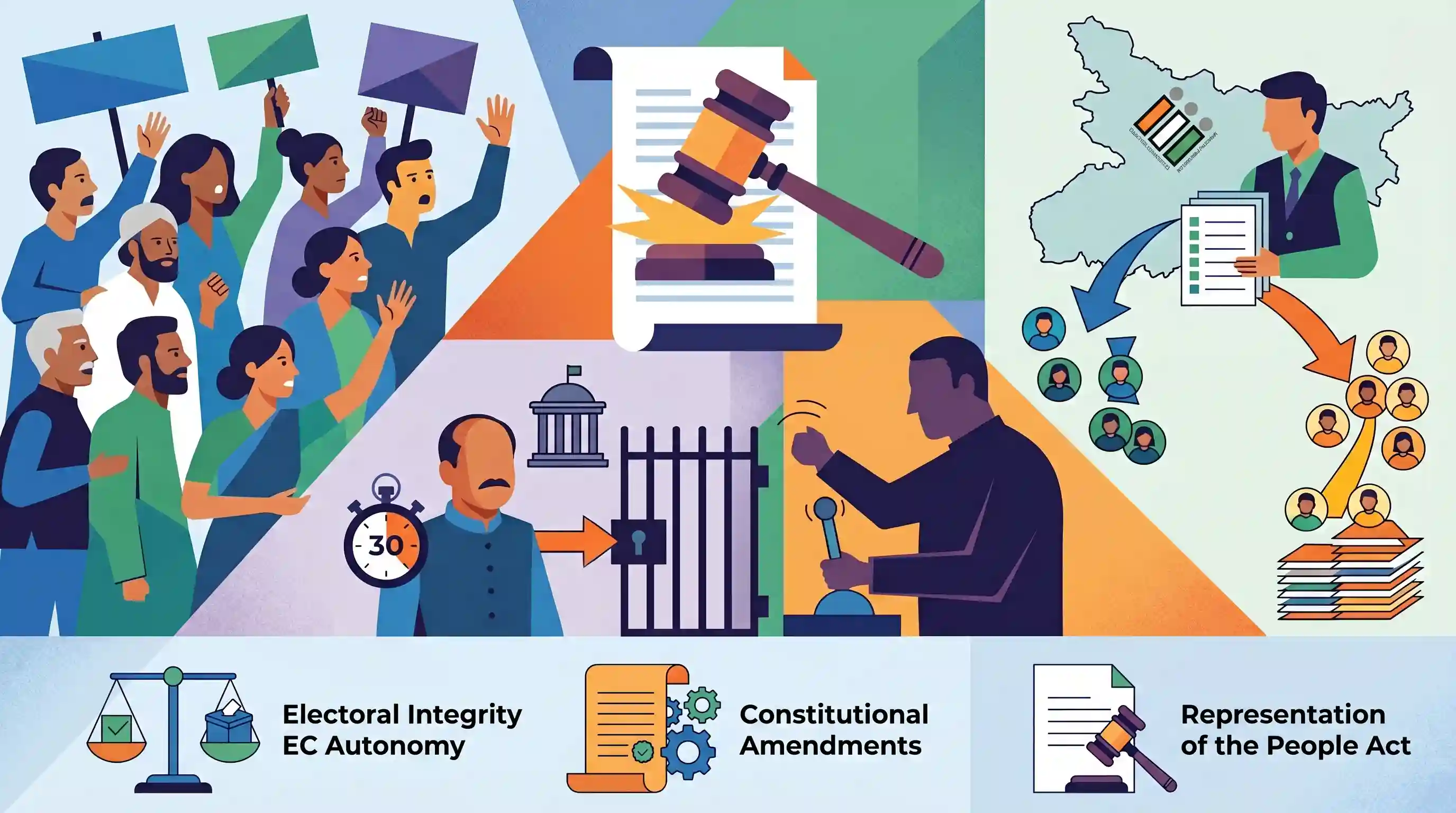
The INDIA bloc, led by the Congress, has strongly opposed the Constitution (130th Amendment) Bill, 2025, which seeks to disqualify ministers, including the Prime Minister, if they spend 30 consecutive days in jail. Opposition leaders argue that the bill is a politically motivated move by the ruling NDA to sideline adversaries. Additionally, the bloc raised serious concerns regarding the Election Commission's Special Intensive Revision of electoral rolls in Bihar, alleging foul play through the targeted deletion of opposition voters and the addition of ruling party supporters. The issue underscores ongoing debates over electoral integrity, the autonomy of constitutional bodies, and the statutory grounds for political disqualification.
Key Points
- The INDIA bloc has vowed to block the Constitution (130th Amendment) Bill, 2025, which proposes disqualifying any minister or prime minister who spends 30 consecutive days in jail.
- Congress General Secretary K.C. Venugopal accused the NDA government of using bills like this and the Waqf Bill to distract from its failures and target political opponents.
- The opposition raised alarms over the Special Intensive Revision (SIR) of voter lists in Bihar, alleging the Election Commission is permitting the arbitrary deletion of anti-BJP votes and the addition of pro-BJP votes.
- The INDIA bloc intends to officially petition the Election Commission of India (ECI) to ensure electoral roll integrity and protect the autonomy of the electoral process.
Important Terms
Constitution (130th Amendment) Bill, 2025

A proposed 2025 amendment seeking the removal of Ministers, including the PM and CMs, if they are detained in custody for 30 consecutive days, even without a formal conviction.
UPSC context
GS Paper II (Polity); tests understanding of legislative disqualification, executive accountability, and the principle of 'innocent until proven guilty'.
Representation of the People Act, 1951
The principal Act of Parliament governing the conduct of elections, qualifications, and disqualifications of legislators; currently requires a two-year conviction for disqualification under Section 8.
UPSC context
GS Paper II (Elections); a core statutory topic for questions on electoral reforms and the decriminalization of Indian politics.
Election Commission of India (ECI)
An autonomous constitutional body under Article 324 tasked with supervising elections, maintaining voter lists, and ensuring the integrity of the democratic process at Union and State levels.
UPSC context
GS Paper II (Constitutional Bodies); critical for topics on institutional autonomy and the administration of free and fair elections.
Special Intensive Revision (SIR)
A comprehensive door-to-door verification process by the ECI to update and error-correct electoral rolls, often conducted under Section 21 of the Representation of the People Act, 1950.
UPSC context
GS Paper II (Governance); relevant to debates on voter exclusion, administrative transparency, and electoral roll integrity.
INDIA bloc
A multi-party opposition alliance (Indian National Developmental Inclusive Alliance) formed to challenge the ruling NDA, focusing on issues of federalism, democratic rights, and electoral integrity.
UPSC context
GS Paper II (Polity); illustrates current dynamics of coalition politics and the role of the opposition in a parliamentary system.
Articles 75 and 164
Key constitutional articles prescribing the appointment, tenure, and responsibility of the Union (Art 75) and State (Art 164) Councils of Ministers, currently being targeted by the 130th Amendment.
UPSC context
GS Paper II (Executive); fundamental for understanding the constitutional framework governing the appointment and removal of ministers.
Prelims Trap
Under the RPA 1951, a minister is automatically disqualified if detained in police custody for 30 consecutive days.
Under existing law, mere detention does not disqualify a legislator. The RPA 1951 mandates actual judicial conviction with a sentence of two years or more (Lily Thomas case) for disqualification.
Static Concepts Connected
What are the current legal grounds for disqualifying legislators upon imprisonment?
- RPA 1951 (Sec 8): Requires actual judicial conviction with a sentence of at least two years to trigger immediate disqualification of a legislator.
- Lily Thomas (2013): Struck down the statutory 3-month appeal window (Section 8(4)), making disqualification upon conviction immediate.
- Preventive Detention: Mere detention or arrest without a judicial conviction does not currently disqualify a Member of Parliament or State Legislature.
How are electoral rolls prepared and revised in India?
- Statutory Basis: The Representation of the People Act, 1950 (not 1951) governs the preparation, revision, and maintenance of electoral rolls.
- Article 324: Vests the overarching power of superintendence, direction, and control of electoral rolls in the Election Commission of India.
- Types of Revision: Includes Summary Revision (at designated centers) and Special Intensive Revision (rigorous house-to-house verification) explicitly ordered by the ECI.
Cross-Topic Patterns
Executive agencies vs. Electoral mandates
The 130th Amendment raises basic structure concerns by potentially allowing central investigative agencies to unseat state Chief Ministers through pre-trial detention, circumventing the separation of powers and federalism.
ECI Autonomy & Voter Deletion
Allegations of targeted voter deletions during roll revision (RPA 1950) tie into broader structural debates regarding the recent Chief Election Commissioner Appointment Act and the institutional neutrality of the poll body.

Expect a multi-statement prelims question contrasting disqualification via conviction (RPA 1951) versus pre-trial detention proposals.
Linked PYQs · 5
Linked PYQs · 5
- 2020MainsGS2
There is a need for simplification of procedure for disqualification of persons found guilty of corrupt practices under the Representation of Peoples Act". Comment.
- 2022MainsGS2
Discuss the procedures to decide the disputes arising out of the election of a Member of the Parliament or State Legislature under The Representation of the People Act, 1951. What are the grounds on which the election of any returned candidate may be declared void ? What remedy is available to the aggrieved party against the decision ? Refer to the case laws.
- 2019MainsGS2
On what grounds a people's representative can be disqualified under the Representation of Peoples Act, 1951? Also mention the remedies available to such person against his disqualification.
- 2024MainsGS2
Examine the need for electoral reforms as suggested by various committees with particular reference to "one nation one election" principle.
- 2024PrelimsGS1
As per Article 368 of the Constitution of India, the Parliament may amend any provision of the Constitution by way of : 1. Addition 2. Variation 3. Repeal Select the correct answer using the code given below:
