Parliamentary Oversight on National Security and Foreign Policy
Source:The Hindu ↗
Why It Matters
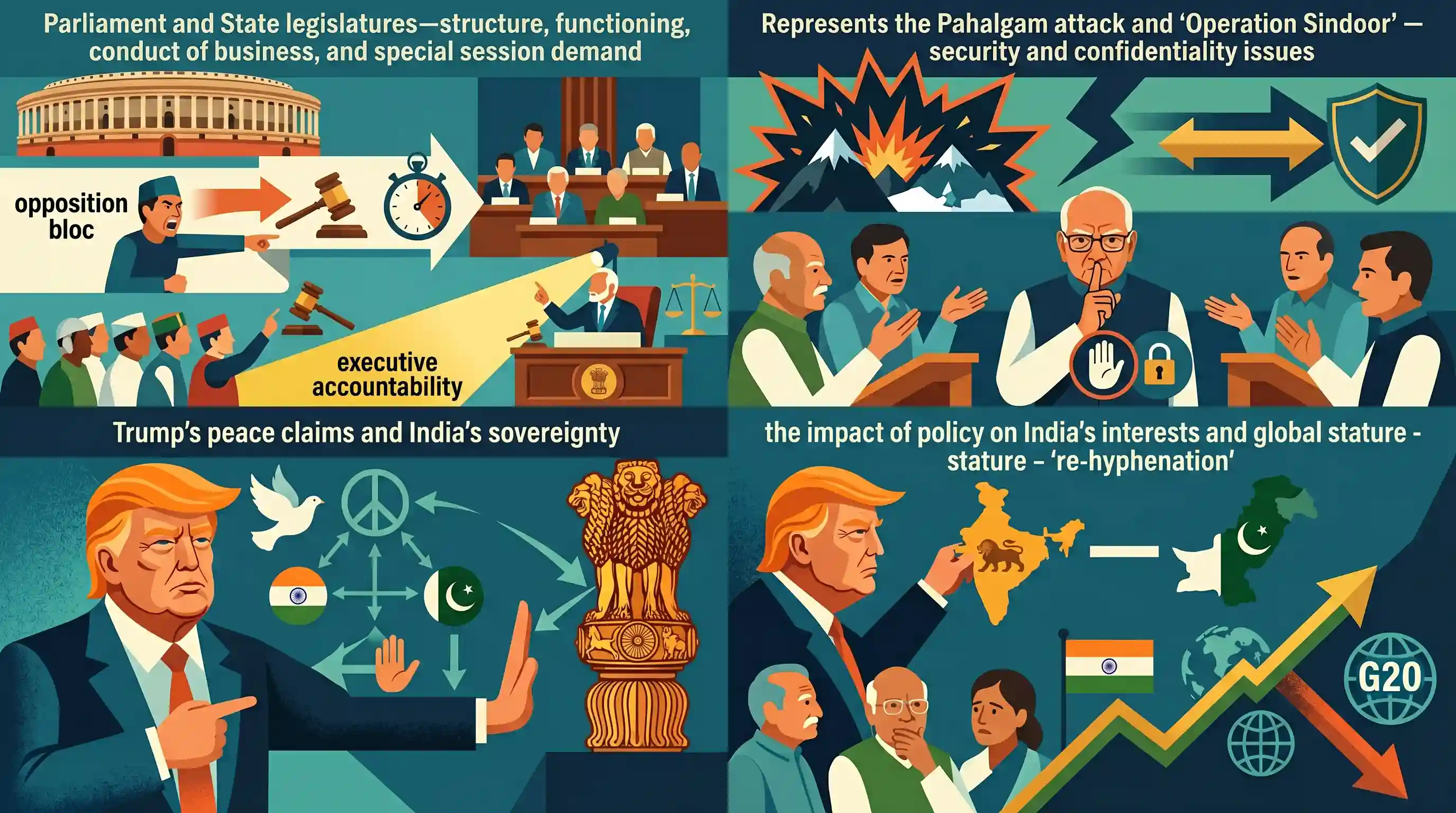
Highlights the ongoing tension between parliamentary accountability and the need for confidentiality in national security matters. It also illustrates the diplomatic challenges India faces, specifically how unsolicited foreign mediation (like US claims) can contradict India's strict bilateralism stance and inadvertently 'hyphenate' India and Pakistan, complicating its strategic global posture.
Summary
The opposition INDIA bloc is pushing for a special session of Parliament to debate the national security and foreign policy implications of the Pahalgam terror attack and the subsequent 'Operation Sindoor'. The demand centers on ensuring executive accountability, although leaders like Sharad Pawar have stressed the need to maintain confidentiality on sensitive security matters. Additionally, the opposition has raised concerns over US President Donald Trump repeatedly claiming credit for brokering peace. Leaders argue that such unsolicited American mediation undermines India's sovereign foreign policy and re-'hyphenates' India and Pakistan, negatively impacting India's global stature.
Key Points
- The INDIA bloc is deliberating on demanding a special session of Parliament to discuss the Pahalgam terror attack and the subsequent Operation Sindoor.
- Proponents of the session seek a full parliamentary debate on national security and foreign policy implications, emphasizing executive accountability.
- NCP (SP) leader Sharad Pawar opposed the open discussion, arguing that sensitive security matters should remain confidential in the national interest.
- RJD MP Manoj K. Jha criticized the government over US President Donald Trump's claims of brokering peace between India and Pakistan.
- Jha argued that unsolicited American mediation undermines India's sovereign foreign policy and effectively 'hyphenates' India and Pakistan again, hurting India's global standing.
Important Terms
Special Session of Parliament

A parliamentary meeting convened outside the three regular sessions (Budget, Monsoon, Winter) to address urgent or specific national issues, often used to debate critical events or ensure government accountability.
UPSC context
GS II (Polity): Parliamentary functioning and the power of the President (Art. 85) to summon sessions.
Executive Accountability
The constitutional principle (Art. 75) ensuring the Council of Ministers remains answerable to the Lok Sabha for administrative actions, national security, and policy implementation through tools like debates and motions.
UPSC context
GS II (Polity): Key feature of the Parliamentary form of government and checks and balances.
Hyphenation (India-Pakistan)
A diplomatic tendency where the international community links India and Pakistan as equivalent entities in policy. India advocates for 'de-hyphenation' to be recognized as a standalone global power.
UPSC context
GS II (IR): Foreign policy strategy, India's global stature, and neighborhood relations.
INDIA bloc
A multi-party opposition coalition (Indian National Developmental Inclusive Alliance) formed to challenge the ruling government on legislative scrutiny, federalism, and socio-economic governance.
UPSC context
GS II (Polity): Role of political parties and coalitions in a multi-party democracy.
Operation Sindoor
An Indian military operation (May 2025/2026) involving targeted strikes on terror infrastructure in Pakistan and PoJK following a major security breach in Pahalgam.
UPSC context
GS III (Internal Security): Military response strategies and cross-border terrorism management.
Prelims Trap
The Constitution explicitly outlines the procedure for a 'Special Session' if one-tenth of Lok Sabha members demand it.
The Constitution doesn't define 'Special Session'. It falls under general summoning powers (Article 85). Aspirants confuse this with a 'Special Sitting' (Article 352), which requires a 1/10th member demand.
Static Concepts Connected
How are special parliamentary sessions convened and can they be held in secret?
- Constitutional Basis: The Constitution doesn't mention 'Special Sessions'. They are convened under the President's general summoning power (Article 85), following a decision by the Cabinet Committee on Parliamentary Affairs.
- Secret Sittings: Parliament holds the collective privilege to exclude strangers. The Leader of the House can request a secret sitting to discuss security, during which media publication is strictly prohibited.
What is the legal basis for India's rejection of third-party mediation?
- Simla Agreement: Signed in 1972, it formally institutionalized bilateralism, legally obligating India and Pakistan to resolve differences peacefully through bilateral negotiations without third-party intervention.
- De-hyphenation Policy: India's diplomatic strategy to engage global powers on its distinct strategic merits, pushing back against historical Western foreign policy lenses that treated India and Pakistan as a single conflict entity.
Cross-Topic Patterns
Executive Accountability vs National Security
The tension between parliamentary oversight and executive secrecy during military operations frequently tests the boundaries of Parliamentary Privileges and the invocation of the Official Secrets Act.
De-hyphenation and US Domestic Politics
Unsolicited mediation offers by US presidents test India's 'de-hyphenation' strategy, revealing how shifts in US domestic leadership can temporarily revive tendencies to view India strictly through an Indo-Pak lens.

Expect a Prelims question confusing a 'Special Session' (Article 85) with a 'Special Sitting' under National Emergency (Article 352).
Linked PYQs · 3
Linked PYQs · 3
- 2021MainsGS2
To what extent, in your view, the Parliament is able to ensure accountability of the executive in India?
- 2019MainsGS2
‘What introduces friction into the ties between India and the United States is that Washington is still unable to find for India a position in its global strategy, which would satisfy India's national self-esteem and ambitions.’ Explain with suitable examples.
- 2015MainsGS2
Terrorist activities and mutual distrust have clouded India-Pakistan relations. To what extent the use of soft power like sports and cultural exchanges could help generate goodwill between the two countries? Discuss with suitable examples.
