Opposition Escalates Protests Over Electoral Roll Revision Process
Source:The Hindu ↗
Why It Matters
This issue underscores critical debates on the constitutional mandate of the Election Commission of India, particularly regarding the boundaries between revising electoral rolls and verifying citizenship. It also highlights the mechanisms of parliamentary accountability and the role of the opposition in safeguarding electoral integrity.
Summary
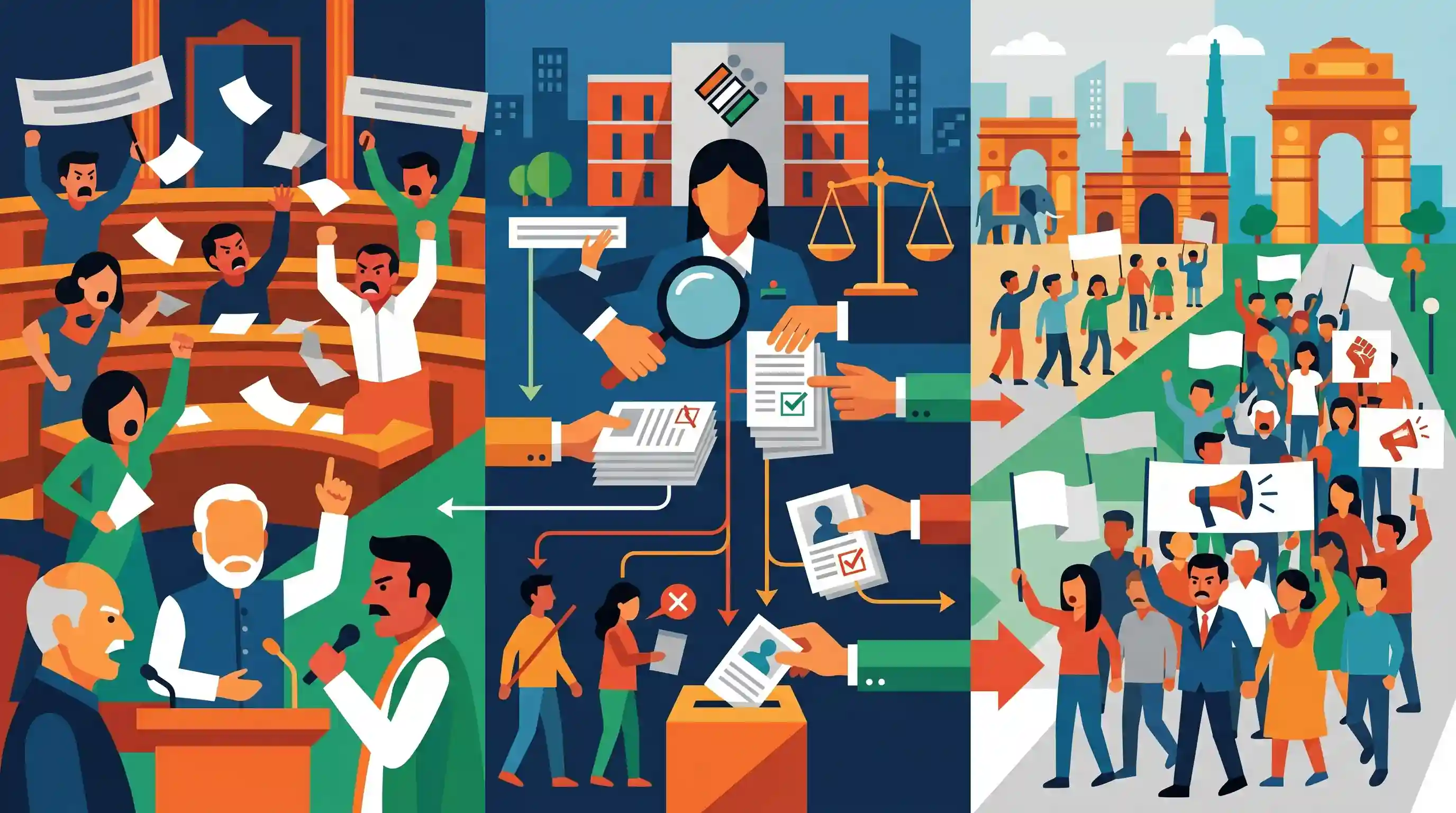
The INDIA bloc has escalated its opposition to the Election Commission of India's (ECI) ongoing Special Intensive Revision (SIR) of electoral rolls in Bihar, alleging that the exercise exceeds the ECI's mandate by acting as a backdoor mechanism to determine voters' citizenship. Citing alleged instances of large-scale voter deletion and addition in states like Karnataka and Maharashtra, leaders such as Rahul Gandhi and Tejashwi Yadav have framed the issue as "vote theft" ('vote ki chori'). The controversy has resulted in significant disruptions in Parliament, and the opposition plans to take the agitation to the streets of Bihar and Delhi to demand transparency and protect electoral integrity.
Key Points
- The INDIA bloc is intensifying protests against the Special Intensive Revision (SIR) of electoral rolls in Bihar, accusing the Election Commission of India (ECI) of overstepping its mandate by attempting to determine citizenship through this process.
- Opposition leaders plan a fortnight-long agitation in Bihar starting in August and a march to the ECI headquarters in Delhi to raise public awareness.
- Rahul Gandhi alleged that 'vote theft' occurred in recent assembly polls in Karnataka and Maharashtra through deliberate deletion and addition of lakhs of voters, promising to release data proving this.
- The controversy over the SIR exercise has led to repeated disruptions and adjournments in both Houses of Parliament, as the opposition seeks to force the government and the ECI to address their concerns.
- Opposition parties are focusing on simplified messaging, using phrases like 'vote-bandi' and 'vote ki chori', to effectively communicate complex electoral manipulation concerns to the public.
Important Terms
Special Intensive Revision (SIR) of electoral rolls

A comprehensive door-to-door verification drive by the ECI to update voter lists, involving fresh enumeration to remove duplicates, deceased, or ineligible entries, typically preceding major elections.
UPSC context
GS Paper II: Statutory bodies and electoral reforms; tests understanding of ECI's discretionary powers and procedural integrity.
Election Commission of India (ECI)
A permanent constitutional body established under Article 324 responsible for the superintendence, direction, and control of elections to Parliament, State Legislatures, and the offices of President and Vice-President.
UPSC context
GS Paper II: Appointment to various Constitutional posts, powers, functions and responsibilities of various Constitutional Bodies.
Representation of the People Act, 1950
The primary legislation governing the allocation of seats, delimitation of constituencies, and the preparation and revision of electoral rolls (voter lists) in India.
UPSC context
GS Paper II: Salient features of the Representation of People’s Act; essential for understanding the legal framework of Indian democracy.
Article 324 of the Indian Constitution
The constitutional provision vesting the Election Commission with the power of superintendence, direction, and control of the preparation of electoral rolls and the conduct of all elections.
UPSC context
GS Paper II: Constitutional provisions; tests knowledge of the ECI's mandate and the scope of its administrative authority.
Booth Level Officer (BLO)
A grassroots-level election official, usually a government employee, responsible for house-to-house verification, collecting forms, and maintaining accurate electoral rolls at the polling station level.
UPSC context
GS Paper II: Electoral processes; focuses on the administrative machinery and challenges in ensuring "one person, one vote."
INDIA bloc
A political coalition of 26+ opposition parties in India, formed in 2023 to contest the 2024 Lok Sabha elections against the ruling National Democratic Alliance (NDA).
UPSC context
GS Paper II: Pressure groups and formal/informal associations; tests understanding of multi-party systems and the role of the opposition.
Article 326 of the Indian Constitution
Specifies that elections to the Lok Sabha and State Assemblies shall be based on adult suffrage, ensuring every citizen aged 18+ is eligible to vote unless disqualified.
UPSC context
GS Paper II: Fundamental rights and constitutional provisions; examines the legal basis of voting rights and disqualification criteria.
Prelims Trap
"The Election Commission holds the authority to conclusively determine an individual's citizenship during Special Intensive Revisions."
ECI only verifies documents for voter eligibility (RPA 1950). Under the Citizenship Act, 1955, citizenship determination is strictly the domain of the Ministry of Home Affairs.
Static Concepts Connected
What governs the preparation and qualification for electoral rolls in India?
- Statutory basis: The Representation of the People Act (RPA), 1950 governs the allocation of seats, delimitation, and preparation of electoral rolls.
- Voter qualifications: Under RPA 1950 Section 19, one must be 18 years old and an 'ordinary resident' of the constituency.
- Disqualifications: Section 16 disqualifies non-citizens, persons of unsound mind, and those convicted of certain election offenses.
How does Special Intensive Revision (SIR) differ from routine Summary Revision?
- Summary Revision: Conducted annually by the ECI to add newly eligible voters and remove deceased/shifted voters without exhaustive physical surveys.
- Intensive Revision: Triggered by specific ECI directives. It involves fresh, rigorous house-to-house enumeration and document verification to heavily sanitize rolls.
- Constitutional mandate: Both are conducted under Article 324, which vests superintendence, direction, and control of electoral rolls in the ECI.
Cross-Topic Patterns
NRC overlap with RPA 1950 mandates
The political friction highlights the blurred lines between demographic identification (an MHA mandate under the Citizenship Act) and ensuring voter list purity (an ECI mandate under the RPA 1950).
Constitutional nature of the Right to Vote
Arbitrary voter deletions touch upon Article 326. UPSC frequently tests the exact legal nature of the right to vote (a Constitutional Right) versus its statutory administrative mechanisms.

Expect a 2026 Prelims question testing the exact boundaries of ECI's powers under Article 324 vs MHA's citizenship mandate.
Linked PYQs · 5
Linked PYQs · 5
- 2022MainsGS2
Discuss the role of the Election Commission of India in the light of the evolution of the Model Code of Conduct.
- 2018MainsGS2
In the light of recent controversy regarding the use of Electronic Voting Machines (EVM), what are the challenges before the Election Commission of India to ensure the trustworthiness of elections in India?
- 2017PrelimsGS1
For election to the Lok Sabha, a nomination paper can be filed by
- 2017PrelimsGS1
Right to vote and to be elected in India is a
- 2021MainsGS2
To what extent, in your view, the Parliament is able to ensure accountability of the executive in India?
