INDIA Bloc Consultations for Vice Presidential Election
Source:The Hindu ↗
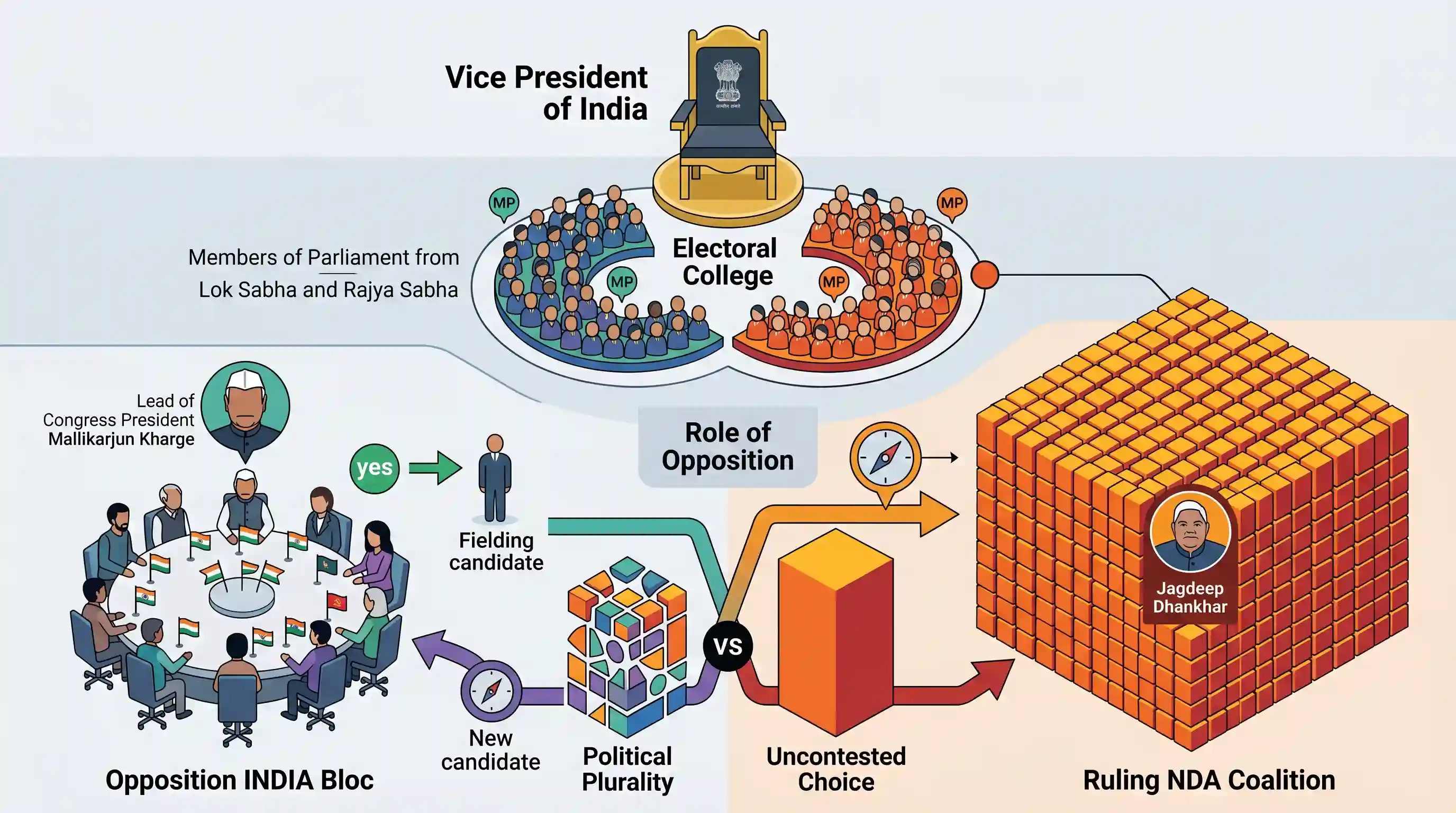
Why It Matters
Understanding the structure of the electoral college for the Vice-President (Article 66) is a foundational concept in Indian Polity for UPSC aspirants. Furthermore, the strategic decision by the opposition to contest despite an imminent loss underscores the importance of political pluralism and the functional role of the opposition in maintaining democratic traditions.
Summary
The opposition INDIA bloc convened a meeting led by Congress President Mallikarjun Kharge to deliberate on fielding a candidate for the upcoming Vice-Presidential elections. While the ruling NDA coalition, which has nominated Jagdeep Dhankhar, possesses a significant majority in the electoral college (composed entirely of Members of Parliament), the opposition views contesting as a democratic imperative. The move is designed to register a political point and emphasize that key constitutional elections should reflect political plurality rather than going uncontested.
Key Points
- The INDIA bloc is holding talks to finalize a candidate for the Vice-Presidential election, with the meeting presided over by Congress President Mallikarjun Kharge.
- The NDA has already announced Jagdeep Dhankhar as its Vice-Presidential candidate.
- The Vice-Presidential electoral college consists exclusively of Members of Parliament (MPs), giving the NDA a decisive numerical advantage.
- Despite the likely defeat, the opposition is fielding a candidate to assert its political standpoint and ensure that the constitutional post does not go uncontested.
Important Terms
Vice-Presidential Electoral College

The specific body that elects the Vice President, comprising all members (both elected and nominated) of the Lok Sabha and the Rajya Sabha.
UPSC context
GS Paper II - Executive and Constitutional bodies; tests knowledge of differences between Presidential and Vice-Presidential elections.
Article 66
The constitutional provision detailing the election, eligibility, and manner of appointment for the Vice President of India.
UPSC context
GS Paper II - Indian Constitution; tests understanding of specific constitutional procedures for high offices.
INDIA bloc
The Indian National Developmental Inclusive Alliance, a multi-party opposition coalition formed in 2023 to contest against the ruling NDA.
UPSC context
GS Paper II - Political parties and pressure groups; relevant for contemporary coalition dynamics.
NDA (National Democratic Alliance)
The National Democratic Alliance, a center-right political coalition led by the BJP, first formed in 1998.
UPSC context
GS Paper II - Coalition politics; focuses on the structure and history of the ruling alliance.
Proportional Representation (STV)
The system used for the Vice-Presidential election where members rank candidates by preference to ensure the winner has majority support.
UPSC context
GS Paper II - Elections; tests technical comprehension of indirect voting methods in India.
Prelims Trap
The electoral college for the Vice-President includes elected members of State Assemblies but excludes nominated MPs.
This incorrectly mixes up Presidential and VP elections. The VP electoral college consists ONLY of MPs (both elected and nominated), and completely excludes State MLAs.
Static Concepts Connected
How do Presidential and Vice-Presidential electoral colleges differ?
- Nominated Members: Nominated MPs vote in the Vice-Presidential election, but are strictly excluded from the Presidential election.
- State MLAs: Elected MLAs participate in electing the President, but have absolutely no role in electing the Vice-President.
What is the constitutional procedure for removing the Vice-President?
- Exclusive Initiation: A resolution for removal can only be introduced in the Rajya Sabha, not the Lok Sabha. A 14-day advance notice is mandatory.
- Majority Requirement: The resolution requires an effective majority in the Rajya Sabha and must then be agreed to by a simple majority in the Lok Sabha.
- No Impeachment: Unlike the President, there is no formal impeachment process requiring special majorities in both Houses on grounds of Constitutional violation.
Cross-Topic Patterns
Symbolic contests & constitutional conventions
Fielding candidates despite numerical disadvantage highlights the opposition's democratic duty, linking to static syllabus themes of parliamentary opposition, constitutional plurality, and the avoidance of rubber-stamp appointments.

Expect comparative statement questions on President vs VP elections, specifically targeting the voting rights of nominated MPs and State MLAs.
Linked PYQs · 3
Linked PYQs · 3
- 2004PrelimsGS1
The resolution for removing the Vice-president of India can be moved in the:
- 2023PrelimsGS1
Consider the following statements in respect of election to the President of India: 1. The members nominated to either House of the Parliament or the Legislative Assemblies of States are also eligible to be included in the Electoral College. 2. Higher the number of elective Assembly seats, higher is the value of vote of each MLA of that State. 3. The value of vote of each MLA of Madhya Pradesh is greater than that of Kerala. 4. The value of vote of each MLA of Puducherry is higher than that of Arunachal Pradesh because the ratio of total population to total number of elective seats in Puducherry is greater as compared to Arunachal Pradesh. How many of the above statements are correct?
- 2023PrelimsGS1
Consider the following statements: 1. If the election of the President of India is declared void by the Supreme Court of India, all acts done by him/her in the performance of duties of his/her office of President before the date of decision become invalid. 2. Election for the post of the President of India can be postponed on the ground that some Legislative Assemblies have been dissolved and elections are yet to take place. 3. When a Bill is presented to the President of India, the Constitution prescribes time limits within which he/she has to declare his/her assent. How many of the above statements are correct?
