Opposition Strategy on Foreign Policy and Security
Source:The Hindu ↗
Why It Matters
Highlights the crucial role of the Opposition in a parliamentary democracy in holding the executive accountable on sensitive national security issues, foreign policy claims, and federal disputes like statehood and delimitation.
Summary
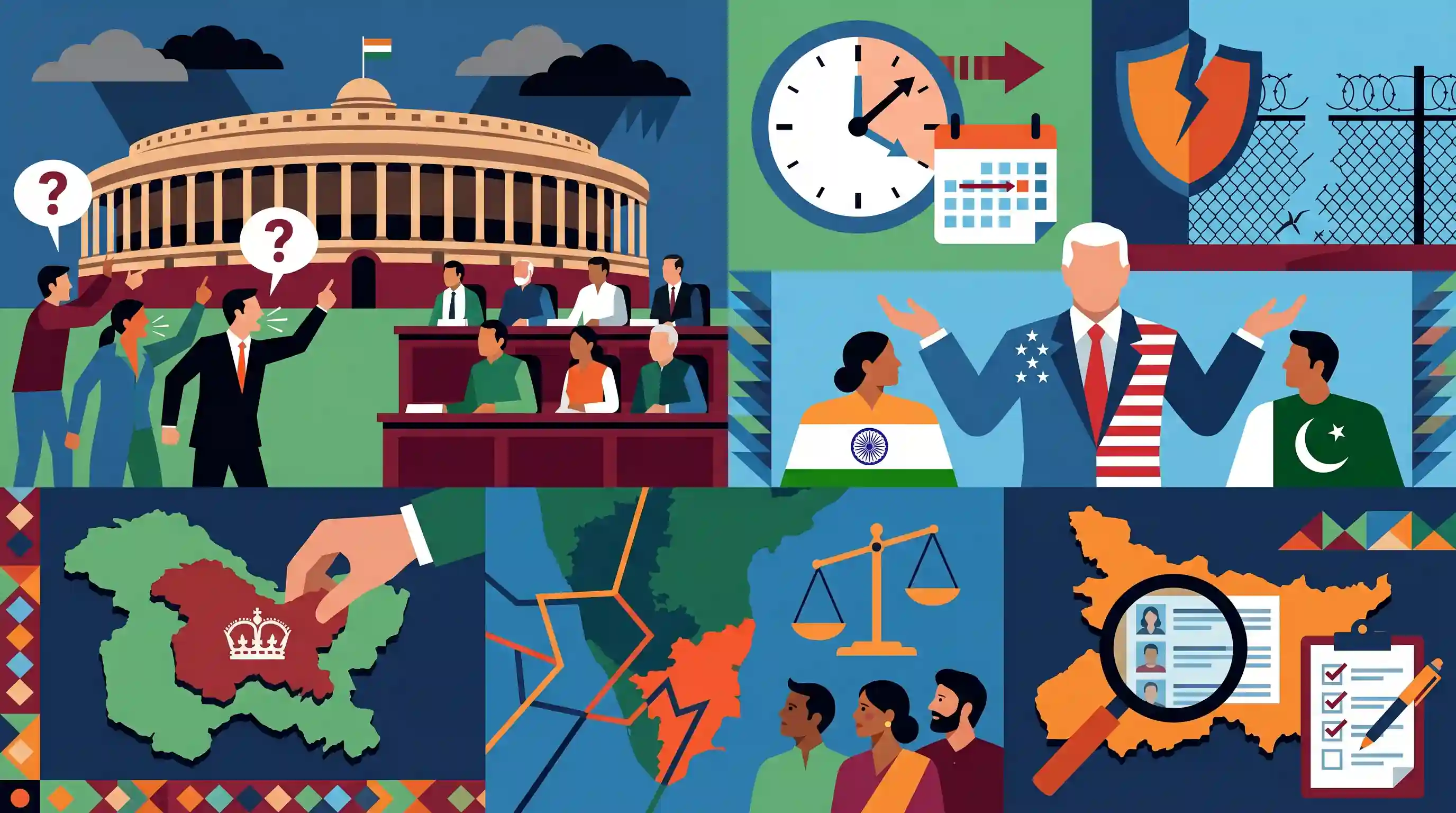
The INDIA bloc opposition parties have resolved to aggressively question the central government during the upcoming Monsoon Session of Parliament over significant foreign policy and internal security issues. Key areas of focus include alleged intelligence failures leading to the Pahalgam terror attack, objections to the tenure extension of Intelligence Bureau chief Tapan Deka, and demands for clarity on U.S. President Donald Trump's claim of mediating peace between India and Pakistan during 'Operation Sindoor'. The Opposition also plans to raise domestic and federal issues, prominently advocating for the restoration of full statehood to Jammu and Kashmir, addressing Southern states' concerns over impending delimitation, and questioning the Special Intensive Revision of electoral rolls in Bihar.
Key Points
- INDIA bloc leaders resolved to target the government during the Monsoon Session over perceived foreign policy failures and intelligence lapses.
- Opposition parties will demand accountability for the Pahalgam terror attack and question the extension given to Intelligence Bureau chief Tapan Deka.
- The bloc plans to seek a statement regarding U.S. President Donald Trump's claims of brokering peace between India and Pakistan during Operation Sindoor.
- Additional issues to be raised include restoring statehood for Jammu and Kashmir, impending delimitation concerns of Southern States, and the Electoral rolls' Special Intensive Revision in Bihar.
Important Terms
Operation Sindoor

A 2025 retaliatory military strike by India against terror infrastructure in Pakistan following the Pahalgam attack; notable for a diplomatic row over U.S. claims of third-party mediation.
UPSC context
GS Paper II & III: India-Pakistan relations and strategic deterrence; tests policy on third-party mediation.
Special Intensive Revision (SIR)
A rigorous, house-to-house electoral roll verification by the Election Commission to ensure accuracy by removing duplicates and ineligible entries using strict documentation.
UPSC context
GS Paper II: Representation of People Act and Electoral Reforms; tests ECI powers and electoral integrity.
INDIA bloc
The Indian National Developmental Inclusive Alliance; a multi-party opposition coalition formed to challenge the ruling National Democratic Alliance in national and state elections.
UPSC context
GS Paper II: Parliamentary Democracy and Federalism; tests the role of Opposition in holding the executive accountable.
Intelligence Bureau (IB)
India's premier internal intelligence agency under the Ministry of Home Affairs, responsible for domestic security, counter-espionage, and counter-terrorism activities.
UPSC context
GS Paper III: Security Agencies and their mandate; tests knowledge of India’s internal security framework.
Tapan Deka
The 28th Director of the Intelligence Bureau (1988-batch IPS), whose tenure extensions until 2026 have sparked debate over institutional independence and intelligence accountability.
UPSC context
GS Paper II: Statutory and executive appointments; tests awareness of legal rules governing tenure extensions of security chiefs.
Prelims Trap
"The Intelligence Bureau (IB) functions under a statutory framework and is directly accountable to a dedicated Parliamentary Standing Committee."
The Intelligence Bureau (IB) has no dedicated statutory backing; it operates purely through executive orders, rendering it exempt from direct parliamentary oversight.
Static Concepts Connected
How does the Constitution manage the delimitation freeze for Lok Sabha seats?
- 84th Amendment (2001): Extended the freeze on the total number of Lok Sabha seats based on the 1971 census until the relevant figures for the first census post-2026 are published.
- Article 82: Empowers Parliament to enact a Delimitation Act after every census to readjust seat allocation, though interstate allocation remains frozen to protect states with lower population growth.
Why does India strictly reject third-party mediation in the Kashmir dispute?
- Shimla Agreement (1972): Established the core principle of bilateralism, legally mandating that India and Pakistan resolve all outstanding disputes strictly through direct, peaceful negotiations.
- Sovereign Posture: India consistently views any foreign mediation offers (e.g., from the US or UN) as a direct violation of this foundational bilateral treaty.
Cross-Topic Patterns
Demographic penalties in federalism
Southern states' delimitation fears closely mirror debates surrounding Finance Commission tax devolution formulas, where successful population control paradoxically leads to reduced federal resource allocation and political representation.
Intelligence oversight accountability gaps
Opposition demands for IB accountability highlight the contrast between India's executive-controlled intelligence apparatus and mature democracies like the UK or US, where parliamentary oversight is codified by statute.

Post-2026 delimitation and its intersection with asymmetric federalism is a highly probable GS-II Mains question for the 2026 exam cycle.
Linked PYQs · 3
Linked PYQs · 3
- 2025MainsGS2
Discuss the nature of Jammu and Kashmir Legislative Assembly after the Jammu and Kashmir Reorganization Act, 2019. Briefly describe the powers and functions of the Assembly of the Union Territory of Jammu and Kashmir.
- 2025MainsGS3
Terrorism is a global scourge. How has it manifested in India? Elaborate with contemporary examples. What are the counter measures adopted by the State? Explain.
- 2023MainsGS3
Winning of 'Hearts and Minds' in terrorism-affected areas is an essential step in restoring the trust of the population. Discuss the measures adopted by the Government in this respect as part of the conflict resolution in Jammu and Kashmir.
