Constitutional removal procedure for Chief Election Commissioner
Source:The Hindu ↗
Why It Matters
This article touches upon the fundamental mechanisms that ensure the independence of the Election Commission. For UPSC aspirants, understanding the exact constitutional procedure for the removal of the CEC (which mirrors that of a Supreme Court Judge) and the provisions of the new 2023 CEC Act (including immunity clauses) is crucial for both Prelims (polity facts) and Mains (governance/democratic institutions).
Summary
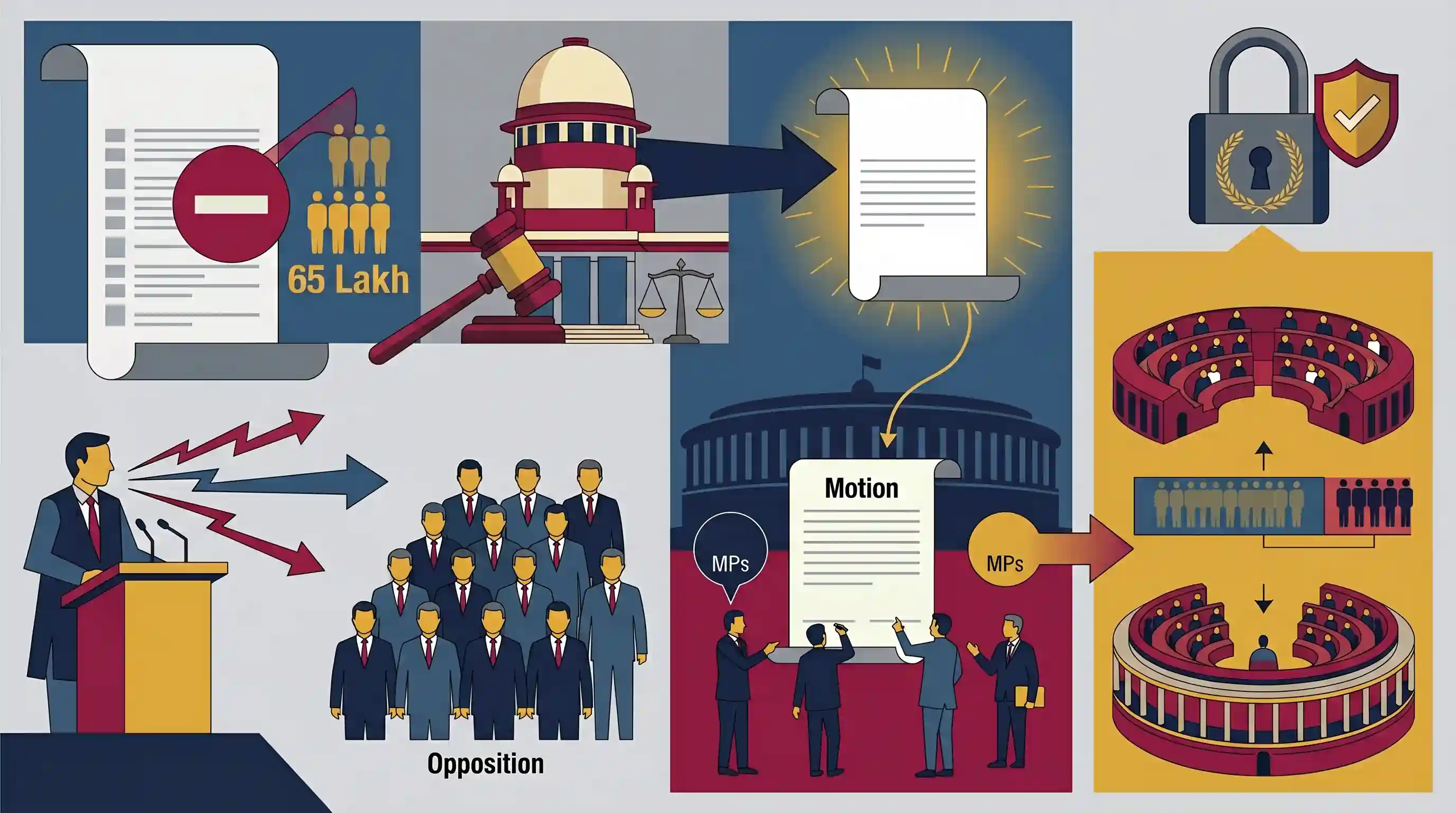
The opposition INDIA bloc is exploring a parliamentary motion to remove Chief Election Commissioner Gyanesh Kumar. This follows his public criticism of the Opposition over allegations concerning the deletion of 65 lakh voters from Bihar's draft electoral roll. The Supreme Court has intervened, directing the Election Commission of India to publish details of these exclusions made during a Special Intensive Revision. Constitutionally, removing a CEC is an arduous process identical to the impeachment of a Supreme Court judge, requiring a motion signed by requisite MPs and a special two-thirds majority in both Houses of Parliament. The episode highlights ongoing political friction over electoral integrity and the robust constitutional safeguards insulating the CEC's office.
Key Points
- The INDIA bloc is considering introducing a motion in Parliament for the removal of Chief Election Commissioner (CEC) Gyanesh Kumar.
- The controversy arose after 65 lakh voters were excluded from the draft electoral roll during a Special Intensive Revision (SIR) in Bihar, which the Supreme Court has asked the ECI to clarify.
- Opposition leaders criticized the CEC for using a press conference to accuse them of spreading misinformation regarding the deleted voters.
- Under the Constitution, the CEC can only be removed in the same manner and on the same grounds as a judge of the Supreme Court, ensuring independence.
- A removal motion requires the signatures of at least 50 members to be admitted in the Rajya Sabha, followed by a two-thirds majority vote in both Houses of Parliament.
- The 2023 Act regulating the CEC and ECs grants them immunity from legal proceedings regarding their past or present official decisions.
Important Terms
Election Commission of India (ECI)

A permanent constitutional body (Article 324) responsible for conducting free and fair elections to Parliament, State Legislatures, and the offices of President and Vice-President.
UPSC context
GS Paper 2: Constitutional Bodies. Core topic for electoral management and institutional independence.
Chief Election Commissioner and Other Election Commissioners (Appointment, Conditions of Service and Term of Office) Act, 2023
A 2023 law establishing a three-member Selection Committee (PM, Cabinet Minister, LoP) for appointing ECI members and equating their service conditions to the Cabinet Secretary.
UPSC context
GS Paper 2: Appointment to various Constitutional posts. Tests understanding of legislative shifts in executive vs. judicial control.
Removal of the Chief Election Commissioner
A constitutional safeguard (Article 324(5)) requiring a parliamentary motion and a special two-thirds majority, identical to the removal process for a Supreme Court judge.
UPSC context
GS Paper 2: Constitutional Provisions. Tests knowledge of security of tenure and independence of high offices.
Special Intensive Revision (SIR)
An intensive door-to-door verification exercise by the ECI to update electoral rolls by removing dead, migrated, or ineligible voters and adding new ones.
UPSC context
GS Paper 2: Electoral Reforms. Relevance to voter disenfranchisement concerns and administrative transparency.
INDIA bloc
The Indian National Developmental Inclusive Alliance; a coalition of opposition parties formed in 2023 to contest elections against the ruling National Democratic Alliance (NDA).
UPSC context
GS Paper 2: Political Parties/Federalism. Relevant for coalition politics and executive-opposition dynamics.
Special Majority
A voting requirement where a motion must be passed by a majority of the House's total membership and two-thirds of those present and voting.
UPSC context
GS Paper 2: Parliament and State Legislatures. Key procedural detail for amending the Constitution or removing constitutional heads.
Prelims Trap
The Chief Election Commissioner and other Election Commissioners are removed in the same manner as a Supreme Court judge.
Article 324(5) grants SC judge-like tenure security ONLY to the CEC. Other Election Commissioners can be removed by the President solely on the CEC's recommendation.
Static Concepts Connected
What is the constitutional procedure to remove the Chief Election Commissioner?
- Constitutional Grounds: The CEC can only be removed on grounds of 'proved misbehaviour' or 'incapacity', identical to a Supreme Court judge.
- Initiation: Governed by the Judges (Inquiry) Act, 1968, requiring a motion signed by 100 Lok Sabha or 50 Rajya Sabha MPs.
- Special Majority: Requires a majority of the total membership of each House and a 2/3rd majority of members present and voting.
Under what legal framework are India's electoral rolls prepared and revised?
- RPA 1950: Section 21 of the Representation of the People Act (RPA), 1950 dictates the preparation and annual revision of electoral rolls.
- Special Intensive Revision: The ECI conducts exhaustive door-to-door verification under its discretionary powers to clean up duplicate or deceased voters.
- Qualifying Dates: Recent amendments introduced four qualifying dates (Jan 1, Apr 1, Jul 1, Oct 1) for youth to register as voters.
Cross-Topic Patterns
EC Immunity vs Article 361 Privileges
The 2023 CEC Act grants the ECI statutory immunity from legal proceedings. This mirrors the constitutional protections usually reserved exclusively for the President and Governors under Article 361.
Electoral Rolls and Future Delimitation
Controversies over massive voter deletions during Special Intensive Revisions highlight demographic data integrity challenges ahead of the highly sensitive, politically charged post-2026 Delimitation exercise.

Expect a tricky Prelims question mixing the CEC's removal procedure with the new statutory immunity provisions under the 2023 ECI Act.
Linked PYQs · 2
Linked PYQs · 2
- 2019PrelimsGS1
Consider the following statements: 1. The motion to impeach a Judge of the Supreme Court of India cannot be rejected by the Speaker of the Lok Sabha as per the Judges (Inquiry) Act, 1968. 2. The Constitution of India defines and gives details of what constitutes 'incapacity and proved misbehaviour' of the Judges of the Supreme Court of India. 3. The details of the process of impeachment of the Judges of the Supreme Court of India are given in the Judges (Inquiry) Act, 1968. 4. If the motion for the impeachment of a Judge is taken up for voting, the law requires the motion to be backed by each House of the Parliament and supported by a majority of total membership of that House and by not less than two-thirds of total members of that House present and voting. Which of the statements given above is/are correct?
- 2022MainsGS2
Discuss the role of the Election Commission of India in the light of the evolution of the Model Code of Conduct.
