India OECM Conservation Network and Biodiversity Goals
Source:Indian Express ↗
Why It Matters
Crucial for understanding India's strategy to meet international biodiversity goals (30x30 target) through community-led and non-traditional conservation frameworks (OECMs).
Summary
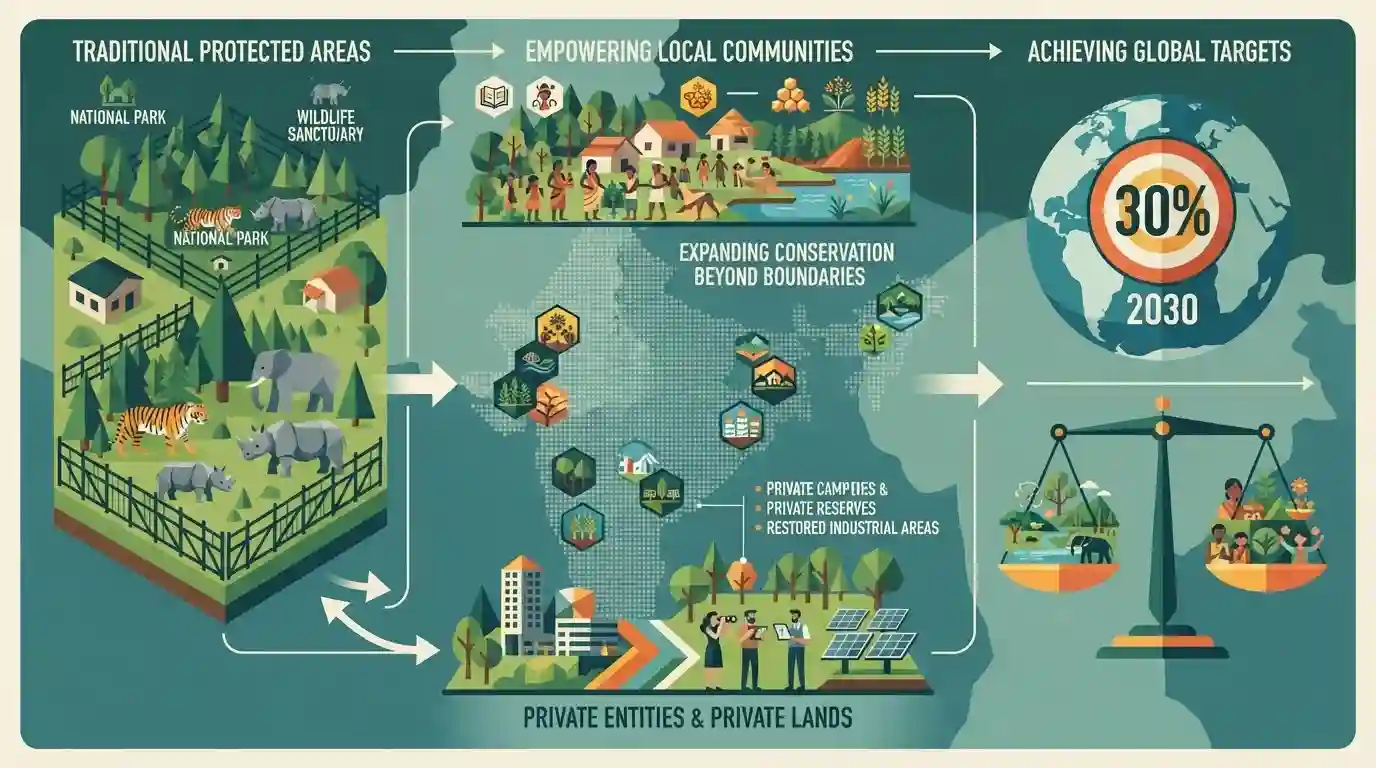
The article discusses the significance of Other Effective Area-based Conservation Measures (OECMs) in India's conservation strategy. Moving beyond conventional protected areas like national parks and wildlife sanctuaries, OECMs empower local communities, private entities, and indigenous groups to protect biodiversity. This approach is critical for achieving global commitments such as the 30x30 target under the Kunming-Montreal Global Biodiversity Framework while balancing ecological integrity with sustainable local livelihoods.
Key Points
- Other Effective Area-based Conservation Measures (OECMs) provide a pathway to recognize areas outside traditional protected areas that achieve effective in-situ biodiversity conservation.
- OECMs cover diverse landscapes managed by local communities, indigenous groups, and private entities, highlighting inclusive conservation.
- India is scaling up its OECM identification network to meet global biodiversity targets like the 30x30 goal under the Kunming-Montreal Global Biodiversity Framework.
- Challenges include balancing development pressures, ensuring sustainable financial support, and formalizing legal recognition for OECM sites.
Important Terms
Convention on Biological Diversity

An international treaty adopted at the 1992 Earth Summit in Rio de Janeiro, dedicated to the conservation of biodiversity, sustainable use of its components, and fair sharing of genetic resource benefits.
UPSC context
UPSC Prelims/Mains (GS Paper III: Environment & Ecology). Frequently tested for its protocols (Cartagena, Nagoya) and objectives.
Kunming-Montreal Global Biodiversity Framework
An ambitious global agreement adopted under the CBD in 2022 aiming to halt and reverse biodiversity loss by 2030, including the flagship '30x30' conservation target.
UPSC context
UPSC Prelims/Mains (GS Paper III: Biodiversity). Essential for questions regarding global environmental targets, climate action, and conservation metrics.
India Biodiversity Oecm Conservation Network
Areas outside traditional protected areas (like national parks) where governance achieves effective, long-term in-situ biodiversity conservation alongside indigenous and community livelihoods.
UPSC context
UPSC Prelims/Mains (GS Paper III: Environment and Ecology). Important for community-led conservation, participatory resource management, and India's biodiversity targets.
Static Concepts Connected
What are Other Effective Area-based Conservation Measures (OECMs) and how do they differ from Protected Areas?
- Definition Focus: CBD definition refers to geographically defined spaces outside conventional protected areas achieving positive in-situ biodiversity outcomes.
- Governance Diversity: Unlike National Parks or Wildlife Sanctuaries, OECMs can be managed by private entities, indigenous groups, or local communities under diverse governance models.
- Global Targets: They contribute significantly to Target 3 of the Kunming-Montreal Global Biodiversity Framework (the 30x30 target).
Cross-Topic Patterns
OECMs & Community Forest Resource Rights
India's OECM network links environmental conservation under CBD Target 3 with the Forest Rights Act, 2006, highlighting community forest resource governance.

OECMs vs Protected Areas (National Parks) distinction, plus 30x30 target origin, will feature in environment prelims.
Linked PYQs · 3
Linked PYQs · 3
- 2026PrelimsGS1
Which one of the following is the first Plan Vivo certified Reducing Emissions from Deforestation and Forest Degradation (REDD+) project in India ?
- 2023PrelimsGS1
Consider the following statements: 1. In India, the Biodiversity Management Committees are key to the realization of the objectives of the Nagoya Protocol. 2. The Biodiversity Management Committees have important functions in determining access and benefit sharing, including the power to levy collection fees on the access of biological resources within its jurisdiction. Which of the statements given above is/are correct?
- 2023PrelimsGS1
Consider the following statements: Once the Central Government notifies an area as a 'Community Reserve' 1. the Chief Wildlife Warden of the State becomes the governing authority of such forest 2. hunting is not allowed in such area 3. people of such area are allowed to collect non-timber forest produce 4. people of such area are allowed traditional agricultural practices How many of the above statements are correct?
