India Biodiversity OECM Network and Community Conservation
Source:Indian Express ↗
આ શા માટે મહત્વનું છે
It addresses the evolving paradigm of conservation in India, shifting focus toward community-managed landscapes and OECMs, which are crucial for sustainable development and meeting global biodiversity commitments under the Kunming-Montreal Global Biodiversity Framework.
સારાંશ
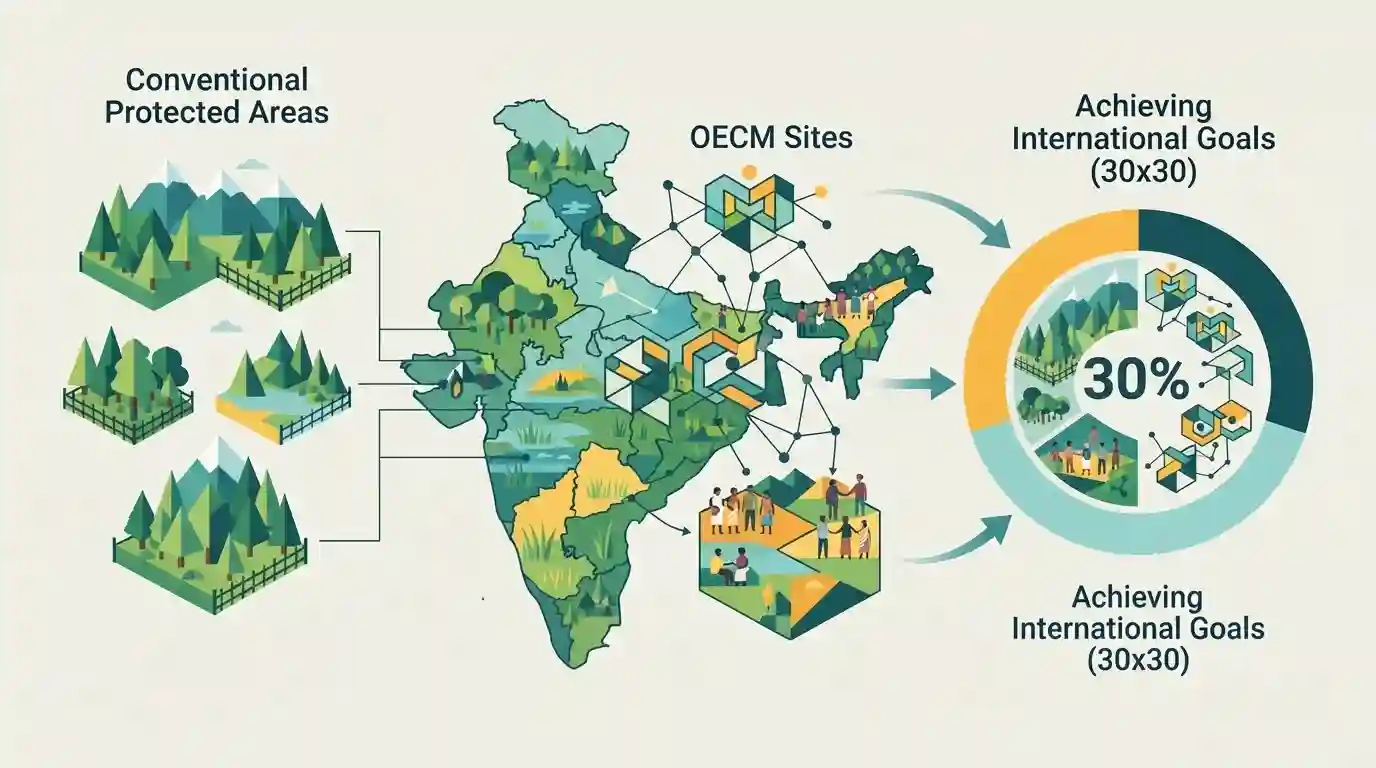
The article discusses the emergence and significance of the India Biodiversity Oecm Conservation Network, highlighting how Other Effective Area-based Conservation Measures (OECMs) are vital for expanding biodiversity conservation beyond conventional protected areas to achieve international targets like the 30x30 goal under the Kunming-Montreal Global Biodiversity Framework.
મુખ્ય મુદ્દા
- Other Effective Area-based Conservation Measures (OECMs) represent a crucial shift in biodiversity conservation by recognizing conservation efforts outside traditional protected areas like national parks and wildlife sanctuaries.
- The India Biodiversity Oecm Conservation Network aims to identify, map, and support areas managed by local communities, indigenous groups, and private entities that effectively preserve biodiversity.
- Under the Kunming-Montreal Global Biodiversity Framework, countries have committed to protecting 30% of the planet's land and marine areas by 2030 (the 30x30 target), making OECMs vital for achieving this goal without impinging on local livelihoods.
- Challenges include formalizing recognition, ensuring long-term financial and institutional support, and balancing traditional resource use with stringent conservation criteria.
મહત્વપૂર્ણ શબ્દો
Kunming-Montreal Global Biodiversity Framework

A historic 2022 agreement under the UN CBD that includes the 30x30 target to conserve 30% of land and ocean areas globally by 2030.
UPSC context
Crucial for GS Paper III (Environment & Ecology); tested for international biodiversity targets and global conservation frameworks.
India Biodiversity Oecm Conservation Network
A collaborative network identifying Other Effective Area-based Conservation Measures (OECMs) across India to protect biodiversity outside conventional national parks and wildlife sanctuaries.
UPSC context
Important for GS Paper III (Environment); highlights India's strategic policy responses for non-traditional conservation areas.
Convention on Biological Diversity (CBD)
A legally binding multilateral treaty adopted at the 1992 Rio Earth Summit focused on biodiversity conservation, sustainable use, and equitable benefit-sharing.
UPSC context
Core topic for GS Paper III (Environment & Ecology); frequently asked regarding international environmental conventions and protocols.
સંલગ્ન સ્થિર ખ્યાલો
What are Other Effective Area-based Conservation Measures (OECMs) and how do they differ from Protected Areas?
- In-situ focus: Geographical definition: Geographically defined spaces governed and managed to achieve positive, long-term in-situ biodiversity conservation outcomes.
- Non-PA status: Exclusion criteria: They are not traditional protected areas like national parks, wildlife sanctuaries, or conservation reserves under the Wildlife Protection Act.
- Human integration: Community inclusion: They explicitly accommodate sustainable traditional resource use, community stewardship, and private conservation initiatives without strict human exclusion.
- Global target: Global target: Crucial tool for meeting Target 3 of the Kunming-Montreal Global Biodiversity Framework (30x30 goal).
આંતર-વિષય પેટર્ન
OECMs + Forest Rights Act Convergence
OECM sites bridge Wildlife Protection Act boundaries with community forest rights, testing convergence between environment ministry and tribal affairs administration.
Global Biodiversity Targets + Climate Finance
Kunming-Montreal 30x30 targets tie domestic biodiversity mapping directly to international climate finance commitments and convention reporting obligations under CBD.

Expect a statement-based prelims question pairing the 30x30 target with OECM criteria, testing whether OECMs require strict protected area status.
સંલગ્ન PYQ · 2
સંલગ્ન PYQ · 2
- 2012PrelimsGS1
In which one among the following categories of protected areas in India are local people not allowed to collect and use the biomass?
- 2023MainsGS3
Comment on the National Wetland Conservation Programme initiated by the Government of India and name a few India's wetlands of international importance included in the Ramsar Sites.
