Expanding Biodiversity Conservation Beyond Protected Areas
Source:Indian Express ↗
Why It Matters
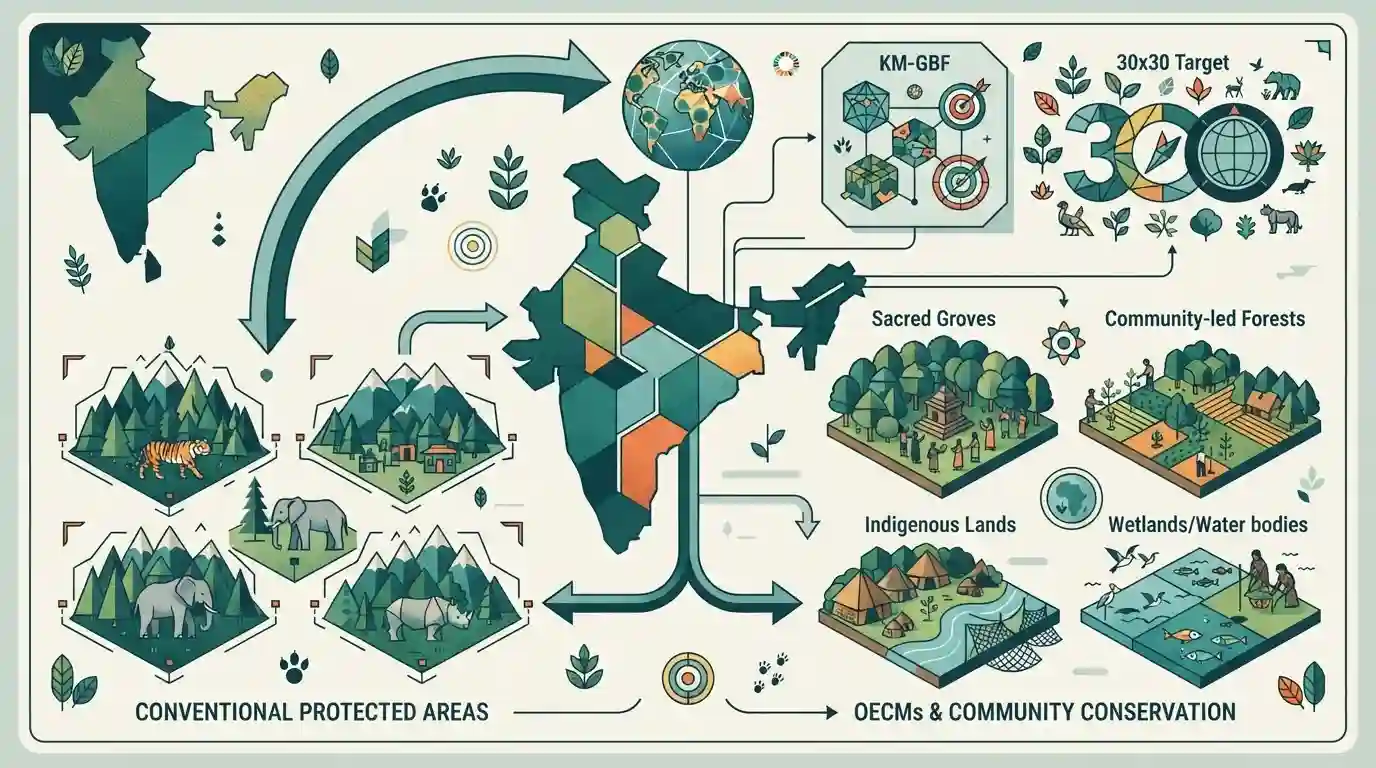
OECMs represent an evolving paradigm in environmental governance, shifting focus from state-centric protected areas to community-led and participatory biodiversity conservation, which is critical for achieving India's international climate and biodiversity commitments.
Summary
The article discusses the significance of 'Other Effective area-based Conservation Measures' (OECMs) in India's biodiversity landscape. It emphasizes moving beyond conventional protected areas (national parks and sanctuaries) to incorporate community-led conservation, sacred groves, and indigenous lands into formal global frameworks, thereby supporting India's commitment to the Kunming-Montreal Global Biodiversity Framework and the 30x30 target.
Key Points
- Other Effective area-based Conservation Measures (OECMs) provide a crucial tool for recognizing biodiversity conservation efforts outside traditional protected areas like national parks and wildlife sanctuaries.
- India's diverse landscapes host numerous community-managed sacred groves, indigenous lands, and traditional ecosystems that qualify for OECM status, expanding the scope of conservation beyond state-owned forests.
- The India Biodiversity OECM Conservation Network highlights the importance of inclusive conservation, integrating local communities, indigenous knowledge, and non-state actors into the formal national conservation framework.
- Aligning with global targets like the Kunming-Montreal Global Biodiversity Framework requires scaling up OECMs to protect 30% of land and sea areas by 2030 (the 30x30 target).
Important Terms
Kunming-Montreal Global Biodiversity Framework

A historic global agreement adopted at CBD COP15 in 2022, establishing 23 targets for 2030, notably the '30x30' target to protect 30% of Earth's land and sea.
UPSC context
UPSC Prelims/Mains (Environment): Essential for international environmental conventions, global biodiversity targets, and India's multilateral commitments.
Other Effective area-based Conservation Measures (OECMs)
Geographically defined spaces, outside formal protected areas, that achieve positive, long-term outcomes for biodiversity conservation under diverse management governance systems like community lands or sacred groves.
UPSC context
UPSC Prelims/Mains (Environment & Biodiversity): Frequently tested under innovative conservation strategies, community participation, and fulfillment of the 30x30 target.
India Biodiversity OECM Conservation Network
An initiative involving government bodies like the NBA and international partners to identify, map, and document non-traditional conservation areas across India to meet biodiversity goals.
UPSC context
UPSC Current Affairs (Environment): Evaluates India's domestic policy mechanisms, institutional frameworks, and progress toward global biodiversity commitments.
International Union for Conservation of Nature (IUCN)
An international organization working in the field of nature conservation and sustainable use of natural resources, famous for publishing the Red List of Threatened Species.
UPSC context
UPSC Prelims: Important for questions on global environmental bodies, species conservation statuses, and protected area categories.
Convention on Biological Diversity (CBD)
A legally binding multilateral treaty adopted at the 1992 Earth Summit in Rio de Janeiro, dedicated to promoting sustainable development and preserving global biodiversity.
UPSC context
UPSC Prelims/Mains: Core international environmental law topic covering biodiversity governance, protocols, and global summits.
Prelims Trap
OECMs are classified as a new category of national parks and wildlife sanctuaries under the Wildlife Protection Act.
OECMs are explicitly distinct from conventional protected areas like national parks and wildlife sanctuaries; they do not carry the same strict legal restrictions under the Wildlife Protection Act, 1972, though they achieve similar biodiversity outcomes.
Static Concepts Connected
What are the key governance types and criteria for OECMs under the CBD?
- Definition: Geographically defined spaces governed and managed to achieve positive in-situ biodiversity outcomes outside formal protected areas.
- Governance Models: Recognizes four distinct models: government-led, private-led, shared/mixed, and indigenous/community-led governance.
- CBD Origin: Established at the 14th Conference of the Parties (COP14) to the CBD in Sharm el-Sheikh in 2018.
Cross-Topic Patterns
Community Forests and Global CBD Targets
Integrating indigenous and community-managed lands into formal biodiversity frameworks tests the intersection of the Forest Rights Act, 2006, and international CBD obligations.

Expect matching questions on CBD targets (Target 3) and distinction between conventional PAs vs non-state OECMs.
Linked PYQs · 1
Linked PYQs · 1
- 2023MainsGS3
Comment on the National Wetland Conservation Programme initiated by the Government of India and name a few India's wetlands of international importance included in the Ramsar Sites.
