Other effective area-based conservation measures in India biodiversity
Source:Indian Express ↗
આ શા માટે મહત્વનું છે
OECMs represent a paradigm shift in environmental governance by recognizing community and non-traditional conservation efforts, making them vital for GS3 syllabus regarding environment and biodiversity conservation.
સારાંશ
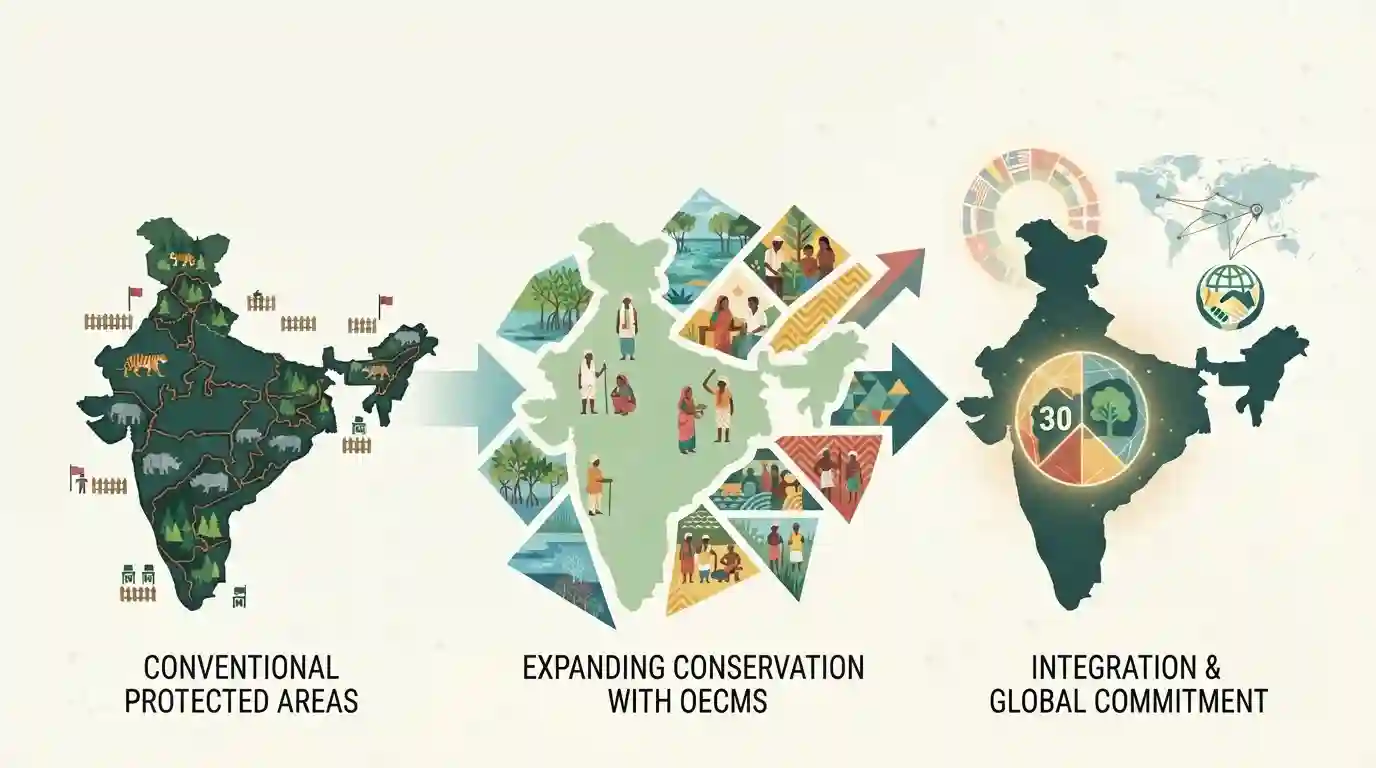
The article discusses the significance of 'Other Effective Area-based Conservation Measures' (OECMs) in India's biodiversity conservation strategy. It highlights how OECMs expand conservation beyond conventional protected areas, integrating community-driven and indigenous efforts to align with international biodiversity commitments like the Kunming-Montreal Global Biodiversity Framework.
મુખ્ય મુદ્દા
- Other Effective Area-based Conservation Measures (OECMs) recognize areas outside traditional protected areas (like national parks and sanctuaries) that achieve effective in-situ conservation of biodiversity.
- OECMs are crucial for involving local communities, indigenous populations, and private entities in conservation, moving beyond state-centric models.
- India is scaling up its OECM framework through networks like the India Biodiversity OECM Conservation Network to meet global biodiversity targets under the Kunming-Montreal Global Biodiversity Framework (GBF).
- Challenges include identifying, documenting, and legally recognizing diverse conservation models without harming community rights or over-bureaucratizing local initiatives.
મહત્વપૂર્ણ શબ્દો
Other Effective Area-based Conservation Measures (OECMs)

Geographically defined spaces, other than formal protected areas, that achieve positive and sustained long-term outcomes for in-situ biodiversity conservation alongside ancillary management objectives.
UPSC context
UPSC GS Paper III (Environment & Ecology): Crucial for understanding alternative conservation strategies, community-driven biodiversity efforts, and meeting international commitments like 30x30.
Kunming-Montreal Global Biodiversity Framework
A landmark international pact adopted at CBD COP15 in 2022, featuring the 30x30 target to protect 30% of global land and marine areas by 2030.
UPSC context
UPSC GS Paper III (Environment): Tests awareness of global biodiversity governance, international environmental treaties, and India's alignment with post-2020 biodiversity targets.
International Union for Conservation of Nature (IUCN)
An international union comprising governments and civil society organizations that provides public, private, and non-governmental entities with knowledge and tools for human development and nature conservation.
UPSC context
UPSC GS Paper III (Environment & Biodiversity): Frequently referenced for its Red List of Threatened Species, protected area categories, and global conservation standards.
પ્રિલિમ્સ ટ્રેપ
OECMs are legally notified protected areas under the Wild Life (Protection) Act, 1972.
Aspirants often confuse OECMs with Wildlife Sanctuaries or National Parks. OECMs are specifically designed for areas outside traditional protected areas that still achieve positive biodiversity outcomes.
સંલગ્ન સ્થિર ખ્યાલો
How do OECMs differ from traditional Protected Areas (PAs) under the Wildlife Protection Act?
- Legal Status: PAs are statutorily notified under the Wild Life (Protection) Act, 1972 with strict restrictions on human use.
- Governance Model: OECMs recognize diverse governance types including indigenous lands, private reserves, and community-managed sacred groves outside statutory PAs.
- Conservation Focus: Both achieve positive and sustained in-situ biodiversity conservation, but OECMs focus on effective outcomes rather than strict legal notification.
આંતર-વિષય પેટર્ન
OECMs & FRA 2006 Convergence
OECMs bridge customary land rights under the Forest Rights Act with international biodiversity goals under the Kunming-Montreal Global Biodiversity Framework (GBF Target 3).
Local Governance & Community Conserved Areas
Scaling community conservation intersects with Panchayati Raj (Schedule IX/PESA) and traditional ecological knowledge (TEK) protection in tribal belts.

Expect a statement-based prelims question comparing OECMs with traditional Protected Areas (National Parks/Sanctuaries) under Wildlife Protection Act.
સંલગ્ન PYQ · 3
સંલગ્ન PYQ · 3
- 2023MainsGS3
Comment on the National Wetland Conservation Programme initiated by the Government of India and name a few India's wetlands of international importance included in the Ramsar Sites.
- 2014PrelimsGS1
The most important strategy for the conservation of biodiversity together with traditional human life is the establishment of
- 2022PrelimsGS1
With reference to Indian laws about wildlife protection, consider the following statements : 1. Wild animals are the sole property of the government. 2. When a wild animal is declared protected, such animal is entitled for equal protection whether it is found in protected areas or outside. 3. Apprehension of a protected wild animal becoming a danger to human life is sufficient ground for its capture or killing. Which of the statements given above is/are correct?
