India Biodiversity OECM Conservation Network and Framework
Source:Indian Express ↗
কেন এটি গুরুত্বপূর্ণ
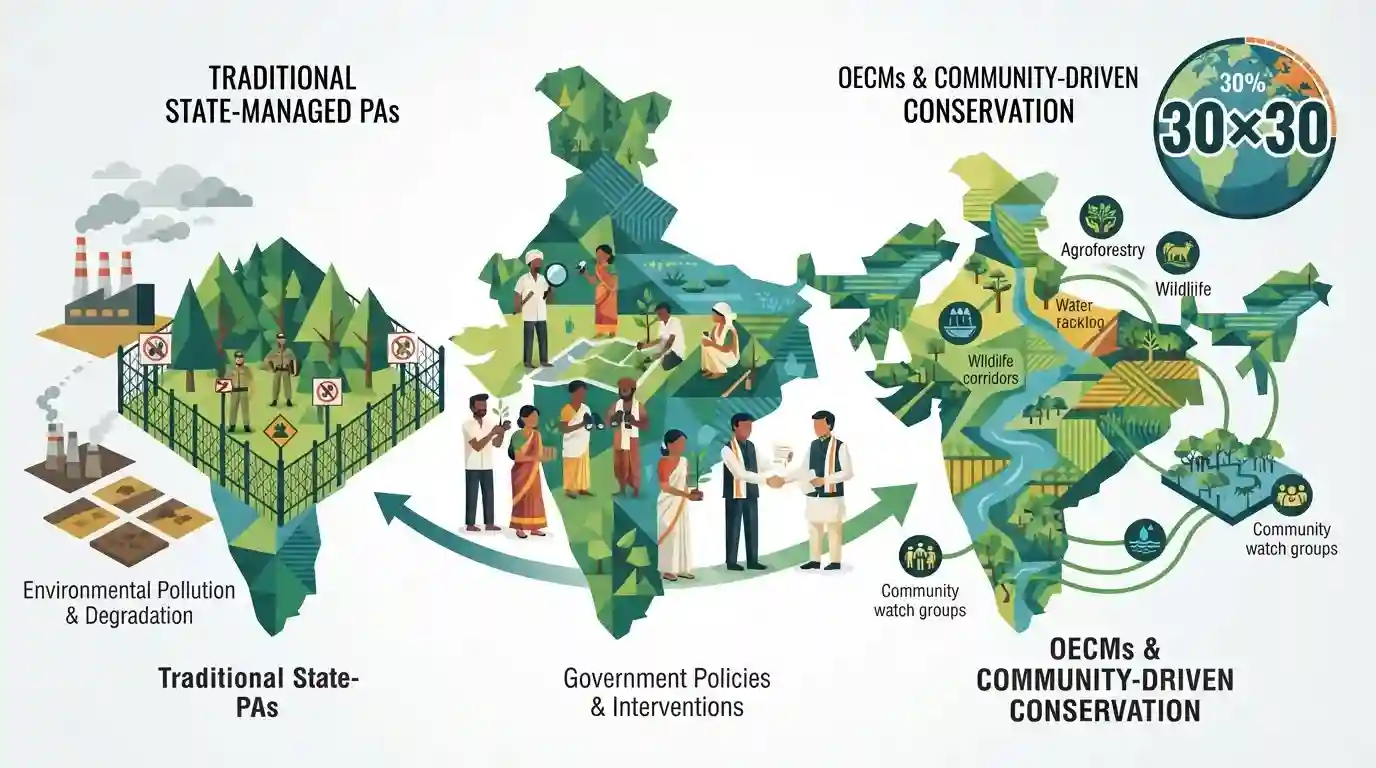
Crucial for understanding alternative and community-led conservation models (OECMs) that complement formal protected areas and help fulfill India's international biodiversity commitments.
সারসংক্ষেপ
The article discusses the significance of Other Effective Area-based Conservation Measures (OECMs) in India's biodiversity landscape. It emphasizes shifting from purely state-managed protected areas to inclusive, community-driven conservation initiatives that safeguard ecosystems outside traditional reserves, contributing to global biodiversity frameworks like the 30x30 goal.
মূল বিষয়
- Other Effective Area-based Conservation Measures (OECMs) recognize biodiversity conservation efforts outside traditional protected areas like national parks and sanctuaries.
- OECMs include sacred groves, community-managed forests, agroforestry zones, and coastal areas managed by local communities or private entities.
- The India Biodiversity Oecm Conservation Network highlights the role of non-state actors and local indigenous knowledge in achieving international conservation targets, such as the 30x30 target under the Kunming-Montreal Global Biodiversity Framework.
- Moving beyond state-centric conservation models helps integrate sustainable use with ecological protection, addressing biodiversity loss while supporting livelihoods.
গুরুত্বপূর্ণ শব্দ
Kunming-Montreal Global Biodiversity Framework

A landmark global accord adopted at COP15 featuring the 30x30 target to conserve 30% of land and sea areas by 2030 through protected areas and OECMs.
UPSC context
GS Paper III (Environment & Ecology): Tests knowledge of international environmental conventions, biodiversity targets, and India's compliance mechanisms.
India Biodiversity Oecm Conservation Network
An initiative aligning with international conservation frameworks to identify and map areas outside traditional reserves—such as sacred groves and urban campuses—that deliver effective biodiversity outcomes.
UPSC context
GS Paper III (Conservation): Essential for questions on inclusive community-driven conservation initiatives, protected area extensions, and the 30x30 goal.
প্রিলিমস ফাঁদ
OECMs are a new category of statutory Protected Areas notified under the Wildlife Protection Act, 1972.
Aspirants often assume OECMs must be officially notified Protected Areas under the Wildlife Protection Act, whereas they are specifically conservation areas *outside* traditional PAs.
সংযুক্ত স্থির ধারণা
What are the key categories of conservation areas recognized under Indian wildlife and biodiversity laws?
- National Parks:: National Parks have the highest degree of protection under WLPA 1972, with no human rights or grazing permitted.
- Community Reserves:: Community Reserves can be declared by state governments on private or community land under WLPA Amendment 2002.
- OECMs:: OECMs are distinct geographic areas outside PAs managed for positive biodiversity outcomes, accommodating sustainable traditional uses.
আন্তঃবিষয় প্যাটার্ন
Biodiversity Conservation + Forest Rights Act
OECM community-led models intersect directly with Schedule VI / CFR titles under FRA 2006, shifting conservation away from colonial fortress models.

Expect matching columns on conservation instruments: Protected Areas vs. OECMs vs. Community Reserves under Wildlife Protection Act.
সংযুক্ত PYQ · 3
সংযুক্ত PYQ · 3
- 2023MainsGS3
Comment on the National Wetland Conservation Programme initiated by the Government of India and name a few India's wetlands of international importance included in the Ramsar Sites.
- 2012PrelimsGS1
In which one among the following categories of protected areas in India are local people not allowed to collect and use the biomass?
- 2018MainsGS3
What is wetland? Explain the Ramsar concept of 'wise use' in the context of wetland conservation. Cite two examples of Ramsar sites from India.
