भारत-अमेरिका व्यापार नीति और द्विपक्षीय वार्ता
स्रोत:इंडियन एक्सप्रेस ↗
क्यों मायने रखता है
Trade constitutes a fundamental pillar of the Indo-US bilateral relationship. Understanding the friction points (like tariffs and market access) and the mechanisms to resolve them is crucial for questions on international relations and economic diplomacy in GS Paper 2 and GS Paper 3.
सारांश
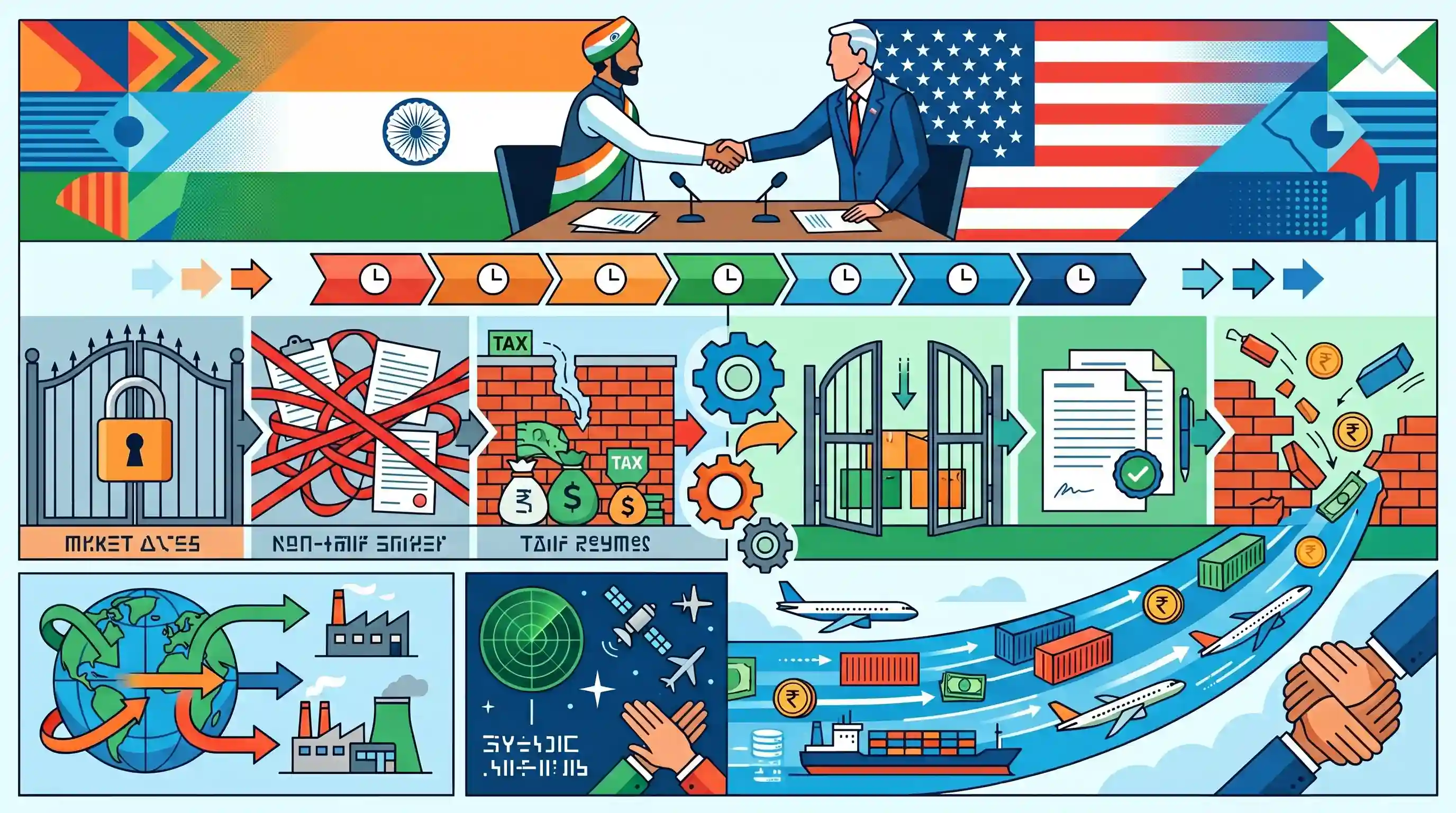
India has initiated a critical week-long round of trade negotiations with the United States. These talks are aimed at addressing structural trade issues, including market access, non-tariff barriers, and tariff regimes, to foster a smoother economic relationship. As global supply chains realign, both nations are looking to strengthen bilateral trade to match the growing proximity in their geopolitical and strategic partnership.
मुख्य बिंदु
- India and the United States have launched a crucial week-long series of bilateral trade negotiations aimed at deepening commercial ties.
- The talks are expected to focus on resolving long-standing market access issues, minimizing non-tariff barriers, and discussing tariffs.
- The negotiations represent an effort to stabilize and grow bilateral trade amidst shifting global supply chains and a mutual desire to reduce dependence on China.
- Successful resolution of these trade frictions is vital to aligning their economic relationship with their rapidly strengthening strategic and defense partnership.
महत्वपूर्ण शब्द
United States Trade Representative (USTR)

The lead U.S. government agency responsible for developing and recommending trade policy to the President and conducting bilateral/multilateral trade negotiations.
UPSC context
GS Paper II: Bilateral Relations. Important for understanding executive-level trade diplomacy and the specific agency India negotiates with.
Ministry of Commerce and Industry
India’s nodal ministry for formulating and implementing foreign trade policy, managing commercial relations, and leading international trade negotiations through its Department of Commerce.
UPSC context
GS Paper III: Indian Economy. Key institution for trade policy, export promotion, and Ease of Doing Business initiatives.
Bilateral Trade Agreement (BTA)
A treaty between two nations to reduce or eliminate tariffs, quotas, and other trade barriers to encourage exchange of goods and services.
UPSC context
GS Paper II/III: International Relations and Economy. Tests knowledge of trade instruments vs. multilateral frameworks like the WTO.
Trade Policy Forum (TPF)
The premier institutional mechanism between India and the US to resolve trade and investment issues, focusing on agriculture, investment, innovation, and services.
UPSC context
GS Paper II: India-US Relations. A recurring institutional framework frequently mentioned in bilateral joint statements.
Section 301 (US Trade Act)
A provision of the US Trade Act of 1974 allowing the USTR to investigate and take action against foreign trade practices deemed "unreasonable" or "discriminatory."
UPSC context
GS Paper II: Bilateral Relations. Critical for understanding trade disputes and unilateral trade measures used by major trading partners.
Non-Tariff Barriers (NTBs)
Trade restrictive measures other than tariffs, such as quotas, sanitary regulations, or technical standards, that can impede market access for exports.
UPSC context
GS Paper III: Indian Economy. Essential concept for understanding modern trade challenges beyond simple tax/tariff rates.
Special 301 Report
An annual USTR review of the global state of intellectual property (IP) protection, often placing India on its 'Priority Watch List' for IP concerns.
UPSC context
GS Paper III: Intellectual Property Rights (IPR). A specific point of friction in India-US economic relations.
World Trade Organization (WTO)
The only global international organization dealing with the rules of trade between nations, providing a framework for resolving disputes and negotiating trade agreements.
UPSC context
GS Paper II/III: Global Groupings. Foundational for comparing multilateral rules with bilateral 'plus' agreements.
प्रारंभिक ट्रैप
India runs a persistent trade deficit with the United States due to high technology imports.
Aspirants often assume India runs trade deficits with all major advanced economies. However, India maintains a persistent goods trade surplus with the US.
संबंधित अवधारणाएँ
What are Non-Tariff Barriers (NTBs) in international trade?
- Sanitary & Phytosanitary: Restrictions based on human, animal, or plant health standards (e.g., US rejecting Indian agricultural exports).
- तकनीकी बाधाएं: Complex product standards, mandatory testing, and certification requirements that make exporting cumbersome and expensive.
- Quotas & Licensing: Direct quantitative limits on imports or complex administrative licensing requirements.
What is the India-US Trade Policy Forum (TPF)?
- Primary Mechanism: The premier bilateral institutional mechanism designed to resolve trade and investment frictions between the two nations.
- Core Pillars: It operates across five key pillars: Agriculture, Investment, Intellectual Property, Services, and Tariffs/Goods.
अंतर-विषय पैटर्न
Weaponization of Tariffs via Geopolitics
The US imposing tariffs on India citing Russian oil purchases highlights how strategic autonomy in energy security now directly triggers retaliatory trade defense mechanisms.
Supply Chain Resilience & IPEF
Bilateral trade integration with the US mirrors multilateral efforts like the Indo-Pacific Economic Framework (IPEF) to build resilient, non-China-centric supply chains.

Expect a 2026 prelims question pairing India's trade surplus partners with the specific institutional mechanisms used to manage them.
संबद्ध PYQ · 3
संबद्ध PYQ · 3
- 2019MainsGS2
‘What introduces friction into the ties between India and the United States is that Washington is still unable to find for India a position in its global strategy, which would satisfy India's national self-esteem and ambitions.’ Explain with suitable examples.
- 2020MainsGS2
What is the significance of Indo-US defence deals over Indo-Russian defence deals? Discuss with reference to stability in the Indo-Pacific region.
- 2023MainsGS3
What are the direct and indirect subsidies provided to farm sector in India? Discuss the issues raised by the World Trade Organization (WTO) in relation to agricultural subsidies.
