India Bangladesh Diplomatic Tensions Escalate Over Minority Protests
Source:Indian Express ↗
Why It Matters
It provides a contemporary case study of how internal domestic politics and non-state actors can spill over to impact India's 'Neighborhood First' policy, complicating diplomatic ties and border stability.
Summary
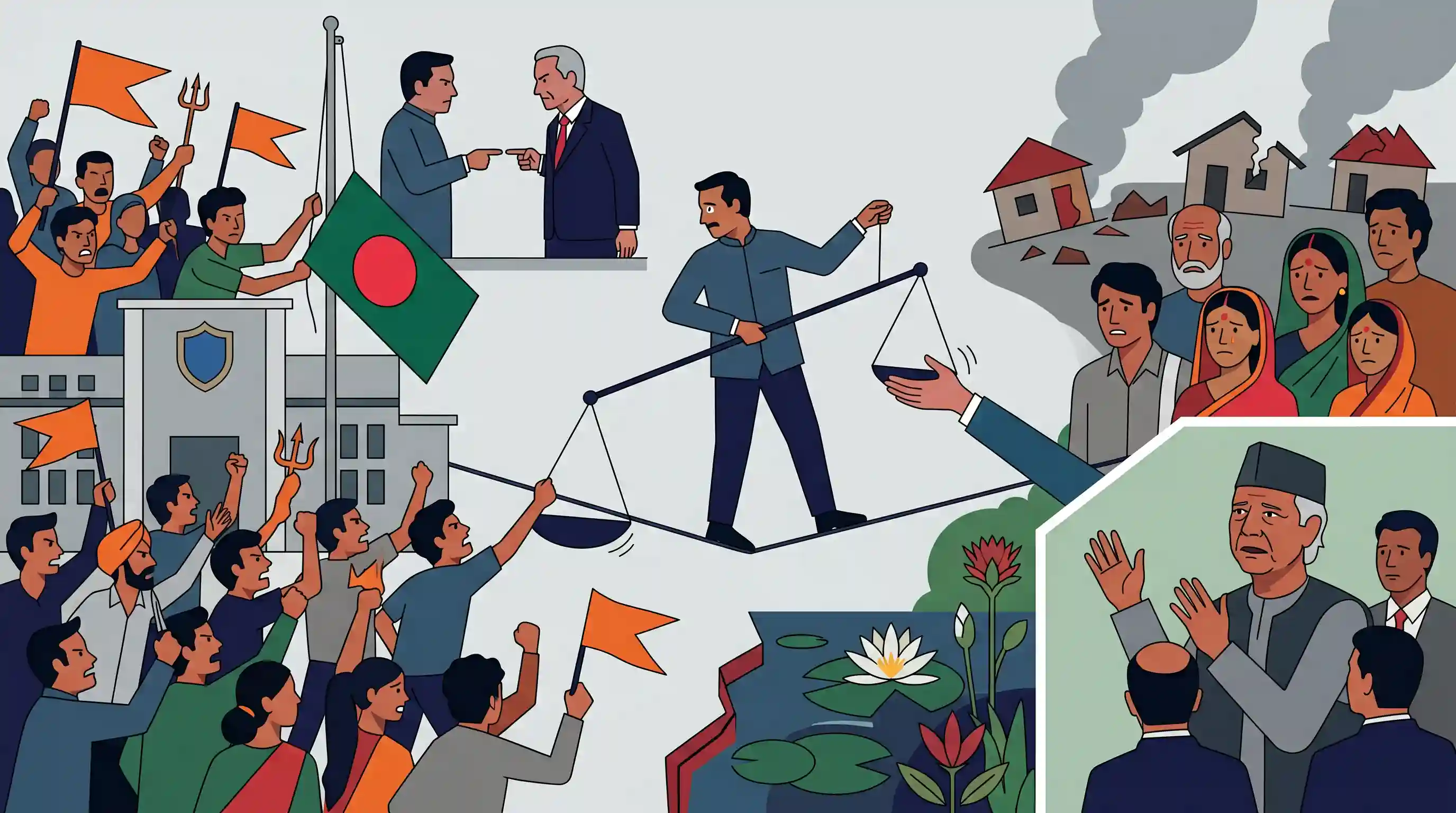
Diplomatic tensions have surged between India and Bangladesh as both nations summoned each other's envoys. The friction was triggered by widespread protests in India, organized by right-wing groups such as the Vishwa Hindu Parishad (VHP) and Bajrang Dal, over the alleged persecution of Hindu minorities in Bangladesh following the ouster of Sheikh Hasina. The interim Bangladeshi government, headed by Muhammad Yunus, expressed deep concern over the security of its diplomatic missions after protests targeted its Assistant High Commission in Agartala. This situation underscores the delicate balance India must maintain in its 'Neighborhood First' policy, especially when domestic non-state actors respond viscerally to the treatment of minorities in neighboring countries.
Key Points
- India and Bangladesh summoned each other's envoys, marking a sharp escalation in diplomatic friction between the two nations.
- The tensions stem from protests in India organized by right-wing outfits like VHP and Bajrang Dal over the alleged mistreatment of Hindu minorities in Bangladesh.
- The interim government in Bangladesh, led by Muhammad Yunus, raised concerns over the security of its diplomatic missions in India following protests in Agartala and New Delhi.
- The incident highlights the growing influence of domestic socio-political developments and non-state actors in shaping foreign policy and bilateral relations.
Important Terms
Vienna Convention on Diplomatic Relations (1961)

A 1961 international treaty defining the framework for diplomatic relations, including diplomatic immunity and the host nation's legal obligation to protect foreign missions (Article 22) from intrusion or damage.
UPSC context
GS Paper 2: International Relations. Essential for understanding diplomatic security, immunity, and state obligations during bilateral tensions.
Neighborhood First Policy
India's core foreign policy approach prioritizing ties with immediate neighbors through connectivity, economic integration, and non-reciprocal development assistance to ensure regional stability and counter external influences.
UPSC context
GS Paper 2: India and its Neighborhood. Tests India’s strategic management of regional relations and stability.
Interim Government (Bangladesh)
A provisional administration formed during political transitions; specifically, the Muhammad Yunus-led government established in 2024 to oversee reforms and elections following Sheikh Hasina's resignation.
UPSC context
GS Paper 2: International Relations. Relevant for analyzing political transitions in neighboring states and their impact on India.
Vishwa Hindu Parishad (VHP)
A prominent Indian right-wing Hindu organization (founded 1964) that functions as a pressure group, often influencing domestic sentiment and foreign policy regarding Hindu interests globally.
UPSC context
GS Paper 2: Pressure Groups. Tests how domestic socio-religious organizations impact national foreign policy and communal harmony.
Non-State Actors
Individuals or organizations (like NGOs, religious groups, or corporations) that hold significant political influence but are not officially affiliated with a sovereign state government.
UPSC context
GS Paper 3: Internal Security/GS Paper 2. Analyzes their role in shaping public opinion and security challenges across borders.
Prelims Trap
Host country police can enter a foreign embassy without permission during violent protests to secure the premises.
Under Article 22 of the Vienna Convention, diplomatic premises are strictly inviolable. Host authorities cannot enter without the mission head's explicit consent, regardless of emergencies.
Static Concepts Connected
What are the key protections under the Vienna Convention on Diplomatic Relations (1961)?
- Absolute Inviolability: The premises of the mission are strictly inviolable. Host state agents cannot enter them without the consent of the mission head.
- Protection Duty: The receiving state has a special legal duty to protect the premises against any intrusion, damage, or disturbance of peace.
- Criminal Immunity: Diplomatic agents enjoy absolute immunity from the criminal jurisdiction of the receiving State, with limited exceptions in civil matters.
What is 'Paradiplomacy' in the context of Indian polity and IR?
- Definition: It refers to the direct involvement of constituent sub-national units (states) in international relations and diplomacy.
- Constitutional Setup: While Foreign Affairs is strictly a Union subject (Article 246, Union List), border states organically influence cross-border ties through trade, culture, and migration.
- Key Examples: West Bengal's veto on the Teesta water sharing treaty and Tripura's impact on Bangladesh transit/trade agreements.
Cross-Topic Patterns
Paradiplomacy and Neighborhood First policy
Protests in Tripura over Dhaka's policies highlight how border states heavily influence India's bilateral ties, linking domestic politics to foreign policy outcomes.
Internal security spillovers from regime changes
Political volatility and minority rights issues in Bangladesh directly impact India's internal law-and-order, linking border management (GS3) with geopolitical strategy (GS2).

Expect a Prelims question testing the absolute inviolability of diplomatic premises under the Vienna Convention vs host state obligations.
Linked PYQs · 3
Linked PYQs · 3
- 2016MainsGS2
In the Indian governance system, the role of non-state actors has been only marginal." Critically examine this statement.
- 2020MainsGS3
Analyze internal security threats and transborder crimes along Myanmar, Bangladesh and Pakistan borders including Line of Control (LoC). Also discuss the role played by various security forces in this regard.
- 2022MainsGS2
Do you think that BIMSTEC is a parallel organisation like the SAARC ? What are the similarities and dissimilarities between the two ? How are Indian foreign policy objectives realized by forming this new organisation?
