India Bangladesh Diplomatic Shift and Political Envoy Appointment
Source:Indian Express ↗
Why It Matters
The appointment of a political leader as an envoy to a crucial neighboring country like Bangladesh marks a shift from conventional diplomatic practices. It highlights the evolving complexities of India's 'Neighbourhood First' policy and the necessity for high-level political engagement to navigate sudden regime changes and domestic political shifts in neighboring nations.
Summary
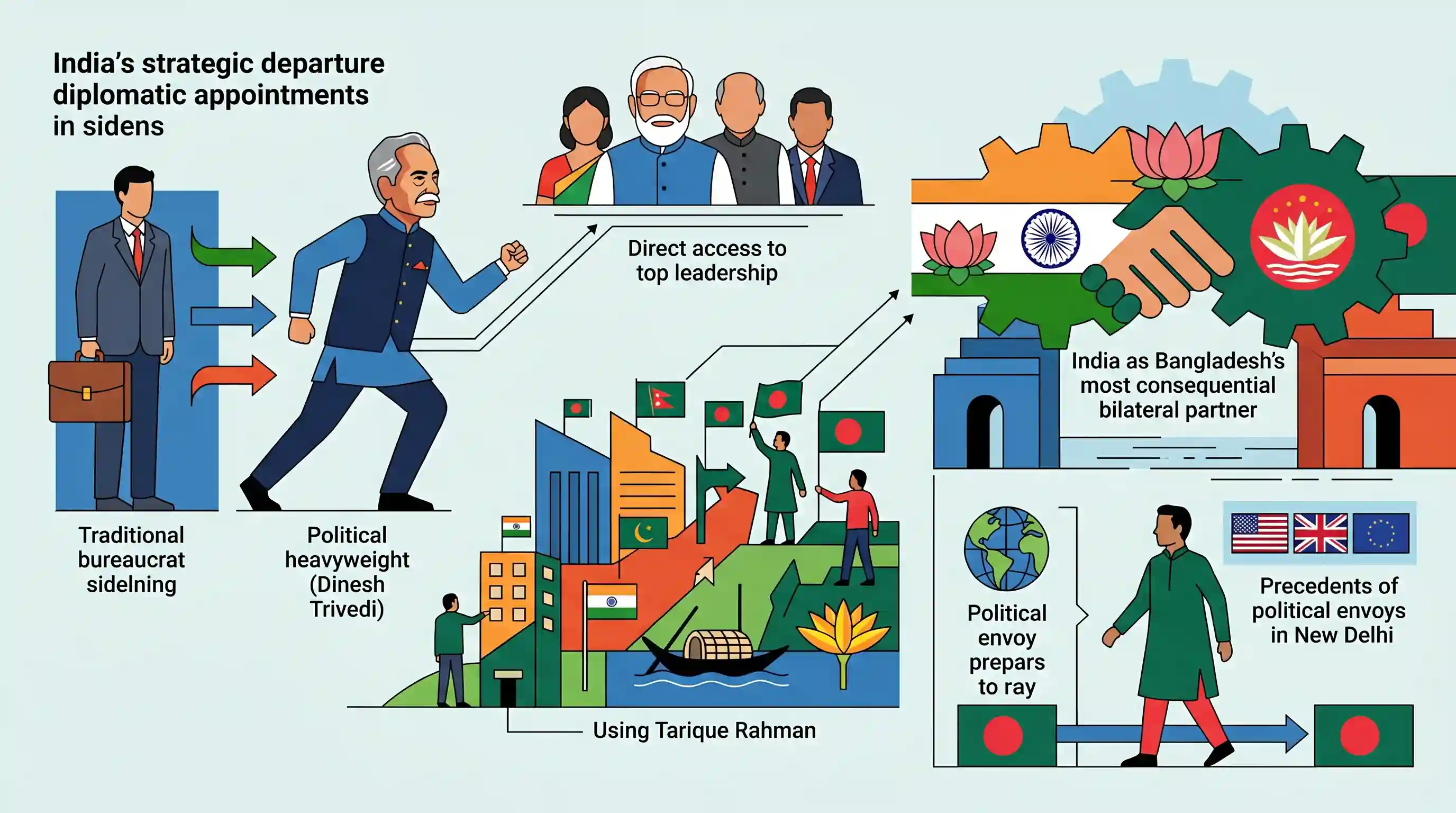
India's decision to appoint former Union Minister Dinesh Trivedi as the High Commissioner to Bangladesh signifies a strategic departure from relying solely on career diplomats for crucial bilateral missions. The article highlights that managing relations with Dhaka, especially amid Bangladesh's political transition towards a Tarique Rahman-led government, requires a political heavyweight who enjoys direct access to top leadership. Noting global precedents of political envoys, the author suggests that Bangladesh should mirror this approach by appointing a political envoy to New Delhi, acknowledging India's overarching importance as its most consequential bilateral partner.
Key Points
- India has appointed former Union Minister Dinesh Trivedi as its High Commissioner to Bangladesh, marking a strategic shift from career diplomats to political appointees for critical missions.
- The political landscape in Bangladesh is transitioning from the Yunus-led interim administration to a more politically concentrated government under Tarique Rahman.
- Political envoys often enjoy direct access to top national leadership, enabling them to bypass bureaucratic hurdles and handle sensitive neighborhood dynamics more effectively.
- The author argues that Bangladesh should reciprocate by appointing a political leader with a state-ministerial rank as its envoy to New Delhi, recognizing India as its most consequential partner.
Important Terms
Ministry of External Affairs (MEA)

The Government of India ministry responsible for formulating and implementing foreign policy, managing diplomatic missions, and representing India in global forums.
UPSC context
GS Paper II (International Relations); central to India’s foreign policy execution and neighborhood management.
Bangladesh Nationalist Party (BNP)
A major center-right political party in Bangladesh, led by Tarique Rahman, emphasizing 'Bangladesh First' policies and sovereign independence in regional engagement.
UPSC context
GS Paper II (India and its Neighborhood); its 2026 electoral victory necessitates a strategic recalibration in New Delhi.
Neighborhood First Policy
India's primary foreign policy framework prioritizing stable, cooperative, and connectivity-driven relations with its immediate neighbors to ensure regional stability and prosperity.
UPSC context
GS Paper II (Foreign Policy); the cornerstone of India's engagement with South Asian nations like Bangladesh.
High Commissioner
The equivalent of an Ambassador within the Commonwealth of Nations, serving as the head of a diplomatic mission in another member state.
UPSC context
GS Paper II (Diplomacy); tests understanding of Commonwealth-specific diplomatic protocols and hierarchical structures.
Political Appointee
An envoy appointed to a diplomatic post based on political standing and proximity to leadership rather than career progression in the foreign service.
UPSC context
GS Paper II (Role of Civil Services); examines the strategic use of politicians over career bureaucrats for sensitive bilateral missions.
Teesta Water-Sharing Agreement
A disputed bilateral treaty regarding the sharing of the Teesta River’s water, critical for Bangladesh's irrigation and India’s West Bengal state.
UPSC context
GS Paper II (Bilateral Relations); a major friction point involving federalism and hydropolitical diplomacy with Bangladesh.
Prelims Trap
Only Indian Foreign Service (IFS) officers can be legally appointed as India's Ambassadors or High Commissioners.
The President appoints envoys on the advice of the Union Cabinet. Eminent persons from politics, military, or academia can also be appointed; it is not legally restricted to IFS officers.
Static Concepts Connected
What distinguishes a High Commissioner from an Ambassador?
- Commonwealth link: 'High Commissioners' are diplomatic representatives exchanged exclusively between member states of the Commonwealth of Nations (e.g., India and Bangladesh).
- Rest of the world: 'Ambassadors' are exchanged between a Commonwealth country and a non-Commonwealth country, or between two non-Commonwealth countries.
- Functional parity: Despite the difference in nomenclature, both hold the exact same diplomatic rank, status, and responsibilities under the Vienna Convention on Diplomatic Relations.
What is the legal framework governing the appointment of Indian envoys abroad?
- Executive domain: The appointment of diplomatic representatives is an executive function carried out by the President of India on the advice of the Council of Ministers.
- No statutory restriction: There is no constitutional or legal mandate restricting envoy appointments to Indian Foreign Service (IFS) officers; political leaders or domain experts can be appointed.
Cross-Topic Patterns
Civil Services vs Political Executive
The deployment of a politician as an envoy touches on GS2 themes regarding the role of civil services, debating the need for political heft versus institutional bureaucratic memory in critical missions.
Neighbourhood First & Regime Changes
India's shift to a political envoy reflects a pragmatic adaptation to Bangladesh's domestic regime change, linking geopolitical strategy directly to agile diplomacy and the 'Neighbourhood First' policy.

A GS2 mains question in 2026 will likely evaluate the merits of political appointees vs career diplomats in 'Neighbourhood First' crises.
Linked PYQs · 3
Linked PYQs · 3
- 2022MainsGS2
India is an age-old friend of Sri Lanka.’ Discuss India's role in the recent crisis in Sri Lanka in the light of the preceding statement.
- 2015MainsGS2
Project 'Mausam' is considered a unique foreign policy initiative of the Indian Government to improve relationship with its neighbours. Does the project have a strategic dimension? Discuss.
- 2024MainsGS2
The Doctrine of Democratic Governance makes it necessary that the public perception of the integrity and commitment of civil servants becomes absolutely positive. Discuss.
