Land Acquisition Bottlenecks in India Bangladesh Border Fencing
Source:Indian Express ↗
Why It Matters
Border management is a core topic in GS Paper 3. The article provides concrete examples of administrative bottlenecks (land acquisition) hindering national security infrastructure, linking internal security challenges with Centre-State governance issues.
Summary
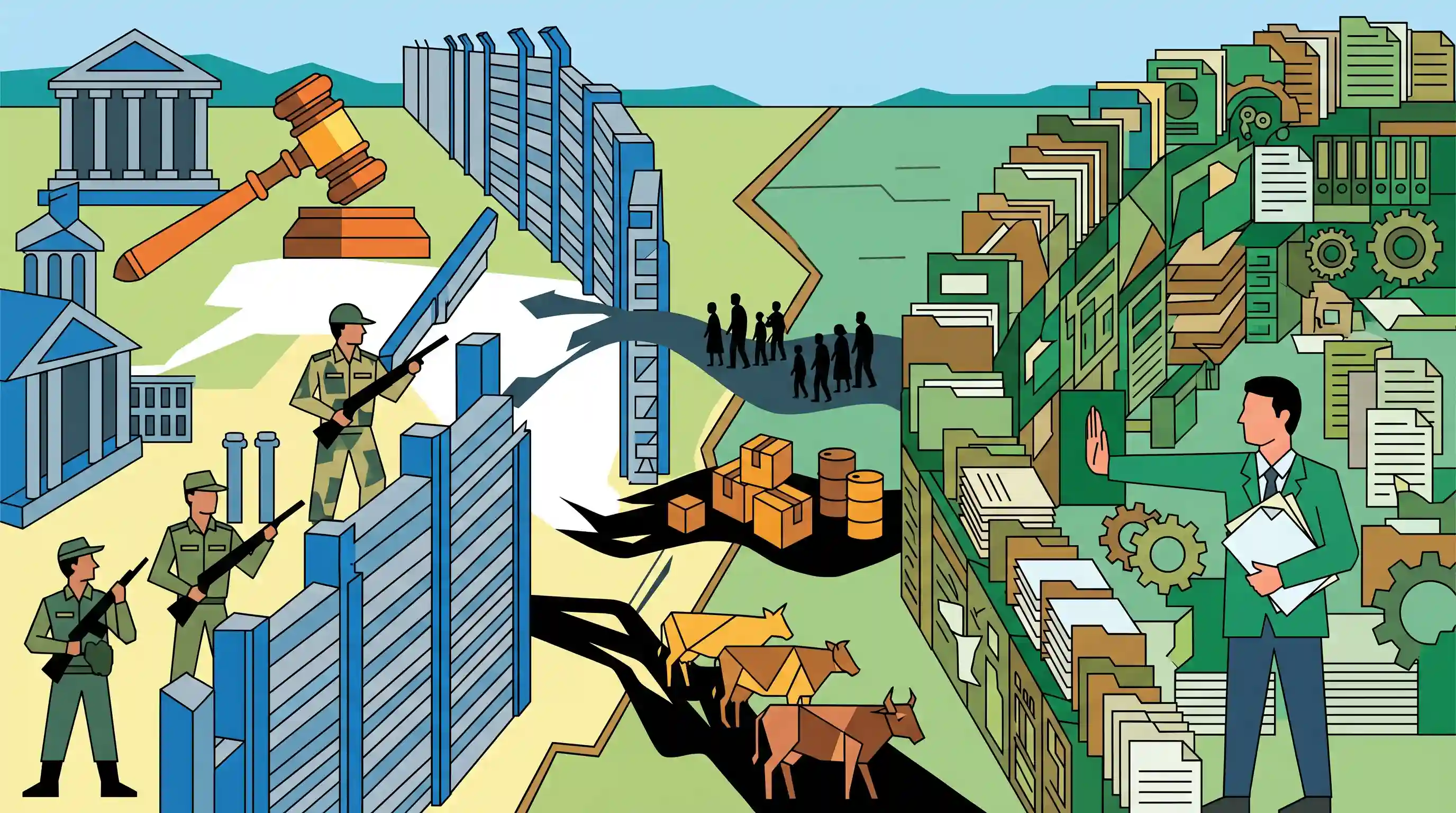
The article examines the legal and administrative friction surrounding the delay in fencing the India-Bangladesh border in West Bengal. Both the Supreme Court (during hearings on Section 6A of the Citizenship Act) and the Calcutta High Court have heavily scrutinized the incomplete fencing due to its facilitation of illegal immigration, drug trafficking, and cattle smuggling. The Central government and the BSF attribute the delay to the West Bengal government's 'Direct Land Purchase Policy', which has significantly slowed down the acquisition of land required for border outposts and physical fencing. This highlights critical challenges in India's border management strategies and illustrates how Centre-State disagreements over land acquisition can directly compromise national internal security.
Key Points
- The Supreme Court and Calcutta High Court have expressed grave concern over delays in fencing the India-Bangladesh border in West Bengal.
- Unfenced border sections act as conduits for illegal immigration, cattle smuggling, and drug trafficking, severely impacting national security.
- The Ministry of Home Affairs cites West Bengal's 'Direct Land Purchase Policy' as the primary bottleneck, causing significant delays in acquiring and handing over land to the BSF.
- During hearings on the validity of Section 6A of the Citizenship Act, the Supreme Court highlighted the demographic and security impacts of porous borders on border states.
- The issue underscores friction in Centre-State relations, where state-level land acquisition procedures obstruct central mandates for border security management.
Important Terms
Citizenship Act, 1955 (Section 6A)

Special provision added to the Citizenship Act post-1985 Assam Accord. It establishes citizenship criteria for migrants entering Assam from Bangladesh between 1966 and 1971.
UPSC context
GS-II (Citizenship); GS-III (Internal Security). Tests understanding of legal frameworks for migration and judicial review of citizenship laws.
Direct Land Purchase Policy (West Bengal)
West Bengal's administrative mechanism for acquiring land through direct negotiation with owners. The Centre cites it as a slower alternative to the central Land Acquisition Act, delaying border fencing.
UPSC context
GS-II (Centre-State Relations); GS-III (Border Management). Tests administrative hurdles in national security projects and federal cooperation challenges.
Border Security Force (BSF)
India's primary 'Border Guarding Force' for frontiers with Pakistan and Bangladesh. It prevents infiltration, smuggling, and trans-border crimes while promoting security among border populations.
UPSC context
GS-III (Security Forces). Core agency for border management; tests knowledge of CAPFs and their specific operational mandates.
Ministry of Home Affairs (MHA)
The nodal Union ministry for internal security and border management. It exercises administrative control over the BSF and coordinates national-level security infrastructure projects.
UPSC context
GS-II (Governance); GS-III (Security). Tests understanding of the executive structure managing India's internal and border security.
Supreme Court of India
The highest judicial body in India. It monitors border fencing status to ensure national security and the effective implementation of citizenship and immigration laws.
UPSC context
GS-II (Judiciary). Tests the 'judicial activism' and oversight role of the apex court in matters of national security.
Calcutta High Court
The jurisdictional high court for West Bengal. It has recently issued strict directives and penalties to expedite state land handover for India-Bangladesh border fencing.
UPSC context
GS-II (Judiciary/Federalism). Tests the role of High Courts in enforcing central security mandates and resolving administrative deadlocks.
Prelims Trap
Land acquisition for international border fencing is exclusively a Union subject, bypassing state government procedures.
While border security is a Union List subject, 'Land' falls under the State List (Entry 18). The Centre must rely on State machinery to acquire land for fencing.
Static Concepts Connected
What is the Comprehensive Integrated Border Management System (CIBMS)?
- Definition: An integrated system replacing physical patrols with electronic surveillance to plug border gaps.
- Technologies: Deploys AI-enabled sensors, thermal imagers, drones, and underground ground sensors.
- Deployment focus: Crucial in riverine (like Brahmaputra), marshy, or rugged terrains where physical fencing is unfeasible.
How does the Constitutional division of powers affect border infrastructure?
- Security mandate: 'Defense of India' and border security fall exclusively under the Union List (List I).
- Land acquisition: 'Land' is a State List subject (Entry 18), requiring State government cooperation to acquire parcels for BSF outposts.
- Executive friction: Article 256 requires States to comply with Union laws, but procedural state policies (like WB's direct purchase) can still cause de facto delays.
Cross-Topic Patterns
Federal Friction in National Security
The clash between the Union's security mandate and State-level land policies exemplifies how administrative federal friction directly impairs GS3 internal security goals.
Demographic shifts & the Assam Accord
SC linking West Bengal's porous borders during Section 6A hearings shows how unchecked transborder migration in one state creates demographic and political shockwaves across the region.

Expect a 2026 Mains GS3 question linking Centre-State friction over land acquisition to vulnerabilities in border management and CIBMS use.
Linked PYQs · 3
Linked PYQs · 3
- 2014MainsGS3
How does illegal transborder migration pose a threat to India's security? Discuss the strategies to curb this, bringing out the factors which give impetus to such migration.
- 2024MainsGS3
India has a long and troubled border with China and Pakistan fraught with contentious issues. Examine the conflicting issues and security challenges along the border. Also give out the development being undertaken in these areas under the Border Area Development Programme (BADP) and Border Infrastructure and Management (BIM) Scheme.
- 2020MainsGS3
Analyze internal security threats and transborder crimes along Myanmar, Bangladesh and Pakistan borders including Line of Control (LoC). Also discuss the role played by various security forces in this regard.
