India Diplomatic Stance on Palestine and Gaza Peace Plan
Source:Indian Express ↗
Why It Matters
This development is crucial for understanding India's 'Strategic Autonomy' in foreign policy. It illustrates how India balances its multifaceted relations in the volatile West Asian region—countering criticisms that its growing alignment with Israel comes at the expense of its historical support for Palestine or its leadership role among developing nations (Global South).
Summary
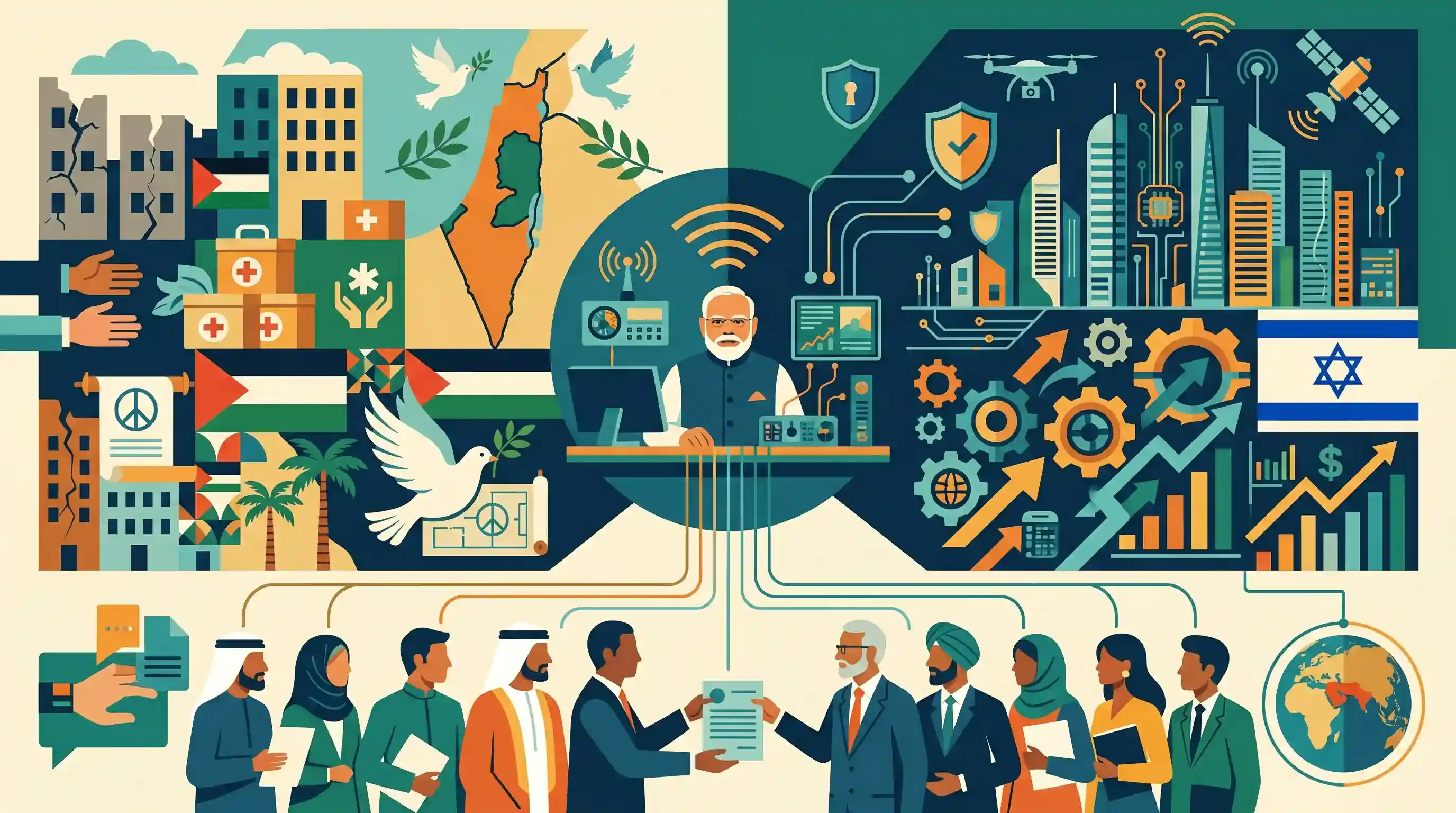
Prime Minister Narendra Modi communicated with Arab leaders to reaffirm India's enduring support for the people of Palestine and to back a peace plan for Gaza. Highlighting the dire humanitarian situation, he reiterated India's traditional stance advocating for a two-state solution to the Israel-Palestine conflict. The messaging underscores India's strategic balancing in West Asia—maintaining deep security and economic ties with Israel while preserving its historical solidarity with the Palestinian cause and strengthening its diplomatic outreach to the Arab world and the broader Global South.
Key Points
- PM Modi reaffirmed India's solidarity with the people of Palestine and endorsed a peace plan to resolve the ongoing humanitarian crisis in Gaza.
- The statement reiterates India's long-standing commitment to the 'two-state solution', advocating for a sovereign, independent State of Palestine existing peacefully alongside Israel.
- Emphasizes the urgent need for humanitarian assistance for civilians in Gaza.
- Showcases India's diplomatic balancing act in West Asia, maintaining robust strategic ties with Israel while reassuring Arab leaders of its traditional support for the Palestinian cause.
- Demonstrates India's continued effort to represent the voice of the Global South and engage constructively in multilateral conflict resolution.
Important Terms
Two-State Solution

A proposed framework for resolving the Israel-Palestine conflict by establishing Palestine as a sovereign, independent state alongside Israel. India advocates for this as the only viable path to enduring peace.
UPSC context
GS2: International Relations. A pillar of India's foreign policy; tests knowledge of long-standing diplomatic stances and West Asian stability.
Arab League
A 22-member regional organization founded in 1945 to promote cooperation and safeguard sovereignty among Arab nations. It is a key diplomatic platform for the Palestinian cause in West Asian geopolitics.
UPSC context
GS2: Regional Groupings. Tests understanding of regional organizations and India’s diplomatic outreach to the Arab world.
Gaza Peace Plan
Refers to diplomatic frameworks (like the US-backed 20-point plan) involving a ceasefire, hostage release, and international reconstruction. India supports these initiatives to restore regional stability and humanitarian relief.
UPSC context
GS2: Effect of Policies of Developed and Developing Countries. Tests India’s role in global peace initiatives and strategic interests in Gaza.
Strategic Balancing
A foreign policy strategy (often called de-hyphenation) where India maintains parallel, independent relationships with both Israel and Arab nations, ensuring one partnership does not compromise the other.
UPSC context
GS2: Indian Foreign Policy. Tests ability to analyze India’s "balancing act" between strategic defense partners and traditional regional allies.
Global South
The collective term for developing nations, primarily in the Southern Hemisphere. India positions itself as the "voice of the Global South," advocating for their shared interests and sovereignty.
UPSC context
GS2: International Groupings. Tests India’s leadership role and pursuit of equity in a multipolar world order.
Prelims Trap
"India's de-hyphenation policy means it no longer supports an independent Palestinian state."
De-hyphenation merely separates India's bilateral ties with Israel from its ties with Palestine. India still officially advocates for a sovereign, independent Palestinian state.
Static Concepts Connected
What are the historical pillars of the Two-State Solution?
- UN Resolution 181: The 1947 United Nations partition plan that originally proposed dividing Mandatory Palestine into independent Arab and Jewish states, with Jerusalem under an international regime.
- Oslo Accords: The 1990s peace agreements that established the Palestinian Authority, granting it limited self-rule in parts of the West Bank and Gaza Strip.
- India's Official Stance: India officially advocates for a sovereign, independent, and viable State of Palestine, within secure and recognized borders, co-existing peacefully alongside Israel.
What defines India's "De-hyphenation" policy in West Asia?
- Independent Bilateralism: Engaging with Israel and Palestine as completely separate entities, ensuring that deepening strategic ties with one do not dictate, constrain, or hold hostage ties with the other.
- Standalone Diplomacy: The policy was visibly cemented when PM Modi undertook standalone, separate visits to Israel in 2017 and Palestine in 2018, discarding the traditional combined-tour approach.
Cross-Topic Patterns
Minilateralism amid conflict (I2U2/IMEC)
India's diplomatic balancing allows it to pursue strategic geo-economic initiatives like the India-Middle East-Europe Economic Corridor (IMEC) and I2U2 without alienating the Arab world over the Gaza crisis.
From Non-alignment to Multi-alignment
The shift from historical pro-Palestine non-alignment to pragmatic multi-alignment is visible in how India condemns terrorism unequivocally but simultaneously sends massive humanitarian aid to Gaza.

Gaza crisis + IMEC viability + India's de-hyphenation policy is highly likely as a 15-marker Mains question on West Asia diplomacy in 2026.
Linked PYQs · 4
Linked PYQs · 4
- 2018MainsGS2
“India’s relations with Israel have, of late, acquired a depth and diversity, which cannot be rolled back.” Discuss.
- 2019MainsGS2
‘The long-sustained image of India as a leader of the oppressed and marginalised nations has disappeared on account of its new found role in the emerging global order.’ Elaborate.
- 2018PrelimsGS1
The term "two-state solution" is sometimes mentioned in the news in the context of the affairs of
- 2023PrelimsGS1
Consider the following statements: Statement-I: Israel has established diplomatic relations with some Arab States. Statement-II: The 'Arab Peace Initiative' mediated by Saudi Arabia was signed by Israel and Arab League. Which one of the following is correct in respect of the above statements?
