India Azerbaijan Diplomatic Reset and Caucasus Geopolitics
Source:Indian Express ↗
ఇది ఎందుకు ముఖ్యం
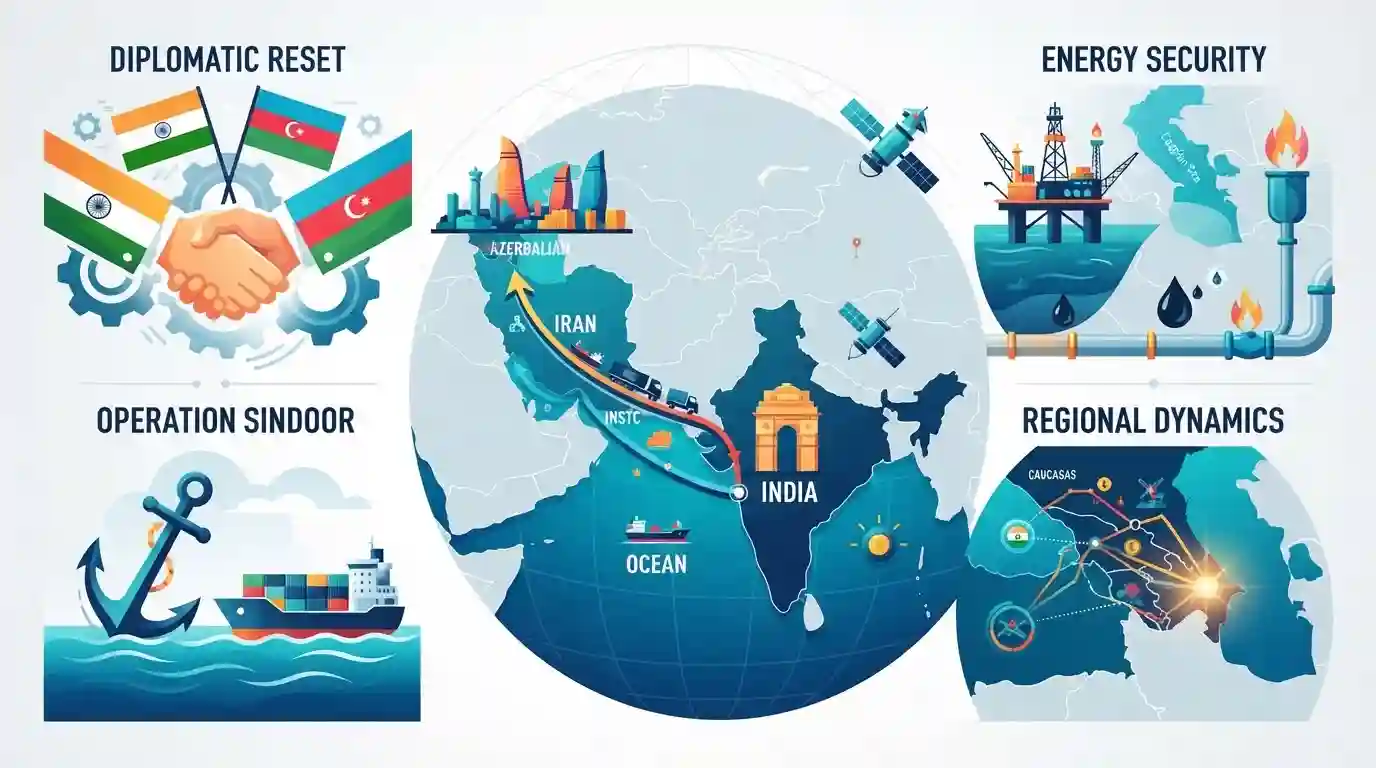
This article highlights India's evolving diplomatic outreach in the Caucasus region, balancing historical frictions (such as Azerbaijan-Pakistan alignment) with strategic imperatives like energy cooperation and regional connectivity under INSTC.
సారాంశం
India and Azerbaijan are working towards a diplomatic reset, encapsulated by recent strategic engagements including 'Operation Sindoor', shifting the dynamics of bilateral ties in the Caucasus region, energy security, and regional connectivity corridors like INSTC.
ముఖ్య అంశాలు
- India and Azerbaijan are attempting a diplomatic reset in their bilateral relations, moving past past strategic friction points like Azerbaijan's alignment with Pakistan on Kashmir.
- The diplomatic outreach, codenamed or referenced in context of strategic re-engagement, signifies India's proactive diplomatic maneuvers in the Caucasus and Central Eurasian region.
- Geopolitical convergence includes economic ties, energy cooperation, and connectivity initiatives such as the International North-South Transport Corridor (INSTC).
ముఖ్యమైన పదాలు
Operation Sindoor

India's comprehensive tri-service counter-terror military operation executed in May 2025 as a retaliatory response against cross-border terrorist infrastructure following the Pahalgam terror attack.
UPSC context
UPSC GS Paper II & III: International Relations, Internal Security, and India's counter-terrorism doctrine.
International North South Transport Corridor
A 7,200-km multi-modal transportation network linking India, Iran, Azerbaijan, Russia, and Central Asia via ship, rail, and road to optimize trade connectivity.
UPSC context
UPSC GS Paper II: International Relations, India's strategic connectivity projects, and Eurasian engagement.
Ministry of External Affairs
The nodal government department of India responsible for the execution, formulation, and management of the nation's foreign policy and bilateral diplomacy worldwide.
UPSC context
UPSC GS Paper II: Polity and Governance, Institutional machinery of Indian foreign policy and international diplomacy.
అనుసంధానమైన స్థిర భావనలు
What are the member nations and strategic objectives of the International North-South Transport Corridor (INSTC)?
- Route & Scope: Multimodal route spanning 7,200 km connecting India, Iran, Azerbaijan, Russia, and Central Asia/Europe via ship, rail, and road.
- Strategic Goal: Reduces transit time and freight costs between Mumbai and Moscow significantly compared to the traditional Suez Canal route.
- Geopolitical Value: Provides India land-mass access to Central Asia and Russia, bypassing Pakistan-controlled transit barriers.
అంతర-అంశ నమూనాలు
Caucasus balancing & India's multi-alignment foreign policy
India's diplomatic balancing act between Armenia and Azerbaijan mirrors its multi-alignment strategy in West Asia (Israel-Palestine/Gulf).
INSTC connectivity & Eurasian trade corridors
INSTC bypasses traditional maritime choke points, directly linking India via Iran and Azerbaijan to Russia and Europe, intersecting Indo-European trade security.

Expect statement-based questions pairing INSTC route geography with India's concurrent strategic outreach to both Armenia and Azerbaijan.
అనుసంధాన PYQలు · 2
అనుసంధాన PYQలు · 2
- 2024MainsGS2
Critically analyse India's evolving diplomatic, economic and strategic relations with the Central Asian Republics (CARs) highlighting their increasing significance in regional and global geopolitics.
- 2018MainsGS2
A number of outside powers have entrenched themselves in Central Asia, which is a zone of interest to India. Discuss the implications, in this context, of India's joining the Ashgabat Agreement, 2018.
