India and Australia Unveil New Defence Pact for Indo Pacific Security
Source:The Hindu ↗
Why It Matters
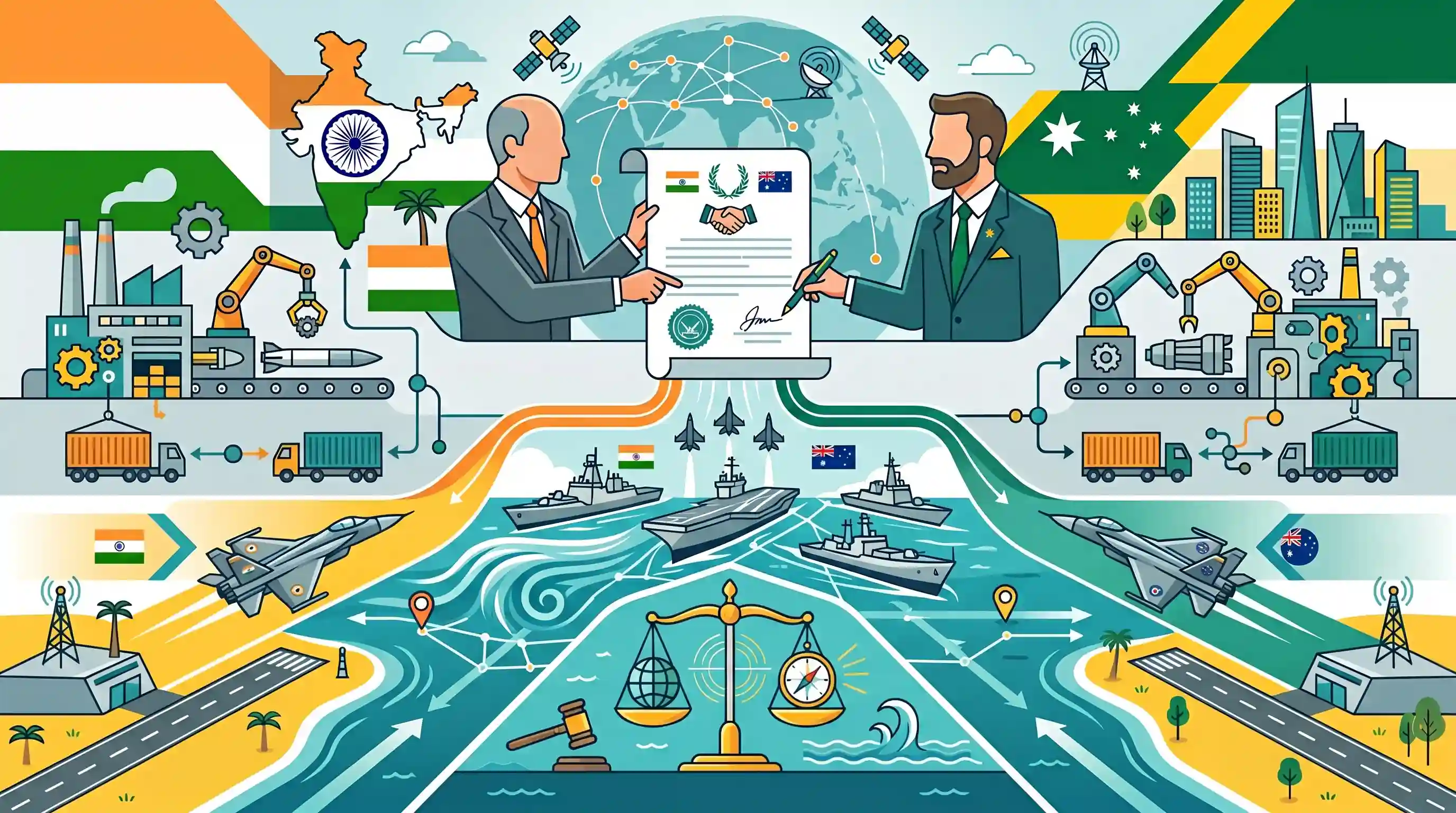
This declaration elevates India-Australia ties to an operational defense partnership with reciprocal logistics and aircraft deployments. Amid rising geostrategic tensions in the Indo-Pacific, it strengthens the strategic posture of both democracies, bolsters the security framework of the Quad, and underlines the rule-based maritime order under UNCLOS.
Summary
India and Australia have adopted a new Joint Declaration on Defence and Security Cooperation to significantly deepen operational military engagement, strengthen defense industrial collaboration, and secure maritime lanes in the Indo-Pacific. Signed in Melbourne by PM Narendra Modi and Australian PM Anthony Albanese on July 9, 2026, the declaration paves the way for reciprocal aircraft deployments, joint maritime security roadmaps, defense supply-chain integration, and mutual alignment on international laws such as UNCLOS.
Key Points
- On July 9, 2026, Indian Prime Minister Narendra Modi and Australian Prime Minister Anthony Albanese adopted a new 'Joint Declaration on Defence and Security Cooperation' in Melbourne to deepen military, maritime, and defense industrial ties.
- The declaration builds upon the 2009 Joint Declaration on Security Cooperation and complements existing dialogue channels, including the Foreign Ministers' Framework Dialogue, the 2+2 Ministerial Dialogue, and the Defence Ministers' Dialogue.
- Military Interoperability: The agreement envisages increased complexity of bilateral and multilateral military exercises, closer strategic consultations, enhanced interoperability, and reciprocal aircraft deployments from each other's territories.
- Maritime Security: Key emphasis is placed on the implementation of the India-Australia Maritime Security Collaboration Roadmap to strengthen coordination across the Indian Ocean and the wider Indo-Pacific region.
- Defense Industry and Supply Chains: Both countries committed to integrating their defense industries, building resilient supply chains, and expanding cooperation in defense innovation and advanced science and technology.
- Human Resource Exchange: Plans include deeper personnel exchanges through education, training, liaison appointments, and exploring joint recruitment opportunities for skilled defense workforces.
- Regional Peace and UNCLOS: The leaders called for peaceful dispute resolution, respect for sovereignty, and strict adherence to the 1982 United Nations Convention on the Law of the Sea (UNCLOS), especially regarding freedom of navigation and overflight. They also reaffirmed support for regional platforms like IORA, ASEAN-led architectures, and the Pacific Islands Forum.
Important Terms
Joint Declaration on Defence and Security Cooperation (2026)

A landmark bilateral agreement signed by India and Australia on July 9, 2026, to significantly elevate military interoperability, defense supply-chain resilience, and maritime security in the Indo-Pacific.
UPSC context
GS Paper II (International Relations). Tests knowledge of bilateral defense pacts, strategic partnerships, and Indo-Pacific geopolitics.
India-Australia Joint Declaration on Security Cooperation (2009)
A foundational bilateral framework adopted in November 2009 by Prime Ministers Manmohan Singh and Kevin Rudd, establishing early cooperation in counter-terrorism, defense dialogue, and maritime security.
UPSC context
GS Paper II (International Relations). Essential for analyzing the historical evolution of India-Australia security ties and Quad cooperation.
United Nations Convention on the Law of the Sea (UNCLOS)
A 1982 international treaty establishing a comprehensive legal framework to govern all ocean spaces, maritime zones, navigational rights, and marine resource exploitation.
UPSC context
GS Paper II (International Relations) & Paper III (Security). Key for analyzing maritime boundary disputes and freedom of navigation.
India-Australia Maritime Security Collaboration Roadmap
A strategic roadmap adopted in July 2026 to enhance operational coordination, maritime domain awareness, and capacity building between Indian and Australian maritime forces in the Indo-Pacific.
UPSC context
GS Paper II (International Relations). Tests understanding of operational defense roadmaps and non-traditional maritime security coordination.
Indian Ocean Rim Association (IORA)
An intergovernmental organization of 23 member states bordering the Indian Ocean, established in 1997 to foster regional economic cooperation and maritime security.
UPSC context
GS Paper II (International Relations). Important for India’s neighborhood diplomacy, SAGAR doctrine, and maritime leadership.
ASEAN
An intergovernmental organization of ten Southeast Asian nations established in 1967 to accelerate economic growth, social progress, and regional political stability.
UPSC context
GS Paper II (International Relations). Central to India's Act East Policy and multilateral security architectures.
Pacific Islands Forum (PIF)
An intergovernmental organization of 18 Pacific nations and territories, founded in 1971, focusing on regional trade, security, climate resilience, and sustainable development.
UPSC context
GS Paper II (International Relations). Crucial for analyzing geopolitical competition in the South Pacific and India’s island diplomacy.
Prelims Trap
India's 2+2 ministerial dialogue mechanism is a security forum exclusive to members of the Quadrilateral Security Dialogue (Quad).
India holds 2+2 dialogues with Quad nations (US, Japan, Australia) but also conducts them with key non-Quad strategic partners like Russia and the United Kingdom.
Static Concepts Connected
What are the maritime zones and jurisdictions defined under the 1982 UNCLOS?
- Territorial Sea: Extends up to 12 nautical miles where coastal states exercise complete sovereignty, subject to innocent passage of foreign vessels.
- Contiguous Zone: Extends up to 24 nautical miles, allowing limited jurisdiction to prevent/punish customs, fiscal, immigration, or sanitary law violations.
- Exclusive Economic Zone: Extends up to 200 nautical miles, granting sovereign rights over resource exploitation but not absolute territorial sovereignty.
What is the Indian Ocean Rim Association (IORA) and its operating principle?
- Origin and Secretariat: Established in 1997 with its secretariat in Mauritius, focusing on regional cooperation across the Indian Ocean rim.
- Open Regionalism: Operates on consensus-based, non-controversial decision-making, deliberately excluding bilateral disputes from its active agenda to focus on trade/security.
- Priority Areas: Prioritizes maritime safety, fisheries, trade facilitation, disaster management, academic cooperation, and blue economy development.
Cross-Topic Patterns
Critical Minerals & Defense Indigenisation
India's defense supply-chain integration with Australia relies heavily on securing raw materials like lithium and cobalt, linking bilateral defense pacts directly to the Critical Minerals Investment Partnership.
Indo-Pacific blue carbon & climate security
Maritime roadmaps under UNCLOS are expanding beyond security to address sea-level rise and joint climate adaptation for small island states in the Indian Ocean and Pacific.

Bilateral military logistics pacts and UNCLOS maritime zone jurisdictions are highly likely to be framed as a joint conceptual MCQ in 2026.
Linked PYQs · 3
Linked PYQs · 3
- 2015PrelimsGS1
With reference to Indian Ocean Rim Association for Regional Cooperation (IOR-ARC)', consider the following statements: 1. It was established very recently in response to incidents of piracy and accidents of oil spills. 2. It is an alliance meant for maritime security only. Which of the statements given above is/are correct?
- 2020MainsGS2
What is the significance of Indo-US defence deals over Indo-Russian defence deals? Discuss with reference to stability in the Indo-Pacific region.
- 2014MainsGS2
With respect to the South China sea, maritime territorial disputes and rising tension affirm the need for safeguarding maritime security to ensure freedom of navigation and over flight throughout the region. In this context, discuss the bilateral issues between India and China.
