India and Australia sign defence pacts to boost Indo-Pacific ties
Source:The Hindu ↗
Why It Matters
The continuous strengthening of the India-Australia defence partnership is vital for maintaining a balance of power in the Indo-Pacific, ensuring freedom of navigation, and giving practical, operational weight to multilateral alliances like the Quad against growing regional assertiveness.
Summary
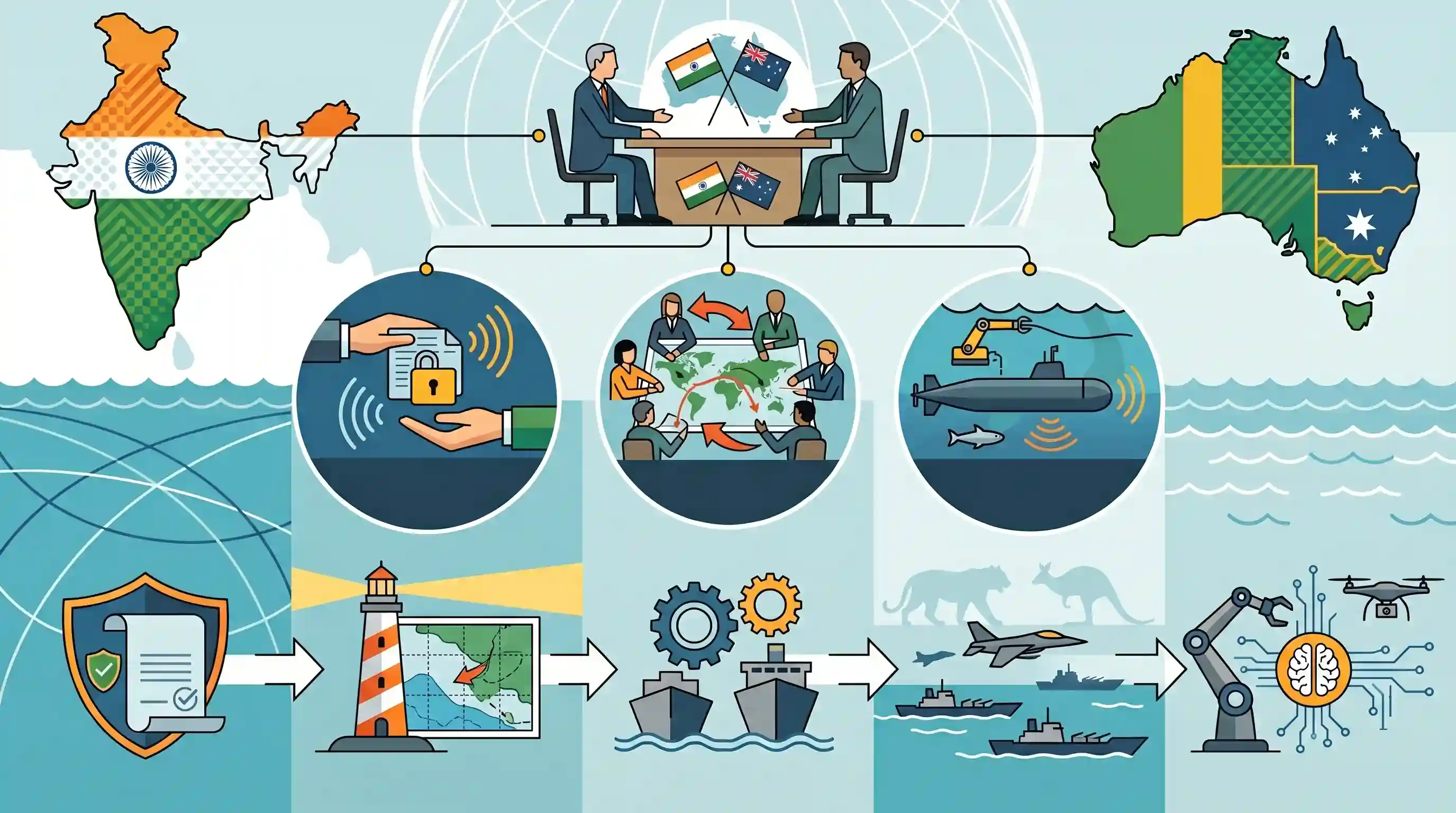
India and Australia recently formalized their growing strategic partnership by holding their inaugural Defence Ministers\' dialogue in Canberra, where three key defence pacts were signed. These include agreements on military information sharing, joint staff talks, and submarine search and rescue cooperation. Both nations emphasized their shared commitment to a free and rules-based Indo-Pacific aligned with UNCLOS. The agreements, supplemented by a new Maritime Security Collaboration Roadmap, underscore deepening defence interoperability through mutual ship maintenance, joint exercises like Austrahind, and technological cooperation in areas such as AI and unmanned systems.
Key Points
- India and Australia held the inaugural Defence Ministers\' Dialogue in Canberra, co-chaired by Rajnath Singh and Richard Marles.
- Three pivotal defence agreements were signed, covering information sharing, submarine search and rescue, and the establishment of joint staff talks.
- The nations unveiled a Joint Maritime Security Collaboration Roadmap to enhance domain awareness in the Indo-Pacific region.
- Discussions emphasized the importance of a free, open, and rules-based Indo-Pacific in adherence to UNCLOS, and included plans for ship maintenance and emerging technology cooperation.
Important Terms
UNCLOS (United Nations Convention on the Law of the Sea)

A 1982 international treaty establishing a legal framework for all marine and maritime activities. It defines maritime zones and rights of coastal states, forming the basis for a 'rules-based Indo-Pacific'.
UPSC context
GS-II (International Relations); critical for questions on maritime security, South China Sea, and India's 'SAGAR' vision.
Air-to-Air Refuelling Agreement
A bilateral pact signed in late 2024 allowing the Royal Australian Air Force's KC-30A tankers to refuel Indian aircraft, significantly extending the operational reach of the Indian Air Force across the Indo-Pacific.
UPSC context
GS-II (Bilateral Relations); tests knowledge of practical defence interoperability and India's strategic reach in the IOR.
Joint Maritime Security Collaboration Roadmap
A strategic blueprint discussed in 2025 to synchronize maritime domain awareness, information sharing, and joint operations between India and Australia to ensure sea lane security and regional stability.
UPSC context
GS-II (Bilateral Agreements); relevant for Indo-Pacific geopolitics and maritime security architecture.
Exercise Black Carillon
The Royal Australian Navy’s annual submarine search and rescue exercise. India was recently invited to participate following the 2025 bilateral 'Implementing Arrangement on Mutual Submarine Rescue Support and Cooperation'.
UPSC context
GS-II & GS-III (Security); specific instance of high-end naval cooperation and underwater safety.
Exercise Talisman Sabre
Australia’s largest biennial multinational military exercise. India’s growing participation (observer to full participant) reflects deepening 'minilateral' strategic alignment with the U.S., Japan, and Australia (the Quad).
UPSC context
GS-II (Regional Groupings); highlights India's military diplomacy and interoperability with 'like-minded' partners.
Exercise Austrahind
An annual bilateral land force exercise between the Indian and Australian Armies (started 2022) focused on semi-urban operations and joint military tactics to enhance field-level cooperation.
UPSC context
GS-II (Bilateral Relations); standard army-to-army diplomacy term.
Exercise Puk Puk
A long-standing Australian-led engineering exercise with Papua New Guinea. India's recent engagement (as an observer/participant) signals its expanding strategic footprint in the South Pacific alongside Australia.
UPSC context
GS-II (International Relations); reflects India's 'Act East' extension into the Pacific Islands.
Australia-India-Indonesia Trilateral
A middle-power minilateral initiative focused on maritime security and regional stability, bridging the Indian and Pacific Oceans by involving three key regional democracies.
UPSC context
GS-II (Regional Groupings); tests understanding of minilateralism as a tool for regional balance.
Prelims Trap
AUSTRAHIND is a joint naval exercise between India and Australia aimed at enhancing Indo-Pacific maritime security.
AUSTRAHIND is a bilateral Army exercise focusing on sub-conventional operations in semi-urban terrains. The naval exercise is AUSINDEX. Aspirants often confuse the two.
Static Concepts Connected
What are the key maritime zones defined under UNCLOS?
- Territorial Sea: Extends up to 12 nautical miles from the baseline; the coastal state exercises full sovereignty over airspace, water, and seabed.
- Contiguous Zone: Extends up to 24 nautical miles; the coastal state can enforce customs, fiscal, immigration, and sanitary laws.
- Exclusive Economic Zone: Extends up to 200 nautical miles; provides the coastal state with sovereign rights for exploring and exploiting marine resources.
What are the foundational pillars of India-Australia defence ties?
- Comprehensive Strategic Partnership: Upgraded in 2020, this framework facilitates deep cooperation across defence, trade, and emerging technologies.
- MLSA: The Mutual Logistics Support Arrangement enables reciprocal access to military facilities, fueling, and maintenance.
- Minilateral Groupings: Strategic coordination extends beyond bilateral to platforms like the Quad and the Australia-India-Indonesia trilateral.
Cross-Topic Patterns
Defence ties + Critical minerals
India and Australia's Comprehensive Strategic Partnership blends military interoperability (AI, unmanned systems) with critical mineral supply chains, securing India's strategic tech and defence manufacturing against Chinese monopolies.
UNCLOS enforcement + Pacific Islands
Bilateral maritime domain awareness roadmaps lay the groundwork for policing illegal fishing, securing sea lanes of communication, and extending net security provider capabilities toward vulnerable Pacific Island nations.

Indo-Pacific defence ties are ripe for a multi-statement Prelims question mixing UNCLOS zones, MLSA utility, and AUSTRAHIND/AUSINDEX.
Linked PYQs · 4
Linked PYQs · 4
- 2020MainsGS2
Quadrilateral Security Dialogue (Quad)' is transforming itself into a trade bloc from a military alliance, in present times - Discuss.
- 2020MainsGS2
What is the significance of Indo-US defence deals over Indo-Russian defence deals? Discuss with reference to stability in the Indo-Pacific region.
- 2021MainsGS2
The newly tri-nation partnership AUKUS is aimed at countering China's ambitions in the Indo-Pacific region. Is it going to supersede the existing partnerships in the region? Discuss the strength and impact of AUKUS in the present scenario.
- 2014MainsGS2
With respect to the South China sea, maritime territorial disputes and rising tension affirm the need for safeguarding maritime security to ensure freedom of navigation and over flight throughout the region. In this context, discuss the bilateral issues between India and China.
