India Climate Equity Funding and Sectoral Concentration Trends
Source:The Hindu ↗
Why It Matters
Analyses the trends, distribution gaps, and sectoral bottlenecks in India's mobilization of climate finance, which is crucial for meeting its net-zero goals and international climate commitments.
Summary
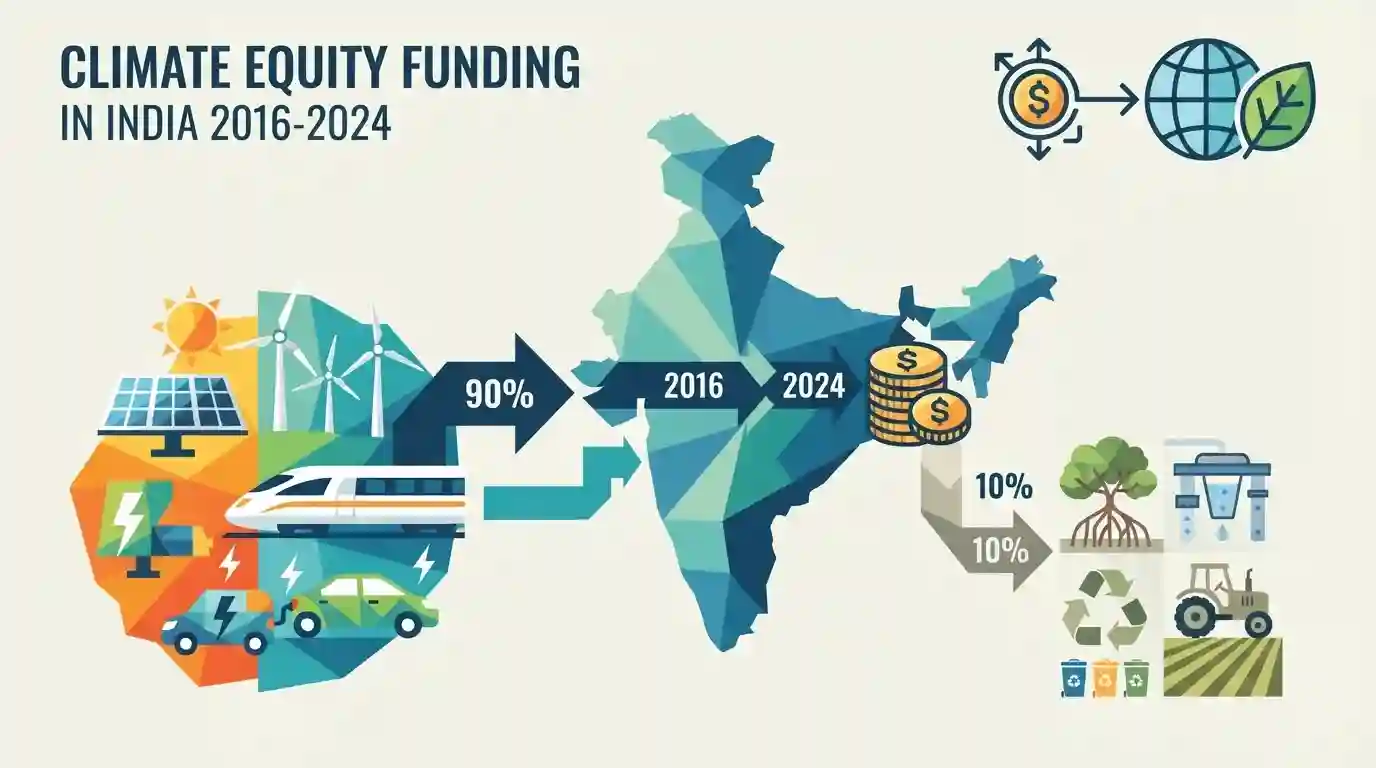
A report by BloombergNEF reveals that India attracted $31 billion in climate equity funding between 2016 and 2024. However, the capital remains highly concentrated, with the power and transport sectors accounting for nearly 90% of the funds, leaving critical adaptation, waste, and agriculture sectors underfunded.
Key Points
- India attracted $31 billion in climate equity funding between 2016 and 2024, according to a BloombergNEF report.
- Capital concentration remains high, with power and transport sectors capturing nearly 90% of total climate equity investments.
- Other critical sectors like agriculture, waste management, circular economy, and adaptation face significant financing gaps.
- Despite strong growth in renewable energy deployment, broader diversification of climate finance is required for comprehensive sustainable development and net-zero targets.
Important Terms
Paris Agreement

A legally binding international treaty on climate change adopted under the UNFCCC at COP21 in Paris, aiming to limit global temperature rise to well below 2°C above pre-industrial levels.
UPSC context
Crucial for GS Paper III (Environment, Climate Change, International Conventions). Tests core international legal frameworks and global governance mechanisms for emission reduction.
Nationally Determined Contributions
Climate action plans submitted by countries under the Paris Agreement detailing individual greenhouse gas emission reduction targets and adaptation strategies to limit global warming.
UPSC context
Important for GS Paper III (Environment and Conservation, Climate Policy). Evaluates India's international climate commitments, such as Panchamrit targets and emission intensity goals.
BloombergNEF
A leading strategic research provider focusing on global commodity markets and the clean energy transition, widely cited for data on climate investments and decarbonization trends.
UPSC context
Relevant for GS Paper III (Resource Mobilization, Infrastructure - Energy, Economy). Frequently utilized in questions concerning climate finance gaps and renewable capital allocation.
Prelims Trap
Climate equity funding in India is evenly distributed across mitigation, adaptation, waste management, and agriculture sectors.
Aspirants often assume total climate finance is evenly distributed across all green sectors, missing that private equity heavily favors bankable mitigation assets (power/transport) over adaptation and waste.
Static Concepts Connected
What are the primary instruments and channels of international and domestic climate finance?
- Capital Types:: Public vs Private: Comprises concessional loans, grants, equity, and green bonds from bilateral, multilateral, and private sources.
- Focus Areas:: Mitigation vs Adaptation: Mitigation aims at greenhouse gas reduction (energy, transport); adaptation focuses on building resilience to climate change impacts (agriculture, coastal protection).
- UNFCCC Architecture:: Global Mechanisms: Key UNFCCC channels include the Green Climate Fund (GCF), Global Environment Facility (GEF), and the newly operationalized Loss and Damage Fund.
Cross-Topic Patterns
Climate Finance vs. Adaptation Funding Gap
While renewable energy attracts equity, adaptation and agriculture require sovereign and concessional finance, directly linking domestic capital allocation to UNFCCC's Loss and Damage debates.
Urban Mitigation vs. Rural Adaptation Dichotomy
The heavy focus on power and transport reflects urban-centric mitigation, contrasting sharply with the rural vulnerability and livelihood dependencies managed via MGNREGS and National Adaptation Fund.

Climate finance skew (mitigation vs adaptation) + private equity concentration will feature in GS-3 sustainable development questions.
Linked PYQs · 2
Linked PYQs · 2
- 2022MainsGS3
Do you think India will meet 50 percent of its energy needs from renewable energy by 2030 ? Justify your answer. How will the shift of subsidies from fossil fuels to renewables help achieve the above objective ? Explain.
- 2025MainsGS3
Write a review on India's climate commitments under the Paris Agreement (2015) and mention how these have been further strengthened in COP26 (2021). In this direction, how has the first Nationally Determined Contribution intended by India been updated in 2022?
