India Attends US-Led Board of Peace Meeting as Observer
Source:The Hindu ↗
Why It Matters
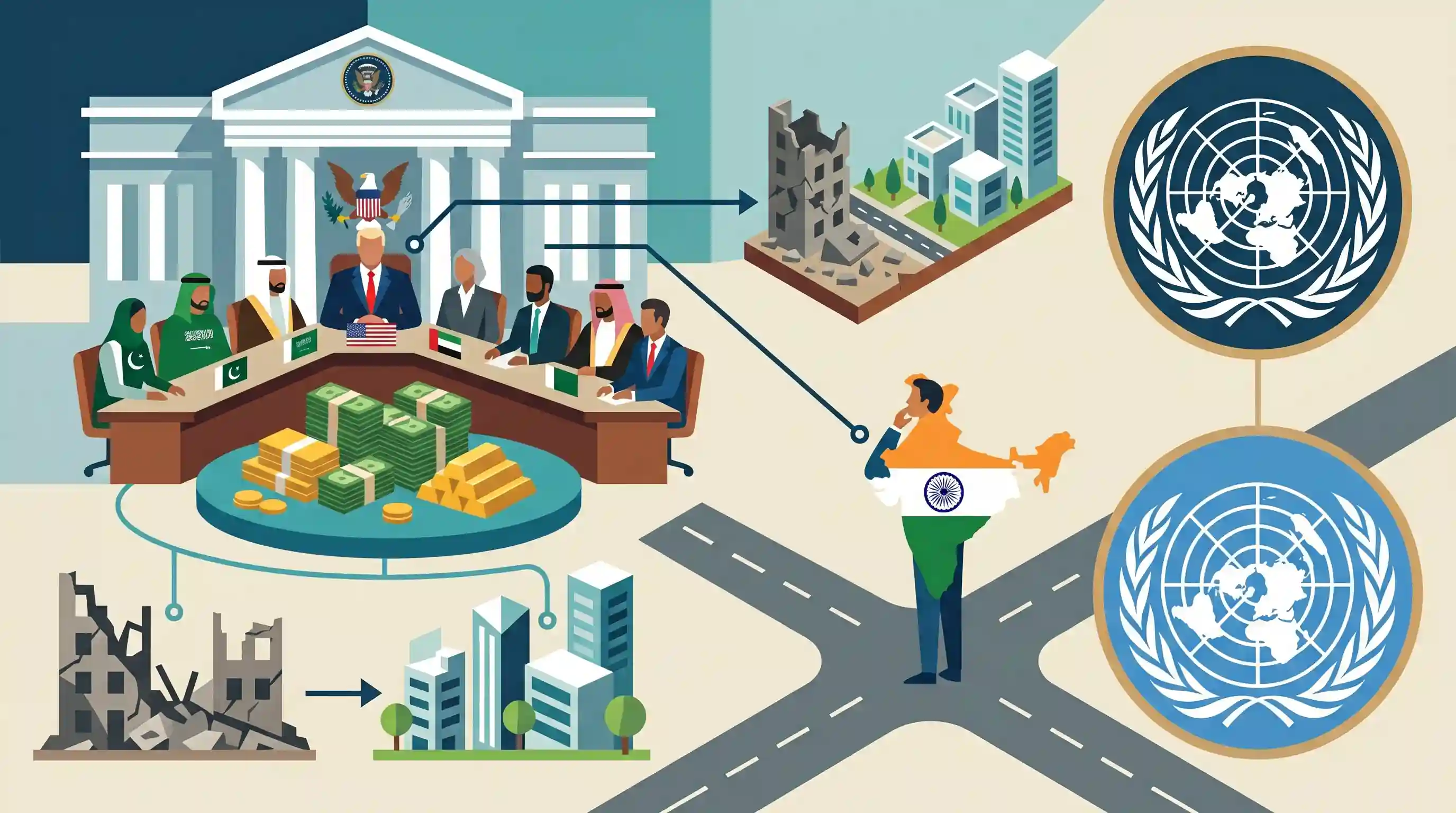
The creation of a parallel multilateral organization ('Board of Peace') by the US challenges the UN's primacy in global governance. India's calibrated response (joining only as an observer) provides an excellent case study on strategic autonomy, global governance reforms, and New Delhi's delicate balancing act in Middle East diplomacy.
Summary
India participated as an observer nation in the inaugural meeting of the US-led 'Board of Peace' in Washington DC. Conceptualized by US President Donald Trump as an alternative to the United Nations, the board aims to oversee the redevelopment of the Gaza Strip following an Israel-Hamas ceasefire agreement. While seven countries (including Pakistan, Saudi Arabia, and the UAE) joined as members with a $10 billion commitment from the US, India opted for observer status. This move underscores New Delhi's strategic autonomy, allowing it to engage with US-led initiatives without undermining the established UN-based multilateral architecture or compromising its balanced approach to Middle Eastern geopolitics.
Key Points
- The United States launched the 'Board of Peace', an alternative international body to the UN, aimed at redeveloping the Gaza Strip.
- India participated in the inaugural meeting of the Board of Peace but chose to remain an observer nation rather than a full member.
- The board includes seven member nations: Argentina, Armenia, Azerbaijan, Hungary, Pakistan, Saudi Arabia, and the UAE, with the US committing $10 billion.
- The initiative is part of the second phase of a ceasefire agreement between Israel and Hamas.
- India's decision to be an observer reflects its policy of strategic autonomy, balancing its strategic partnership with the US against its commitment to traditional UN-led multilateralism and complex Middle East interests.
Important Terms
Board of Peace

A US-led international body (est. 2026) chaired by Donald Trump to oversee post-conflict Gaza redevelopment. It functions as a transitional mechanism for funding, security, and reconstruction outside traditional UN-led frameworks.
UPSC context
GS-II (Global Groupings/International Relations). Tests knowledge of US-led ad-hoc initiatives and their impact on established UN-centric multilateralism.
Strategic Autonomy
The ability of a state to make foreign policy and security decisions independently without structural dependency on external powers or rigid alignment with specific power blocs.
UPSC context
GS-II (International Relations). A core pillar of India’s foreign policy used to balance competing interests in West Asia and beyond.
Observer Status
A non-member role in an international forum allowing participation in deliberations without voting rights. It facilitates diplomatic monitoring and engagement without necessitating full membership, funding, or policy endorsement.
UPSC context
GS-II (International Relations/Polity). Frequent Prelims topic regarding India's role in global bodies and the functional privileges of non-member participants.
Hamas
A Palestinian militant and political organization that has governed the Gaza Strip since 2007. It is a central party in regional conflict and post-ceasefire reconstruction negotiations.
UPSC context
GS-II (Regional Geopolitics). Essential for understanding West Asian conflict dynamics, ceasefire agreements, and India's balanced approach to the Israel-Palestine issue.
Gaza Strip
A Palestinian territory on the Mediterranean coast; the primary focus of the Board of Peace’s reconstruction mandate following prolonged conflict and humanitarian crises involving Israel and Hamas.
UPSC context
GS-I/II (Geography/International Relations). Key focal point for regional stability, India's humanitarian diplomacy, and West Asian trade corridors like IMEC.
Multilateralism
Diplomatic cooperation between three or more nations through established international organizations (e.g., the UN) to create and maintain shared norms, rules, and global governance systems.
UPSC context
GS-II (Global Groupings). Concerns the "crisis of multilateralism" and India's advocacy for "reformed multilateralism" against fragmented, leadership-driven alternatives.
Prelims Trap
India is a founding member of the US-led Board of Peace aimed at rebuilding the Gaza Strip.
India deliberately opted for 'observer status' rather than full membership to preserve its strategic autonomy and avoid undermining the UN.
Static Concepts Connected
What is 'Minilateralism' in modern geopolitics?
- Definition: Small, exclusive, ad-hoc coalitions (like Quad, I2U2) formed by like-minded countries to address specific, targeted issues quickly.
- Vs Multilateralism: Broad-based, formal, inclusive institutions (like the UN or WTO) governed by complex consensus and universal treaties.
- Rise and Utility: Minilaterals are rising rapidly due to the consensus paralysis, veto-gridlock, and structural stagnation in traditional UN Security Council frameworks.
How does 'Strategic Autonomy' define India's foreign policy?
- Core Principle: The ability of a state to pursue its national interests independently without being constrained by formal alliances or major power dictates.
- Evolution: It evolved from Nehruvian Non-Alignment (NAM) into issue-based multi-alignment, engaging concurrently with competing blocs (e.g., Quad vs SCO).
- Current Application: It avoids treaty-based military alliances, allowing India to balance its US partnership against historic Russia ties and Global South leadership.
Cross-Topic Patterns
Rise of minilateralism bypassing the UN
The 'Board of Peace' exemplifies a structural shift toward ad-hoc minilaterals (like Quad or I2U2) that bypass paralyzed UN structures to deliver targeted, fast-tracked geopolitical outcomes.
India's Middle East tightrope and Multi-alignment
India's observer status mirrors its continuous balancing act between Israel (defense ties), the Arab world (energy/diaspora), and the Global South (which heavily favors traditional UN frameworks).

Expect a 2026 Prelims question contrasting 'Board of Peace' membership vs I2U2/IMEC, explicitly testing India's status as an Observer.
Linked PYQs · 3
Linked PYQs · 3
- 2025MainsGS2
"The reform process in the United Nations remains unresolved, because of the delicate imbalance of East and West and entanglement of the USA vs. Russo-Chinese alliance.” Examine and critically evaluate the East-West policy confrontations in this regard.
- 2018MainsGS2
“India’s relations with Israel have, of late, acquired a depth and diversity, which cannot be rolled back.” Discuss.
- 2023MainsGS2
‘The expansion and strengthening of NATO and a stronger US-Europe strategic partnership works well for India.’ What is your opinion about this statement ? Give reasons and examples to support your answer.
