Institutional Resilience and Democratic Evolution in India
Source:The Hindu ↗
हे का महत्त्वाचे आहे
This article provides a comprehensive, multi-dimensional critique of modern Indian constitutionalism, federalism, and democratic institutions. It offers aspirants critical arguments, terminology, and perspectives necessary for writing high-scoring, analytical answers on democratic backsliding, the federal-state trust deficit, and constitutional morality in both GS Paper 2 and the Essay paper.
सारांश
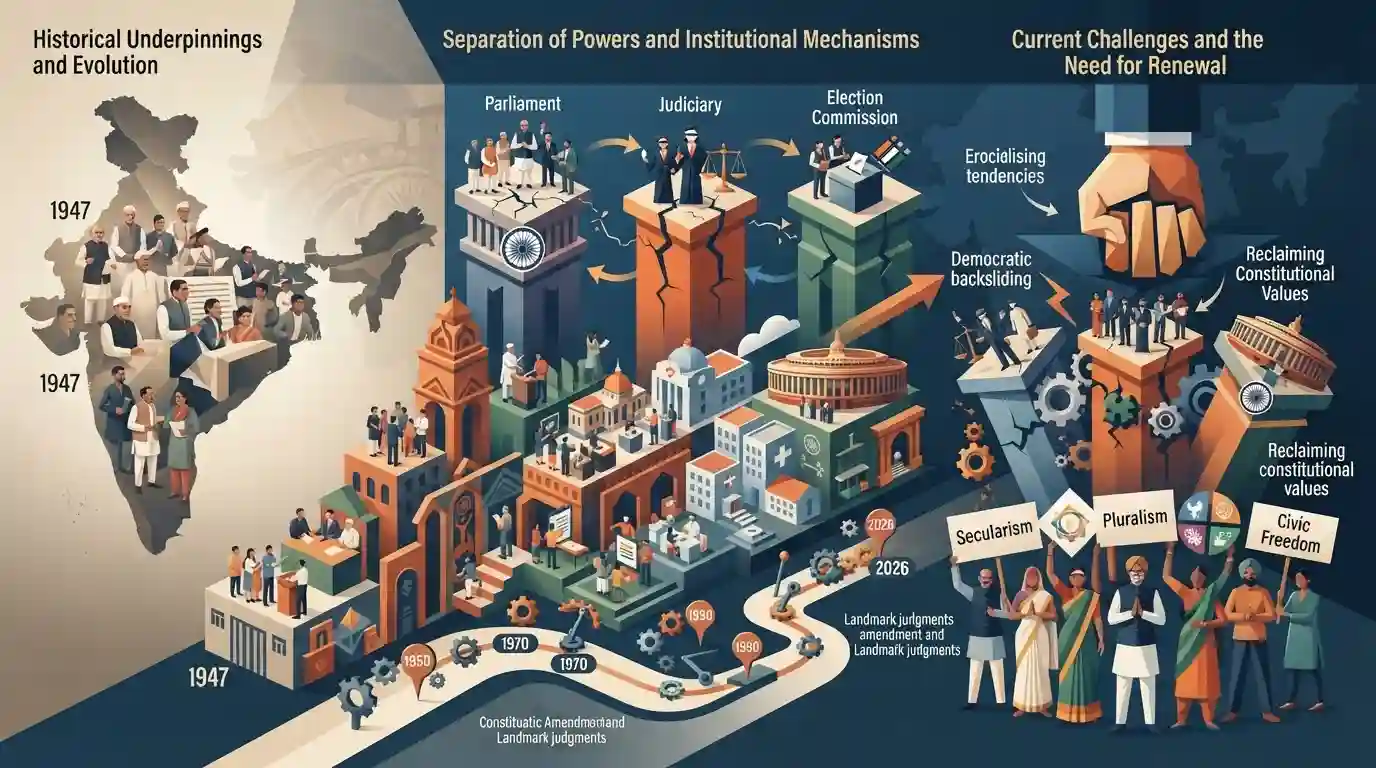
As India enters its 80th year of Independence (August 15, 2026), this lead article critically reflects on the developmental trajectory and present challenges of Indian democracy. While India successfully defied historical skeptics by maintaining a democratic framework despite deep diversity and poverty, it now faces a quiet crisis of democratic backsliding. The author argues that achieving democratic renewal requires arresting institutional erosion (restoring independence to the judiciary, election commission, and parliament), addressing centralising tendencies to revive cooperative federalism, and reclaiming core constitutional values of secularism, pluralism, and civic freedom.
मुख्य मुद्दे
- Historical Triumph vs. Present Crisis: Highlights how India's survival as a vibrant democracy since 1947 was a global miracle, but this legacy is now threatened by democratic backsliding and executive dominance.
- Institutional Erosion: Outlines how independent institutions, including the judiciary, election management bodies, and investigative agencies, have faced challenges to their autonomy, weakening checks and balances.
- Centralisation and Strained Federalism: Examines the ongoing shifts toward administrative and fiscal centralisation, which has strained Centre-State relations and undermined the principles of cooperative federalism.
- Erosion of Secularism and Pluralism: Discusses how rising majoritarian politics and the shrinking space for dissent and free press threaten India's unique model of secularism and social cohesion.
- The Path to Democratic Renewal: Asserts that true democratic renewal requires going beyond periodic elections to actively rebuilding public trust, protecting civic freedoms, and restoring the independence of key democratic watchdogs.
महत्त्वाच्या संज्ञा
Constitution of India

The supreme legal document of India that outlines the framework for democratic governance, establishes the structure and powers of government organs, and guarantees fundamental rights to citizens.
UPSC context
GS Paper II (Polity); essential for analyzing constitutional evolution, basic structure, and significant amendments.
Election Commission of India
A permanent, autonomous constitutional body established under Article 324 to conduct free and fair elections to Parliament, state legislatures, and the offices of President and Vice-President.
UPSC context
GS Paper II (Polity/Governance); tests knowledge on constitutional bodies, electoral reforms, and democratic integrity.
Supreme Court of India
The apex judicial authority of India, established under Article 124, serving as the highest court of appeal, final interpreter of the Constitution, and guardian of fundamental rights.
UPSC context
GS Paper II (Judiciary); tests separation of powers, judicial review, independence of the judiciary, and landmark judgments.
Parliament of India
The supreme bicameral legislative body of the Union, comprising the President, Rajya Sabha, and Lok Sabha, responsible for lawmaking, financial control, and executive oversight.
UPSC context
GS Paper II (Legislature); tests parliamentary functioning, federal legislative relations, and executive accountability mechanisms.
Union Government
The central executive and administrative authority of India, established by the Constitution, representing the collective federal entity of the country and its states.
UPSC context
GS Paper II (Polity/Governance); critical for understanding center-state relations, federal structures, and central administrative power.
पूर्वपरीक्षा सापळा
The phrase 'sentinel on the qui vive' is explicitly mentioned in Article 32 of the Constitution.
It is a judicial doctrine established in State of Madras v. V.G. Row (1952), not explicitly written in the text of the Constitution.
संबंधित स्थिर संकल्पना
What is the difference between procedural and substantive democracy?
- Procedural Democracy: Focuses on the mechanics of democracy, such as regular elections, universal adult franchise, and formal constitutional rules.
- Substantive Democracy: Focuses on the actual outcomes like social justice, economic equality, and the active protection of civil liberties.
How is 'Fraternity' conceptualized in the Indian Constitution?
- Core Meaning: A sense of brotherhood promoting social cohesion. Championed by Dr. B.R. Ambedkar, it was inspired by the Buddhist socio-ethical concept of 'Maitri'.
- Constitutional Mandate: The Preamble states it assures individual dignity and national unity. Article 51A(e) also makes promoting harmony a Fundamental Duty.
- Inseparable Trinity: Ambedkar argued that liberty, equality, and fraternity form an inseparable trinity; without fraternity, liberty and equality would fail.
आंतर-विषय नमुने
Fiscal Centralisation & Federal Friction
The strain on Centre-State relations links Polity (institutional erosion) directly with Economy, especially the debate over cesses and surcharges bypassing the divisible pool of taxes.
Global Indices & Democratic Backsliding
The theme of democratic erosion connects to India's rankings in international assessments like the V-Dem Institute or EIU Democracy Index, a recurring evaluation point in GS2.

Expect a GS2 Mains question linking the 'sentinel on the qui vive' doctrine to executive overreach and erosion of independent institutions.
संबंधित PYQ · 4
संबंधित PYQ · 4
- 2023MainsGS2
“Constitutionally guaranteed judicial independence is a prerequisite of democracy.” Comment.
- 2024MainsGS2
What changes has the Union Government recently introduced in the domain of Centre-State relations ? Suggest measures to be adopted to build the trust between the Centre and the States and for strengthening federalism.
- 2022MainsGS1
Are tolerance, assimilation and pluralism the key elements in the making of an Indian form of secularism? Justify your answer.
- 2019MainsEssay
Biased media is a real threat to Indian democracy
